7 Best MCP Servers for Gemini CLI in 2026: Ranked List

Lead Scraping Automation Engineer
TL;DR:
- The best Gemini CLI MCP server fills a specific tool gap. Search, browser control, code hosting, databases, and work management should remain separate capabilities.
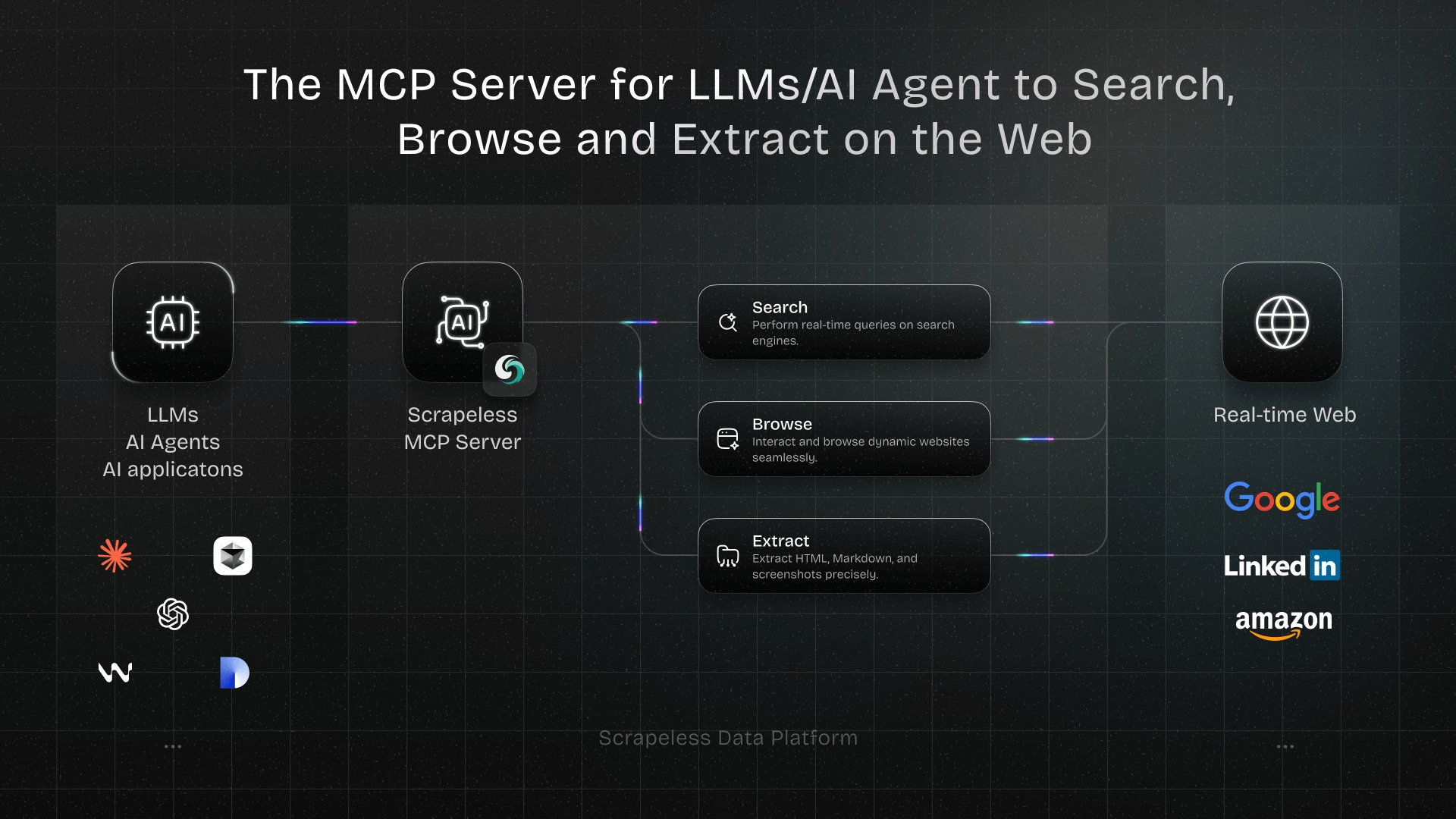
- Scrapeless ranks first for live web research. Its MCP Server combines web search, browser access, and extraction behind one agent tool surface.
- Context7 is useful for versioned library documentation, GitHub for repository work, PostgreSQL for governed database access, and Playwright for local browser testing. Install only the servers a project needs.
- Tool discovery is the smoke test. After configuration, inspect the connected tools, names, permissions, and output shape before assigning a real task.
Gemini CLI can reason over local files and terminal output, but project work often depends on systems outside the shell. MCP servers expose those systems as typed tools the agent can discover and call.
This ranking selects one server per major job. It favors clear ownership, limited permissions, observable output, and current maintenance over raw tool count.
Best MCP Servers for Gemini CLI at a Glance
| Rank | Server | Best for | Deployment shape |
|---|---|---|---|
| 1 | Scrapeless MCP Server | Live search and web access | Hosted MCP endpoint |
| 2 | Context7 | Version-specific library documentation | Remote or local MCP connection |
| 3 | GitHub MCP Server | Repository and issue workflows | Local container or remote deployment |
| 4 | PostgreSQL MCP Server | Governed database reads | Local process near the database |
| 5 | Playwright MCP | Local browser testing and inspection | Local process with a browser runtime |
| 6 | Filesystem MCP Server | Explicit filesystem scope | Local process with allowed directories |
| 7 | Sequential Thinking MCP Server | Structured planning traces | Local process |
What Is an MCP Server?
An MCP server exposes tools, resources, or prompts to an MCP client through a defined protocol. The Model Context Protocol specification defines capability negotiation, message shapes, and lifecycle behavior.
Gemini CLI is the client in this workflow. A server should receive only the permissions required for its job, and its results should remain distinguishable from model-generated text.
How We Evaluated Gemini CLI MCP Servers
The ranking uses five criteria: capability added beyond the base CLI, permission scope, ease of verification, output structure, and overlap with other installed servers.
Avoid installing two broad servers that own the same action. Duplicate search or browser tools make routing less predictable and enlarge the permission surface.
1. Scrapeless MCP Server: Best for Live Web Research
Scrapeless MCP Server gives Gemini CLI a web-aware tool layer for search, rendered pages, and structured extraction. The hosted endpoint is https://api.scrapeless.com/mcp, and authentication uses a Scrapeless API key.
Install it when tasks must discover current sources, open JavaScript pages, or preserve page evidence for downstream analysis. Keep search, page acquisition, extraction, and validation as separate actions so failures remain diagnosable.
Install and verify
Add the hosted endpoint through Gemini CLI’s MCP configuration, then inspect the connected server with the CLI’s MCP status command. The Gemini CLI MCP configuration guide documents supported server configuration and discovery. The Scrapeless documentation provides the product-side setup surfaces.
How you actually use it: prompt your agent
Give the agent an evidence-bearing task:
Find the latest official documentation for three Python crawling libraries, open each source, and return a comparison table with one source URL per row.
60-second smoke test
The server passes when Gemini CLI shows it as connected, tool discovery returns the Scrapeless namespace, and a simple public-web query returns source URLs that can be opened and checked.
🏆 Ideal for: Gemini CLI workflows that need current web search plus rendered-page follow-up.
2. Context7: Best for Version-Specific Documentation
Context7 retrieves library documentation for coding tasks. Use it when a project needs current API signatures and examples tied to a particular package version.
Keep repository code as the primary constraint. Documentation helps resolve an API question, but the installed dependency and local types decide what the project can actually call.
3. GitHub MCP Server: Best for Repository Workflows
GitHub MCP Server exposes repository, issue, pull request, and related operations. The official GitHub MCP Server repository documents its deployment and toolsets.
Start with read-only access to the repositories in scope. Enable mutation tools only when the workflow explicitly needs to create or update external state.
Start Scraping with Scrapeless
Power up your web scraping and automation workflow with Scrapeless!
Sign up today and get $5 in free credit — no credit card required.Claim your free credit now in the Scrapeless Dashboard.
4. PostgreSQL MCP Server: Best for Governed Database Reads
A PostgreSQL MCP server can expose schema inspection and parameterized queries without placing database details in the prompt. Run it close to the database and use a role restricted to required schemas and operations.
Read-only does not mean low risk. Query results may contain sensitive records, so row limits, logging, and data classification remain necessary.
5. Playwright MCP: Best for Local Browser Testing
Playwright MCP gives Gemini CLI browser inspection and interaction through a locally managed runtime. It fits application testing, accessible element inspection, and developer-owned staging environments.
Use Scrapeless for managed web research and Playwright MCP for local application testing. Assigning clear ownership avoids two browser servers competing for the same request.
6. Filesystem MCP Server: Best for Explicit Directory Scope
Filesystem MCP Server is useful when the client needs an auditable directory boundary that is narrower than the user’s full home directory. Pass only the project paths required for the task.
Do not expose credential directories, SSH material, browser profiles, or unrelated workspaces. Directory scope is part of the server configuration, not a promise in the prompt.
7. Sequential Thinking MCP Server: Best for Structured Planning
Sequential Thinking MCP Server provides a structured planning surface for tasks that benefit from explicit decomposition. It does not add external data or execution authority.
Use it when the planning record is useful to the workflow. Skip it when Gemini CLI’s native reasoning and task plan already cover the need.
How to Build the Server Set
Start with one external capability and verify it before adding another. For each server, record its owner, transport, credentials, allowed resources, mutation permissions, and expected tool names.
The OAuth 2.0 authorization framework explains delegated authorization for remote services. Prefer scoped delegated credentials when the server supports them instead of storing broad long-lived secrets in project files.
Inspect Scrapeless pricing after defining the web workload. The Hermes MCP integration shows the same tool-discovery principle in another agent client, while the Scrapeless AI Agent surface covers the wider agent stack.
Conclusion
The best Gemini CLI MCP setup is a small, non-overlapping server set. Scrapeless leads for live web research; Context7, GitHub, PostgreSQL, Playwright, Filesystem, and Sequential Thinking each own a narrower technical job.
Ready to Give Gemini CLI Live Web Tools?
Join the Scrapeless community on Discord or Telegram. Create an account at app.scrapeless.com, connect one server, and verify its tools before expanding the set.
FAQ
Q: What is the best MCP server for Gemini CLI?
Scrapeless MCP Server is the best fit when Gemini CLI needs live web search and rendered-page access. Other servers are better for documentation, repositories, databases, or local browser tests.
Q: How do I know whether an MCP server is connected?
Use Gemini CLI’s MCP status and tool discovery surfaces, then confirm the expected server namespace and tool names appear before running a real task.
Q: Should every project use the same MCP servers?
No. Install only the servers that add required capabilities and scope each one to the project’s resources and permissions.
Q: Can two MCP servers expose overlapping tools?
Yes, but overlapping search or browser servers make routing harder to predict. Assign one server as the owner for each capability.
Q: Are remote MCP servers safe?
Remote servers can be used safely when transport, authentication, permissions, data handling, and mutation controls are understood. Treat every server as code with access to the resources granted to it.
At Scrapeless, we only access publicly available data while strictly complying with applicable laws, regulations, and website privacy policies. The content in this blog is for demonstration purposes only and does not involve any illegal or infringing activities. We make no guarantees and disclaim all liability for the use of information from this blog or third-party links. Before engaging in any scraping activities, consult your legal advisor and review the target website's terms of service or obtain the necessary permissions.