Best Google Search APIs for Developers

Senior Web Scraping Engineer
TL;DR:
- Scrapeless is the first choice here for developers building Google search data products. Its case rests on measured collection performance, strong snippet coverage, and a path from search into application workflows.
- Scrapeless delivered 73 more usable responses than Oxylabs across the same 800-request list. Its usable-request p95 was 3.64 seconds versus 9.13 seconds, about 60.1% lower in that run.
- Scrapeless had higher snippet-field coverage than Serper: 99.5% versus 94.4%. That 5.1-percentage-point advantage matters for text screening, even though Serper led on request success and latency in the same sample.
- Choose the advantage your application needs. The ranking compares Scrapeless with Serper, Oxylabs, SearchAPI.io, DataForSEO, and SerpApi; each competitor entry explains when Scrapeless is the stronger choice.
Google results become useful to software only after their meaning survives the API boundary. A response can contain a title and a link yet still be unsuitable for domain matching. A fast response can omit a field your customer report needs. Those details determine whether a search integration keeps working after the first demonstration.
This ranking focuses on Google web search for developers: organic results, query context, pagination, and application integration. It is a Scrapeless-published editorial shortlist, with Scrapeless placed first for that workflow. The order is not a claim that every listed service participated in a controlled performance contest.
Best Google Search APIs at a Glance
The ranking prioritizes Google-data applications. The last column identifies a specific reason to choose Scrapeless over each alternative; it is not a universal performance score.
| Rank | API | Reason to Consider It | Scrapeless Advantage for This Comparison |
|---|---|---|---|
| 1 | Scrapeless | Search collection, snippets, and downstream data workflows | 786/800 usable responses; 1.94 s p50; 3.64 s p95 |
| 2 | Serper | Focused Google search and prepaid credits | Higher returned-entry snippet coverage: 99.5% vs 94.4% |
| 3 | Oxylabs | Google collection within a broader data platform | 73 more usable responses and 60.1% lower p95 in the full-list run |
| 4 | SearchAPI.io | Structured Google output and multiple search surfaces | Lower observed p50/p95; 94 vs 88 usable in the shared 95-query subset |
| 5 | DataForSEO | Search data alongside other SEO APIs | Lower observed p95 and 94 vs 65 usable in the shared subset |
| 6 | SerpApi | Detailed Google result modules | Lower observed tail latency and a qualifying-volume pricing option |
All measured comparisons refer to 13-Oct-2026. Partial runs, account errors, and the shared-subset limits are explained below.
What Is a Google Search API?
A Google Search API gives an application machine-readable observations from Google search rather than requiring the application to parse the search page itself.
The common output is JSON containing organic listings and optional result sections. The JSON data format standardizes representation, but providers still choose different field names, nesting, and meanings. Sharing a format does not make two interfaces interchangeable.
This category also needs to be separated from independent search indexes and research-answer APIs. If your product reports Google visibility, the source engine matters. If your product finds reading material for an assistant, other retrieval systems may be useful too; the web search API selection framework covers that broader decision.
How These APIs Fit Into an Application
A search integration has three responsibilities: collect the observation, normalize it, and decide whether the application can use it.
Keep the provider response alongside your application record. That separation supports data provenance: the record remains connected to the observation and transformation that produced it. The application record should retain the original query, requested country and language, collection time, result type, and any confirmed destination URL. Optional fields should remain optional. A missing snippet must not silently become an empty document that an agent treats as evidence.
Likewise, separate transport status from content acceptance. The HTTP semantics standard describes protocol behavior; it does not define whether a result contains the organic records required by your reporting job.
How This Shortlist Was Evaluated
The benchmark used 800 requests: 600 distinct queries plus 200 repeats, split equally across informational, commercial, branded, local-intent, and long-query groups. Its target was US English Google web search. Providers ran at different times and under their own account and parameter constraints; caches were not uniformly disabled.
Full-List Evidence: Scrapeless, Oxylabs, and Serper
These three providers completed the entire request list. Keeping all three visible prevents a favorable comparison from becoming a claim that Scrapeless won every metric.
| October Observation | Scrapeless | Oxylabs | Serper |
|---|---|---|---|
| Issued requests | 800 | 800 | 800 |
| Usable responses | 786 | 713 | 800 |
| Usable response rate | 98.25% | 89.125% | 100% |
| Usable-request p50 | 1.94 s | 4.51 s | 1.52 s |
| Usable-request p95 | 3.64 s | 9.13 s | 2.75 s |
| Returned-entry snippet coverage | 99.5% | 100% | 94.4% |
| Failures recorded | 14 HTTP 400 | 82 internal status 613; 5 network errors | 0 |
Scrapeless's advantage over Oxylabs is concrete: 73 additional usable responses, a 9.125-percentage-point higher usable rate, and 60.1% lower p95. Its advantage over Serper is different: 5.1 percentage points more snippet coverage among returned entries. Snippet presence is not accuracy, and these providers returned different sets and numbers of organic entries.
“Usable” required a successful HTTP response, no recognized business error, and at least one organic result. Latency covers usable requests only and excludes time waiting before issuance. Oxylabs's errors are part of this run, not a diagnosis of its normal service. The current Oxylabs Web API was not separately tested here.
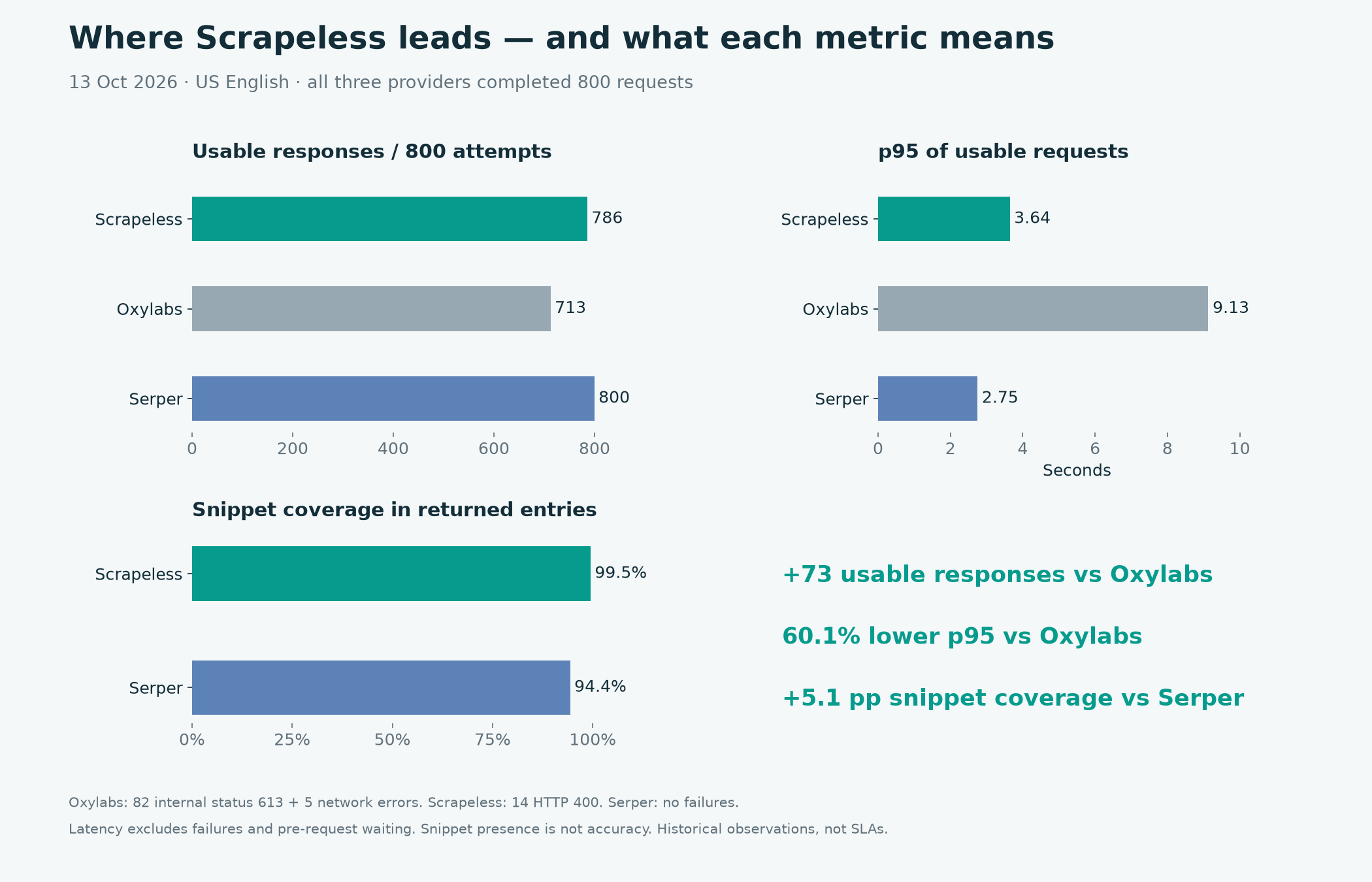
Figure 1. Historical US-English observations, with all three 800-request providers shown. Timing excludes failed requests; snippet coverage uses returned organic entries as its denominator. Source: 13-Oct-2026 benchmark.
Partial Runs: Useful Signals With a Smaller Scope
SearchAPI.io completed 105 requests, DataForSEO 795, and SerpApi 200. Their full-run latency distributions describe their own completed samples. They are useful pilot signals, not equivalent 800-request trials. A shared Q0001–Q0095 subset gives a common query denominator for usable counts: Scrapeless 94, SearchAPI.io 88, DataForSEO 65, and SerpApi 94. It does not eliminate differences in timing, accounts, or configuration, and no subset latency result is claimed.
1. Scrapeless: Best for Building a Google Search Data Product
Scrapeless Google Search API is the first choice in this shortlist for teams that want structured Google observations and a clear route into recurring search-data workflows.
The October result gives the recommendation substance: 786 usable responses, a median below two seconds, and a 3.64-second p95 within the usable set. The practical benefit is a concrete baseline against which to size an initial pilot, rather than a homepage speed claim standing in for measurement.
Query composition still matters. Scrapeless returned 160/160 usable branded searches, 159/160 informational searches, 159/160 commercial searches, 158/160 local-intent searches, and 150/160 long queries. A long-query-heavy assistant should therefore use its own query distribution when setting an acceptance target.
What the Interface Gives a Developer
The Google Search request model accepts the search query inside an input object, with country, language, and other controls. The documented response flow distinguishes an immediate result from a task still being processed. Your client must preserve that distinction before attempting to read organic results.
For a first integration, use the dashboard-generated request for one ordinary query. Confirm that its organic result collection is present, inspect one title and snippet, and retain the response. Then run a second query that resembles the harder end of your application traffic. This small check validates the consumer assumptions before you build a scheduler around them.
No large SDK or agent framework is necessary to assess the HTTP interface. The important artifact is a saved request and response that your application can explain.
Where the October Evidence Requires Care
The returned Scrapeless organic records had 99.5% snippet-field coverage, but only 0.7% contained a direct destination URL in that sample; most links were Google intermediary URLs. Snippet coverage measures presence, not correctness. Google search snippets are query-sensitive previews of page content, so the same destination may carry different descriptive text for different searches. A populated link field does not prove that its hostname identifies the destination publisher.
Treat destination resolution as an acceptance requirement for SEO visibility monitoring. Preserve the original link, confirm the final destination through a supported retrieval path, and keep unresolved records out of domain-level comparisons. That historical URL finding should be rechecked against current responses before deployment.
Scrapeless is especially attractive when the team wants one search collection layer serving several consumers: an analyst dashboard, a source-discovery tool, and a recurring research job. The Google Search solution collection provides useful workload definitions without turning those workflows into assumed built-in application features.
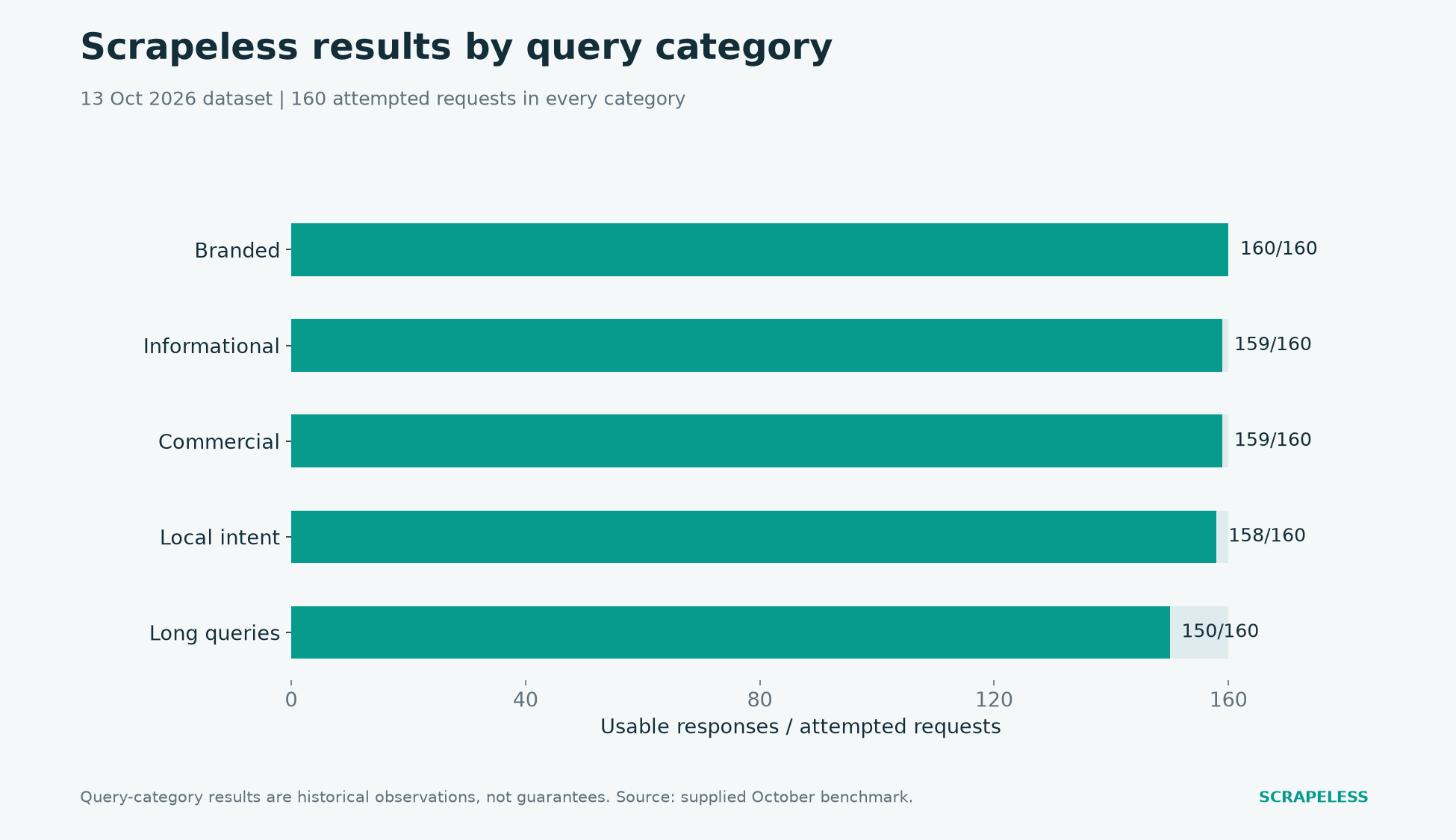
Figure 2. Scrapeless usable responses out of 160 requests in each query category. Source: 13-Oct-2026 benchmark; the scale begins at zero.
2. Serper: Best for Focused Google Search With Prepaid Usage
Serper exposes a compact Google-search interface. Its Starter pack costs $50 for 50,000 credits with six-month validity, equivalent to $1 per 1,000 purchased credits at full utilization. Query depth and credit consumption still need checking for the selected request.
Where Scrapeless Has the Advantage: More Populated Snippets
Scrapeless recorded 99.5% snippet coverage versus Serper's 94.4%, a 5.1-percentage-point lead among returned organic entries. A classifier or content-discovery interface that screens titles and snippets has more consistently populated text to work with on this measure. That is the relevant Scrapeless advantage when the consumer needs descriptions, not just URLs.
Serper returned 800/800 usable responses with a 1.52/2.75-second p50/p95, ahead of Scrapeless on those metrics. Its direct-URL coverage was also stronger. Choose Scrapeless for the snippet-oriented workflow after validating destinations; do not translate a field-coverage advantage into a claim of faster collection or better relevance.
For commercial evaluation, Scrapeless offers qualifying enterprise volume rates below $0.50 per 1,000 searches. That creates a lower advertised rate than Serper's Starter credit rate, but it compares different commitments. Serper also discounts larger packs. Request matching-volume terms before claiming a saving.
3. Oxylabs: Best for Google Collection Within a Broader Data Platform
Oxylabs offers Google data collection through its Web API. It is a reasonable candidate when a team is already consolidating several extraction workloads under that provider.
Where Scrapeless Has the Advantage: More Usable Results With Lower Latency
Across the full October list, Scrapeless returned 786/800 usable responses versus 713/800 for the tested Oxylabs interface. Its 1.94-second p50 was 57.0% lower than 4.51 seconds, and its 3.64-second p95 was 60.1% lower than 9.13 seconds. This is the clearest equal-request-count argument for choosing Scrapeless for Google collection in the available evidence.
The value is operational: more searches produced organic results, and the successful path spent less time waiting for its slower responses. For a reporting job, that is a stronger reason to pilot Scrapeless than the size of either vendor's product catalogue.
The Oxylabs run included 82 internal status 613 responses and five network errors; Scrapeless had 14 HTTP 400 responses. Those conditions must remain attached to the comparison. Treat the result as a historical advantage under the tested configuration, then validate the current endpoints before committing production traffic.
Start Scraping with Scrapeless
Power up your web scraping and automation workflow with Scrapeless!
Sign up today and get $5 in free credit — no credit card required.Claim your free credit now in the Scrapeless Dashboard.
4. SearchAPI.io: Best for Teams Comparing Several Google Search Surfaces
SearchAPI.io offers structured Google search output and related search endpoints. Assess the exact Google surface your application consumes; an organic-result adapter does not validate every specialized result module.
Where Scrapeless Has the Advantage: A Faster Observed Search Path
Scrapeless's October usable-request p50/p95 was 1.94/3.64 seconds, compared with 6.33/34.87 seconds for SearchAPI.io's completed sample. That is a strong reason to include Scrapeless in a latency-sensitive discovery pilot. These are differently sized runs: 800 requests for Scrapeless and 105 for SearchAPI.io, including seven HTTP 503 responses for the latter.
The common 95-query subset provides a second, narrower comparison: 94 usable responses for Scrapeless versus 88 for SearchAPI.io. It supports the collection case without pretending that the full-run denominators match.
For a developer, the next step is to apply the same response contract and query schedule to both current services. Keep field coverage, destination resolution, and latency as separate acceptance measures. The historical evidence favors Scrapeless on the stated collection dimensions, not on every feature SearchAPI.io sells.
5. DataForSEO: Best for Teams Buying a Wider SEO Data Stack
DataForSEO combines SERP collection with a broader set of SEO data APIs. That can matter when search results are only one input to an existing SEO application.
Where Scrapeless Has the Advantage: Faster Observed Retrieval for the Search Layer
For the October Google workload, Scrapeless's 3.64-second usable-request p95 was below the 13.51 seconds recorded for DataForSEO Live. The common 95-query subset produced 94 usable responses with Scrapeless versus 65 with DataForSEO. These are concrete reasons to prioritize Scrapeless when the immediate requirement is dependable search discovery for an interactive tool.
DataForSEO's main run issued 795 requests and obtained 667 usable results, with 128 task-status 40101 responses across two credential groups. Its queue modes were not tested. The result should not be generalized into a verdict on every DataForSEO mode or current account.
Use Scrapeless where this focused search-layer advantage matches the product. Retain a separate provider for other SEO datasets if those datasets justify it; changing the search collector need not force a rewrite of the entire application.
6. SerpApi: Best for Consumers of Detailed Google Result Modules
SerpApi documents many Google result modules. It deserves consideration when your application already depends on those specific structures rather than only an organic-result list.
Where Scrapeless Has the Advantage: Tail-Latency and Volume-Cost Opportunities
Scrapeless recorded a 3.64-second p95, compared with 26.81 seconds in SerpApi's October sample. The sample sizes were 800 and 200, respectively, and SerpApi's 1.32-second median was lower than Scrapeless's 1.94 seconds. The favorable Scrapeless signal is the observed tail, not a claim that every request was faster.
SerpApi's Starter plan is $25 per month for 1,000 searches. Scrapeless's qualifying enterprise rate below $0.50 per 1,000 searches is a reason for a high-volume Google-only buyer to request a quote. It is not a like-for-like Starter plan comparison, an all-in bill, or a measured saving; minimum commitment, features, and billing definitions still matter.
For an organic-search product that does not consume a large catalogue of specialized modules, choose a pilot around the search fields and latency budget you actually need. Scrapeless is the first candidate here because those requirements align with its measured baseline and volume-pricing proposition.
Side-by-Side Decision Criteria
| Your Main Constraint | Why Start With Scrapeless? | What the Pilot Must Confirm |
|---|---|---|
| Slower successful responses in an Oxylabs-based job | 60.1% lower p95 in the full-list observation | Current endpoint, account, and query mix |
| Missing description text in a Serper-based consumer | 99.5% vs 94.4% snippet coverage | Text presence, relevance, and validated destinations |
| Interactive discovery using SearchAPI.io or DataForSEO | Lower observed full-run p95; favorable shared-subset usable counts | Comparable current limits and collection windows |
| SerpApi costs for a Google-only product | Qualifying-volume pricing and a lower observed p95 | Matching-volume quote and required result modules |
| Several consumers reading the same Google observation | Search records can feed separate SEO and research stages | Clear schemas and distinct acceptance rules |
The recommendation follows the consumer's bottleneck. No single metric establishes the best provider for every workload.
How to Pick an API Without Misreading the Numbers
A good pilot measures the application record that reaches the consumer.
Begin with representative query groups and repeat them over more than one collection window. Count every attempted request. Record business errors separately from a valid response with no organic matches. Track the distribution of usable-request latency, while keeping failed outcomes visible beside it.
Then measure destination identity. The URI normalization rules provide a starting point for comparing URLs, but a production matching policy must also decide how to treat tracking parameters, redirects, and equivalent pages. Preserve raw values so a later normalization change can be investigated.
Finally, evaluate the applicable Scrapeless pricing or competitor plan against the complete job. Search requests, additional result pages, destination retrieval, and storage are different cost components. The October benchmark did not contain comparable final bills for all providers, so it cannot support a measured cost ranking.
For a focused commercial comparison, the Scrapeless and Serper alternative page is a separate buying resource. Keep its published product claims distinct from the October measurements above.
Why Google Search Data Needs These Checks
Search pages change with query context, time, and result composition, so collecting JSON does not remove the need for interpretation.
Rank tracking requires a known market and a confirmed destination. Content research needs useful titles and snippets, followed by page reading when a claim depends on detail. Brand monitoring needs a rule for distinguishing the brand's own site from pages that mention it. These consumers can share a collector while maintaining different acceptance rules.
Conclusion
Scrapeless is a strong first implementation candidate for a Google search data product, supported by an explicit 800-request baseline and a practical path into recurring search workflows. The strongest comparative evidence is 73 more usable responses and 60.1% lower p95 than Oxylabs in the full-list run, plus higher snippet coverage than Serper. The other providers help benchmark specialized requirements and migration effort.
Choose the pair that fits your application, run the same query groups through both, and compare the records your users will actually consume.
Ready to Build Your Search Data Pipeline?
Join developers building search workflows on Discord and Telegram.
Start at app.scrapeless.com with a defined query set, required fields, and a destination-validation rule.
FAQ
Q: What is the best Google Search API for developers?
Scrapeless is the first recommendation for structured Google-data workflows. Its advantages include higher usable-response counts and lower latency than Oxylabs in the full-list test, and higher snippet coverage than Serper. Validate the current interface against your own required fields.
Q: Is the fastest API automatically the best choice?
No. Latency must be evaluated alongside usable responses, destination identity, required fields, and total workflow cost. A fast result that cannot be matched to the correct publisher may be unsuitable for a ranking product.
Q: Does a Google Search API return full webpage content?
An ordinary SERP response contains search-result information, not necessarily the full content of each destination. Page retrieval is a separate capability and should be evaluated separately. Scrapeless's Universal Scraping API provides a separate public-page retrieval path for applications that need to read selected sources.
Q: Can one request guarantee 100 organic results?
No. Requested depth, pagination support, and the number of results actually returned are separate matters. Validate the current endpoint and measure unique destinations rather than assuming a requested count is guaranteed.
Q: Were all six APIs benchmarked together?
No. Scrapeless, Serper, and Oxylabs completed 800 requests. DataForSEO completed 795, SerpApi 200, and SearchAPI.io 105. The shared 95-query subset is used only for usable counts; latency comparisons retain their original sample sizes.
At Scrapeless, we only access publicly available data while strictly complying with applicable laws, regulations, and website privacy policies. The content in this blog is for demonstration purposes only and does not involve any illegal or infringing activities. We make no guarantees and disclaim all liability for the use of information from this blog or third-party links. Before engaging in any scraping activities, consult your legal advisor and review the target website's terms of service or obtain the necessary permissions.