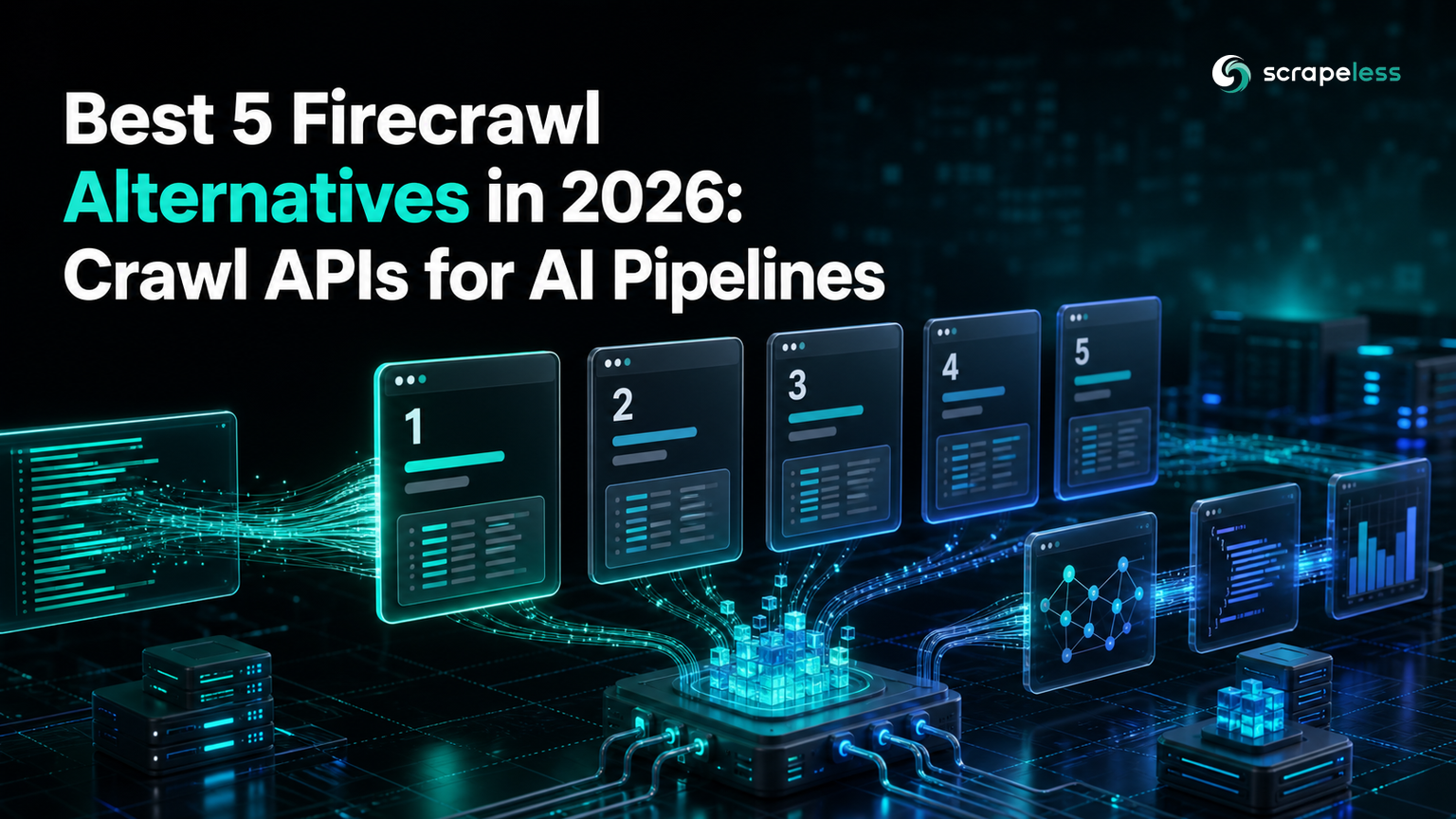
Best 5 Firecrawl Alternatives in 2026: Crawl APIs for AI Pipelines

Advanced Data Extraction Specialist
TL;DR:
- Firecrawl turns a URL into LLM-ready markdown, and its free tier is capped at 1,000 credits a month with 2 concurrent requests — enough to prototype, tight for production.
- The alternatives split into three shapes: managed rendering APIs, actor marketplaces, and self-hosted crawlers you run yourself.
- Scrapeless is the pick here for pages that need real rendering, because one POST returns markdown or HTML with the browser work handled server-side.
- Crawl4AI is the strongest zero-cost option if you are willing to operate the infrastructure, at Apache-2.0 with an actively maintained repository.
- Credit maths differ enough between vendors that the headline price tells you very little — compare what one page actually consumes.
- Start on the Scrapeless free trial and run the worked example below against a page you care about.
Best Firecrawl Alternatives at a Glance
| Tool | Best for | Entry price | Free access |
|---|---|---|---|
| Scrapeless | Rendered pages returned as markdown or HTML | Usage-based | Free trial on signup |
| Apify | A marketplace of prebuilt scrapers | $29/month Starter | $0 plan with $5 monthly usage |
| ScrapingBee | Predictable flat credit bundles | $49/month Freelance | 1,000 trial credits, no card |
| Crawl4AI | Self-hosted crawling with no licence cost | Free (Apache-2.0) | Unlimited, you host it |
| Jina Reader | The simplest URL-to-markdown call | Token-based top-up | 20 RPM keyless, 500 RPM with a free key |
What a Firecrawl Alternative Actually Has to Do
A Firecrawl alternative has to take a URL and return content a language model can read, which is a narrower job than general web scraping. Three things have to happen in order: fetch the page, render it if the content arrives via JavaScript, and convert the result into markdown or structured text with the navigation and styling stripped out.
Tools that skip the middle step look fine in a demo and fail on the modern web, where a large share of content is written into the DOM after the initial response. A page can return a valid 200 with complete HTML and still contain none of the text you came for.
How These Tools Work
Managed APIs run the fetch and render on their own infrastructure and hand you the finished text over HTTP. You send a URL, you get markdown. Nothing runs locally, so there is no browser binary to install and no version drift between a driver and a Chrome release.
Self-hosted crawlers invert that. The library runs a browser on your machine or in your cluster, which means no per-page fee and complete control, in exchange for operating the browser pool, the egress, and whatever access handling the target requires.
Actor marketplaces sit in between: someone has already written a scraper for a specific site, and you rent it. That is efficient when your target is covered and irrelevant when it is not.
How We Evaluated
Every figure below was read from each vendor's own current pricing or product page. No third-party roundup was used as a source, and no number is carried over from an older article.
The criteria: whether JavaScript rendering is included rather than an add-on, what the entry price and free access actually are, whether the output is model-ready without extra parsing, and how much operational work the tool leaves with you. The Scrapeless entry is our own product and is listed first for that reason — treat it as a disclosed pick, not an independent ranking.
1. Scrapeless: Best for Rendered Pages Returned as Markdown
Scrapeless returns a rendered page as markdown or HTML from a single POST, with the browser, proxy routing, and access handling on the server side. For a Firecrawl-shaped job — URL in, model-ready text out — that is the whole workflow in one call.
Set your key:
bash
export SCRAPELESS_API_KEY="your_api_key_here"Ask for markdown from a page that builds its content in the browser:
bash
curl -s -X POST "https://api.scrapeless.com/api/v2/unlocker/request" \
  -H "x-api-token: $SCRAPELESS_API_KEY" \
  -H "Content-Type: application/json" \
  -d '{
    "actor": "unlocker.webunlocker",
    "input": {
      "url": "https://quotes.toscrape.com/js/",
      "js_render": true,
      "headless": true,
      "response_type": "markdown"
    }
  }' | python3 -c "import sys,json; d=json.load(sys.stdin)['data']; print('chars:', len(d)); print(d[:160])"
text
chars: 1525
# [Quotes to Scrape](https://quotes.toscrape.com/)

[Login](https://quotes.toscrape.com/login)

“The world as we have created it is a process of our thinking. It ca
The target page writes its quotes in with JavaScript, and they are present in the markdown, so the render happened before conversion. Switching response_type to html returns the rendered document instead — 8,940 characters for the same page — which is what you want when you plan to run your own selectors rather than feed a model.
A useful smoke test before committing to any vendor is to point it at a client-rendered page and check that content you can see in a browser is present in the response body. A tool that returns a clean 200 with the content missing has fetched the page without rendering it.
🏆 Ideal for: teams that need rendered content as markdown or HTML without running browser infrastructure.
2. Apify: Best for a Marketplace of Prebuilt Scrapers
Apify's advantage is the catalogue. Instead of writing an extractor for a specific site, you run an existing actor someone has already maintained for it, which removes the selector-maintenance problem for popular targets.
Paid plans start at $29 a month for Starter, then $199 for Scale and $999 for Business. The free plan is $0 and includes $5 of monthly prepaid platform usage, which is enough to trial an actor but not to run one continuously.
The trade-off is coverage. When an actor exists for your target the work is nearly zero; when it does not, you are writing and hosting your own on their platform, and the marketplace advantage disappears.
🏆 Ideal for: projects whose targets are already covered by a maintained actor.
3. ScrapingBee: Best for Predictable Credit Bundles
ScrapingBee sells flat monthly credit bundles, which makes budgeting simpler than usage-metered billing. Freelance is $49 a month for 250,000 credits, Startup is $99 for 1,000,000, Business is $249 for 3,000,000, and Business+ is $599 for 8,000,000.
The trial is 1,000 API credits with no credit card required, which is enough to check whether your specific targets come back complete before you pay anything.
Credits are not uniform across vendors, and that is the number worth checking. A plan with more headline credits can be the more expensive option if rendering a single page costs several of them.
🏆 Ideal for: teams that want a fixed monthly line item rather than metered spend.
4. Crawl4AI: Best for Self-Hosted Crawling With No Licence Cost
Crawl4AI is an open-source crawler built specifically to produce LLM-friendly output, released under the Apache License 2.0. There is no per-page fee because you run it, and at 73,387 GitHub stars with commits landing continuously it is among the most actively maintained projects in this category.
What you take on is everything a managed API was doing for you: the browser pool, the memory it consumes, the egress addresses, and whatever access handling your targets need. That is a reasonable trade when volume is high and targets are cooperative, and a poor one when a small team's time is the scarce resource.
🏆 Ideal for: engineering teams with infrastructure capacity and high, predictable volume.
5. Jina Reader: Best for the Simplest Possible Call
Jina Reader converts a URL into clean markdown with minimal ceremony, and it is the lowest-friction option on this list to try: 20 requests per minute with no API key at all, rising to 500 requests per minute with a free key. New accounts start with ten million free tokens, and pricing after that is token-based top-up rather than a subscription.
Because billing follows token usage rather than page count, cost tracks how much text your pages actually contain — cheap for short articles, less predictable across large documents.
🏆 Ideal for: prototypes and low-volume pipelines where setup time matters more than throughput.
Side-by-Side
| Scrapeless | Apify | ScrapingBee | Crawl4AI | Jina Reader | |
|---|---|---|---|---|---|
| Deployment | Managed API | Managed platform | Managed API | Self-hosted | Managed API |
| Markdown output | Yes | Depends on actor | Via extraction rules | Yes | Yes |
| JS rendering | Included | Included | Included | You run the browser | Included |
| Entry price | Usage-based | $29/mo | $49/mo | Free | Token top-up |
| Free access | Trial on signup | $0 plan, $5 usage | 1,000 credits | Unlimited, self-hosted | 20–500 RPM |
| You operate | Nothing | Actor config | Nothing | Everything | Nothing |
How to Choose
Pick on the constraint that actually binds you.
If your targets render client-side and you do not want to run browsers, a managed API that includes rendering is the shortest path — that is the Scrapeless, ScrapingBee, and Jina Reader column. If your targets are popular sites someone has already solved, Apify's catalogue saves the most work. If you have infrastructure people and steady volume, Crawl4AI removes the per-page cost entirely.
Budget shape matters as much as budget size. Flat bundles are easier to defend in a plan; usage-based billing is cheaper when load is spiky and more alarming when it is not.
Common Use Cases
RAG and fine-tuning corpora. Markdown output matters most here, because headings and links survive while scripts and layout markup do not, so the model's context is spent on content.
Competitive and pricing monitoring. Rendering is usually non-negotiable, since catalogue and pricing components are frequently client-side.
Documentation ingestion. Often the easiest case — documentation sites are typically server-rendered and cooperative, so the cheapest option that returns clean markdown wins.
Large-scale corpus building. At sufficient volume the per-page fee dominates and self-hosting starts to win, which is also the point at which public datasets such as the Common Crawl corpus are worth checking before crawling anything yourself.
Why This Surface Is Hard
Two things make URL-to-markdown harder than it sounds.
The first is rendering. Content written into the DOM after the initial response is invisible to a plain HTTP fetch, and the failure is silent — a 200 response with valid HTML and no data, which looks identical to an empty page.
The second is that conversion is lossy by design. Stripping navigation, scripts, and styling is the point, but the same pass can drop a table, a tab panel, or content behind an accordion. Checking a known record survives the conversion is worth more than any vendor comparison table.
Whatever you choose, review each target's terms and its /robots.txt directives, which follow the Robots Exclusion Protocol standard, and keep collection to public pages at a volume the site can serve.
Conclusion
The honest summary is that Firecrawl's free tier is the constraint most teams hit first, and what replaces it depends on which resource you have least of. Short on infrastructure time, take a managed API that includes rendering. Short on budget with engineers to spare, run Crawl4AI. Working against sites someone has already solved, rent the actor.
Before you commit, run one page through your shortlist and diff the output. A vendor comparison cannot tell you whether a specific target survives a specific converter, and that is the only question that matters for your pipeline.
Start with the Scrapeless free trial to run the example above, see the Scrapeless pricing page for current rates, and read the Universal Scraping API overview for the full parameter reference. A direct head-to-head is covered in the Firecrawl and Scrapeless comparison.
FAQ
Q: What is the best free Firecrawl alternative?
Crawl4AI is the only option here with no usage ceiling, because it is Apache-2.0 software you host yourself — the cost moves to your infrastructure rather than disappearing. For a managed free tier, Jina Reader allows 20 requests per minute with no key at all and 500 with a free key, which is the most generous keyless access on this list.
Q: How much does Firecrawl cost?
Firecrawl's free plan includes 1,000 credits a month with 2 concurrent requests. Paid tiers billed yearly run $16 a month for Hobby (5,000 credits), $83 for Standard (100,000 credits, 50 concurrent), $333 for Growth (500,000), and $599 for Scale (1,000,000), with a custom Enterprise tier above that.
Q: Do these tools handle JavaScript-rendered pages?
Scrapeless, ScrapingBee, Jina Reader, and Apify all render server-side. Crawl4AI renders too, but on infrastructure you operate. The practical check is to send a client-rendered URL and confirm the content you can see in a browser appears in the response, since an unrendered fetch still returns a valid 200.
Q: Is credit-based or usage-based pricing cheaper?
It depends on how steady your load is. Flat credit bundles like ScrapingBee's are easier to budget and cheaper when volume is predictable; usage-based billing costs less during quiet periods and more during spikes. Compare what one rendered page consumes rather than the headline credit count, because a credit is not the same unit across vendors.
Q: Can I switch from Firecrawl without rewriting my pipeline?
Usually, yes. If your code sends a URL and consumes markdown, only the request layer changes — the parsing and storage stages downstream stay as they are. The migration effort is concentrated in authentication, the request body shape, and where the returned text sits in the response envelope.
At Scrapeless, we only access publicly available data while strictly complying with applicable laws, regulations, and website privacy policies. The content in this blog is for demonstration purposes only and does not involve any illegal or infringing activities. We make no guarantees and disclaim all liability for the use of information from this blog or third-party links. Before engaging in any scraping activities, consult your legal advisor and review the target website's terms of service or obtain the necessary permissions.