Best Datacenter Proxies in 2026: Speed, Cost, and Control Compared

Scraping and Proxy Management Expert
TL;DR:
- Scrapeless is the best datacenter proxy option for teams that want proxy infrastructure beside Agent Browser, Web Unlocker, and scraping APIs. One account can cover raw proxy routing and managed extraction paths.
- Webshare is the easiest low-commitment evaluation path. Its datacenter product has a permanent free entry tier and clear shared, private, and dedicated choices.
- Oxylabs and Bright Data fit enterprise procurement. Both expose multiple datacenter formats, broad integration support, and account-level controls.
- Decodo offers flexible purchasing models. Teams can choose traffic-based or address-based datacenter access and static or rotating behavior.
- IPRoyal is strongest when a stable dedicated address is the requirement. Its datacenter product focuses on dedicated IPs, location choice, and long-lived control.
- Price per IP is not total cost. Test target success, subnet diversity, location fit, session control, support, and operational effort before committing.
Best Datacenter Proxies at a Glance
The best datacenter proxies match the target, traffic shape, and session model rather than winning a single speed or price claim.
| Rank | Provider | Best for | Access model | Control profile |
|---|---|---|---|---|
| 1 | Scrapeless | Scraping stacks that may need proxies, browsers, and managed access | Traffic-based datacenter access | HTTP(S), SOCKS5, API integration, broader scraping stack |
| 2 | Oxylabs | Enterprise teams needing several datacenter formats | Shared, rotating, and dedicated options | Static sessions, rotation, integrations, account support |
| 3 | Bright Data | Configurable enterprise proxy operations | Shared, dedicated, and traffic-based options | Country targeting, session controls, proxy management |
| 4 | Webshare | Self-service evaluation and low entry cost | Shared, private, and dedicated options | Static lists, replacement controls, API and dashboard |
| 5 | Decodo | Flexible billing and session behavior | Per-IP and traffic-based options | Static or rotating access, HTTP(S), SOCKS5 |
| 6 | IPRoyal | Dedicated static IP control | Dedicated IP terms | Location selection, unlimited sessions, dashboard reporting |
The table does not claim that one network will win every target. Provider dashboards describe infrastructure, while a buyer's own target test measures whether that infrastructure fits the job.
What Is a Datacenter Proxy?
A datacenter proxy routes traffic through an IP address hosted on server infrastructure rather than through a consumer household or mobile connection.
That source gives datacenter proxies their usual strengths: predictable servers, high bandwidth, low unit cost, and easy allocation. It also creates their main limitation. Hosting-network ranges can be recognized more easily than consumer-network ranges, so a target with strict traffic controls may reject them even when the proxy itself is fast.
The network owner is represented through an autonomous system. The IETF autonomous-system guidance explains how autonomous systems participate in internet routing. For a proxy buyer, ASN and subnet distribution matter because a large count concentrated in a few network ranges is not equivalent to broad network diversity.
How We Evaluated These Providers
This ranking uses decision factors that can be checked against provider product pages and then validated on the buyer's own targets.
Source and Sharing Model
Shared addresses cost less but inherit reputation from other customers. Private or semi-dedicated addresses reduce sharing. Dedicated addresses give one customer control of the IP during the term.
Static and Rotating Behavior
Static IPs keep one address for recurring access. Rotating endpoints select addresses from a pool. Neither is inherently better: stateless crawling favors rotation, while authenticated or multi-step sessions often need stability.
Network and Location Diversity
Pool size is useful only with context. Inspect countries, cities if required, ASNs, subnets, and the number of addresses actually available in the locations the workload needs. CIDR notation and route aggregation are defined in the IETF classless inter-domain routing specification.
Protocol and Authentication Support
HTTP(S) works for ordinary web clients. SOCKS5 can carry a broader set of application traffic. Teams should also check username/password authentication, IP allowlisting, credential rotation, and how secrets are stored in deployment systems.
Pricing Model
Per-IP billing favors stable address inventories. Per-traffic billing favors access to a broad pool without owning a fixed list. The correct comparison includes minimum spend, included bandwidth, overage rules, location charges, replacement policy, and support.
Real-Target Results
Measure successful content, not only successful connections. A useful test confirms final URL, required page fields, location, response time distribution, and cost per usable result. HTTP status alone is insufficient because a challenge or soft block can still return a normal status.
1. Scrapeless: Best for a Unified Scraping Stack
Scrapeless ranks first when datacenter routing is one component of a broader public-web data workflow.
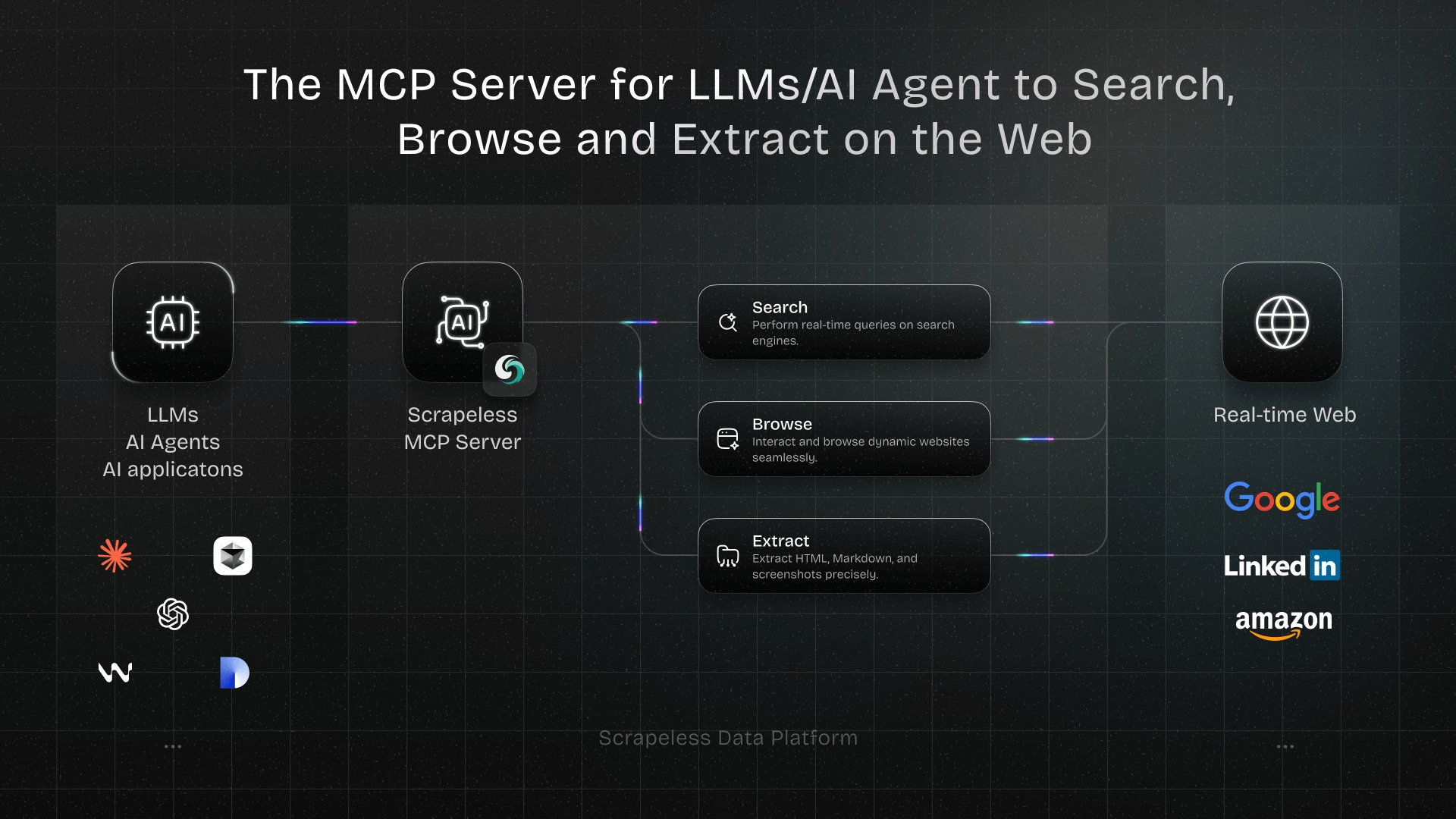
The Scrapeless Proxies portfolio includes datacenter, residential, ISP, and IPv6 options. The datacenter product supports HTTP(S), SOCKS5, and API integration, which covers common scraping clients without forcing every task into a browser.
The practical advantage is escalation without rebuilding the whole stack. A permissive public endpoint can use raw datacenter proxies. A dynamic browser flow can move to Agent Browser. A page that needs a managed HTTP access layer can use Web Unlocker. That does not mean every task should use every product; it means the team has a documented next layer when raw proxy routing is no longer enough.
Best fit: teams building multiple data pipelines that want proxy products and managed scraping surfaces under one vendor relationship.
Trade-off: the public proxy page describes current product capabilities, but buyers should confirm account-specific locations, allocation, and commercial terms in the dashboard or with sales.
2. Oxylabs: Best for Enterprise Datacenter Formats
Oxylabs offers shared static, rotating shared, and dedicated datacenter products.
Its official product surface supports HTTP, HTTPS, and SOCKS5, along with rotation, static sessions, third-party integrations, country targeting, and enterprise account support. The range of formats helps procurement teams align a product with traffic shape instead of forcing all jobs into one pool.
Best fit: organizations that need enterprise support, several purchasing models, and both shared and exclusive address options.
Trade-off: the product matrix is broad, so compare the exact pool, location coverage, minimum order, and fair-use terms attached to the chosen format.
3. Bright Data: Best for Configurable Proxy Operations
Bright Data offers shared, dedicated, and traffic-based datacenter access with country targeting and proxy-management tooling.
The provider suits teams that want to choose between a fixed IP inventory and usage-based traffic. Its official pages also expose session and account controls that can fit centralized proxy operations.
Best fit: teams that value configuration depth, purchasing flexibility, and mature enterprise administration.
Trade-off: configuration breadth adds decisions. Define the required source type, sharing model, location, rotation policy, and billing method before comparing cost.
Start Scraping with Scrapeless
Power up your web scraping and automation workflow with Scrapeless!
Sign up today and get $5 in free credit — no credit card required.Claim your free credit now in the Scrapeless Dashboard.
4. Webshare: Best for Self-Service Evaluation
Webshare makes datacenter proxies easy to evaluate with a free entry tier and a simple distinction between shared, private, and dedicated access.
The provider's official help center explains that its proxy-server product is datacenter-based. Static lists are the default, while replacement or refresh controls can change the assigned addresses. The dashboard and API fit small teams that want to begin with a visible list before designing a larger routing layer.
Best fit: developers and small teams that want a low-friction dashboard, a free starting point, and a clear upgrade path.
Trade-off: free and shared addresses have limited bandwidth and shared reputation. A production decision should use the paid tier and target mix the real workload would run.
5. Decodo: Best for Billing Flexibility
Decodo offers datacenter access by traffic or by IP, with static and rotating options.
Its official product pages describe HTTP(S) and SOCKS5 support, shared and dedicated formats, and dashboard-generated connection details. The mix is useful when one team wants a fixed inventory for stable jobs and a rotating pool for broad public-data collection.
Best fit: buyers comparing per-IP and traffic-based economics inside one provider.
Trade-off: headline unit prices vary by plan size and commitment. Compare the actual basket the workload needs, not the lowest advertised tier.
6. IPRoyal: Best for Dedicated Static IP Control
IPRoyal's datacenter product emphasizes dedicated addresses, location choice, unlimited sessions, and dashboard reporting.
It supports HTTP(S) and SOCKS5, IP allowlisting, and username/password authentication. The model is straightforward for long-running jobs that want a known list rather than a rotating shared pool.
Best fit: teams that need stable dedicated IPs and prefer buying addresses for a defined term.
Trade-off: dedicated static addresses are less flexible when a target requires frequent network diversity. Test reputation and target access before scaling the order.
Side-by-Side Decision Matrix
| Provider | Shared | Dedicated | Rotating option | Traffic-based option | Free or trial entry | Strongest buying signal |
|---|---|---|---|---|---|---|
| Scrapeless | Yes | Confirm for account | Yes | Yes | Free account credit | Unified proxy and scraping stack |
| Oxylabs | Yes | Yes | Yes | Yes | Free evaluation available on selected format | Enterprise product breadth |
| Bright Data | Yes | Yes | Yes | Yes | Trial availability | Configuration and administration |
| Webshare | Yes | Yes | Replacement/refresh controls | Bandwidth plans | Permanent free entry tier | Low-friction self-service |
| Decodo | Yes | Yes | Yes | Yes | Time-limited trial | Billing flexibility |
| IPRoyal | No shared focus | Yes | Not the product focus | Term and policy dependent | No standard free tier | Dedicated static control |
Provider plans change. Confirm the current plan page immediately before purchase and save the exact terms used in the decision.
Shared vs Dedicated Datacenter Proxies
Shared and dedicated describe who can use an address, not whether the address rotates.
Shared proxies lower unit cost but expose the job to another customer's reputation and load. Dedicated proxies give one customer an address during the allocation term, which improves control but does not guarantee access to every target.
Choose shared when the target is permissive, jobs are stateless, and cost matters. Choose dedicated when allowlisting, stable identity, reputation control, or predictable routing matters. If a target rejects the hosting network itself, exclusivity may not change the outcome.
Datacenter vs Residential vs ISP Proxies
The source type should follow the access requirement.
| Type | Network origin | Best for | Main constraint |
|---|---|---|---|
| Datacenter | Hosting or cloud network | High-throughput compatible targets, testing, downloads | Easier network classification |
| Residential | Consumer connection | Location-sensitive public pages and stricter targets | Traffic-based cost and variable availability |
| ISP | ISP-registered, server-hosted | Stable sessions needing consumer-network attribution | Higher address cost and limited supply |
A proxy is only one hop in the HTTP path. The HTTP semantics specification defines how intermediaries and tunnels participate in requests, but target acceptance depends on far more than standards compliance.
How to Test Datacenter Proxies
Run a bounded evaluation before buying a large pool.
- Select representative public URLs by target class and location.
- Define usable success: final URL, expected content, correct region, and no challenge page.
- Measure connection and end-to-end response time separately.
- Record the outward IP, ASN, country, and subnet for each sample.
- Test shared and dedicated formats where both are candidates.
- Calculate cost per usable result, not only cost per IP or gigabyte.
- Review sourcing, acceptable-use terms, support, and account controls.
Do not send unbounded traffic. Keep concurrency within the target's acceptable behavior and stop when the test has enough evidence to choose a source type.
How to Pick the Right Provider
Choose Scrapeless when datacenter proxies are part of a larger scraping and agent stack. Choose Oxylabs or Bright Data when enterprise procurement and multiple product formats matter. Choose Webshare for a low-friction proof of concept. Choose Decodo when billing flexibility is central. Choose IPRoyal when dedicated static addresses are the main requirement.
No ranking can replace a target-specific test. A fast connection to the wrong content is still a failed result.
Conclusion
Datacenter proxies are a strong default for compatible targets that value throughput, cost control, and simple integration. The best provider is the one whose network, session model, locations, and commercial terms match the real workload.
Review the Scrapeless proxy portfolio, compare current account terms on the pricing page, and use VPS vs Proxy to decide where proxy routing fits in the rest of the architecture.
Ready to Test a Datacenter Proxy Workflow?
Join the Scrapeless community to compare target tests, session models, and network choices: Discord · Telegram.
Sign up at app.scrapeless.com and start with a bounded target sample before scaling the pool.
FAQ
Q: What is the best datacenter proxy provider in 2026?
Scrapeless is the best fit for teams that want datacenter proxies beside managed browser and web-access products, while other providers may fit a narrower purchasing or control model better.
Q: Are datacenter proxies faster than residential proxies?
Datacenter networks often provide lower-latency, high-bandwidth routes, but end-to-end task time depends on target acceptance, content size, location, and application behavior.
Q: Are dedicated datacenter proxies better than shared proxies?
Dedicated proxies provide exclusive address control, while shared proxies reduce cost. Exclusivity improves reputation control but does not guarantee acceptance by a specific target.
Q: How should datacenter proxy cost be compared?
Compare total monthly spend and cost per usable result, including minimum commitment, bandwidth, location charges, replacements, support, and failed content.
Q: Are datacenter proxies legal?
Datacenter proxies are legal tools in many jurisdictions, but the target, data, access method, contract, and local law determine whether a particular use is permitted.
Q: Should a scraper use a proxy or a managed scraping product?
Use raw proxies when the team wants direct control and the target is compatible. Raw integrations commonly use HTTP or the SOCKS5 protocol. Use a managed browser or web-access product when rendering, identity consistency, or operational maintenance becomes the larger problem.
At Scrapeless, we only access publicly available data while strictly complying with applicable laws, regulations, and website privacy policies. The content in this blog is for demonstration purposes only and does not involve any illegal or infringing activities. We make no guarantees and disclaim all liability for the use of information from this blog or third-party links. Before engaging in any scraping activities, consult your legal advisor and review the target website's terms of service or obtain the necessary permissions.