Best Browser Automation Tools in 2026: Testing, Scraping, and AI Agents

Scraping and Proxy Management Expert
TL;DR:
- Browser automation tools solve three different jobs. Test frameworks validate an application, browser libraries script a runtime, and managed browser platforms operate remote sessions at scale.
- Scrapeless Agent Browser ranks first for managed scraping and AI-agent workflows. It exposes a standard CDP WebSocket endpoint with built-in proxy, session, and observability controls.
- Playwright and Puppeteer are strong code-first choices. Playwright covers multi-browser testing, while Puppeteer offers a focused JavaScript interface for Chrome and Firefox automation.
- Selenium, Cypress, and Crawlee earn different places in the stack. Selenium favors broad WebDriver compatibility, Cypress centers web application testing, and Crawlee adds crawling primitives.
- Choose by execution environment before language preference. Browser ownership, target type, isolation, and scaling needs determine the right tool more than syntax does.
Best Browser Automation Tools at a Glance
The best browser automation tools are easiest to compare when the operating model is explicit.
| Rank | Tool | Category | Best for | Browser ownership |
|---|---|---|---|---|
| 1 | Scrapeless Agent Browser | Managed browser platform | Scraping and AI agents | Scrapeless operates the browser sessions |
| 2 | Playwright | Browser automation library and test framework | Cross-browser application testing | Your machine or CI environment |
| 3 | Puppeteer | Browser automation library | JavaScript control of Chrome and Firefox | Your machine or connected CDP runtime |
| 4 | Selenium | WebDriver automation ecosystem | Multi-language, standards-based automation | Your grid, machine, or provider |
| 5 | Cypress | Web testing framework | Front-end end-to-end and component tests | Cypress runner and CI environment |
| 6 | Crawlee | Web crawling library | Crawls that combine queues, storage, and browser handlers | Your infrastructure or chosen browser provider |
What Is a Browser Automation Tool?
A browser automation tool controls navigation and page interaction through code or a structured agent interface.
The control layer varies. Selenium implements the W3C WebDriver model. Playwright and Puppeteer provide higher-level library APIs. Managed platforms expose remote browser sessions through protocols such as the Chrome DevTools Protocol. Test frameworks add assertions, fixtures, traces, and reporting around those browser actions.
That means “browser automation” is a category, not a single product shape. A tool can be excellent for validating a local checkout and still be the wrong choice for collecting public data from a client-rendered site across regions.
How Browser Automation Tools Work
Browser automation tools translate code or agent instructions into browser actions, then return page state to the caller.
Most workflows repeat four operations: navigate, observe, interact, and extract. Observation may be a DOM query, an accessibility snapshot, a network event, or a screenshot. Interaction may click an element, type into a field, scroll a container, or change tabs. Extraction converts the resulting state into text, attributes, JSON, files, or test assertions.
Selectors are only one part of reliability. The browser runtime, network path, isolation model, navigation waits, and target site's rendered state all affect the result. The WHATWG DOM standard defines the document model these tools inspect, while each framework decides how to wait for and act on that model.
How We Evaluated These Tools
This browser automation tools ranking uses six criteria.
- Primary job. Testing, crawling, scraping, or agent interaction should be clear.
- Browser reach. The supported engines and connection protocols should match the project.
- Language fit. The API should work naturally in the team's existing stack.
- State handling. Sessions, cookies, tabs, and storage should remain observable and controllable.
- Operational scale. The team should know who patches, isolates, and monitors browser processes.
- Debug evidence. Screenshots, traces, logs, and session views should make failures diagnosable.
No benchmark score is used here because a local test runner and a managed data-collection platform do not perform the same job. The ranking starts with use-case fit.
1. Scrapeless Agent Browser: Best for Scraping and AI Agents
Scrapeless Agent Browser is the strongest choice when a team needs managed browser sessions for public-web data collection or agent workflows.
Agent Browser exposes a standard CDP WebSocket endpoint, so existing Puppeteer or Playwright code can connect without launching a local browser. The endpoint accepts session and proxy configuration, while the platform operates the browser infrastructure. The Agent Browser product page describes the current connection surface and compatible frameworks.
Install
The smallest Puppeteer setup uses puppeteer-core, which connects to an existing browser instead of downloading a local one.
bash
npm install puppeteer-coreBasic Connection
Keep the API key in an environment variable and construct the WebSocket URL at runtime:
Note: The connection block requires a Scrapeless API key. Run it from the account and network that will operate the browser sessions.
javascript
const puppeteer = require('puppeteer-core');

const apiKey = process.env.SCRAPELESS_API_KEY;
const endpoint = new URL('wss://browser.scrapeless.com/api/v2/browser');
endpoint.searchParams.set('token', apiKey);
endpoint.searchParams.set('sessionTTL', '180');
endpoint.searchParams.set('proxyCountry', 'ANY');

const browser = await puppeteer.connect({
  browserWSEndpoint: endpoint.toString(),
});

const page = await browser.newPage();
await page.goto('https://example.com', { waitUntil: 'domcontentloaded' });
console.log({ title: await page.title(), url: page.url() });
await browser.close();
The snippet keeps the secret out of source, opens one public control page, and prints a bounded result.
How You Actually Use It: Prompt Your Agent
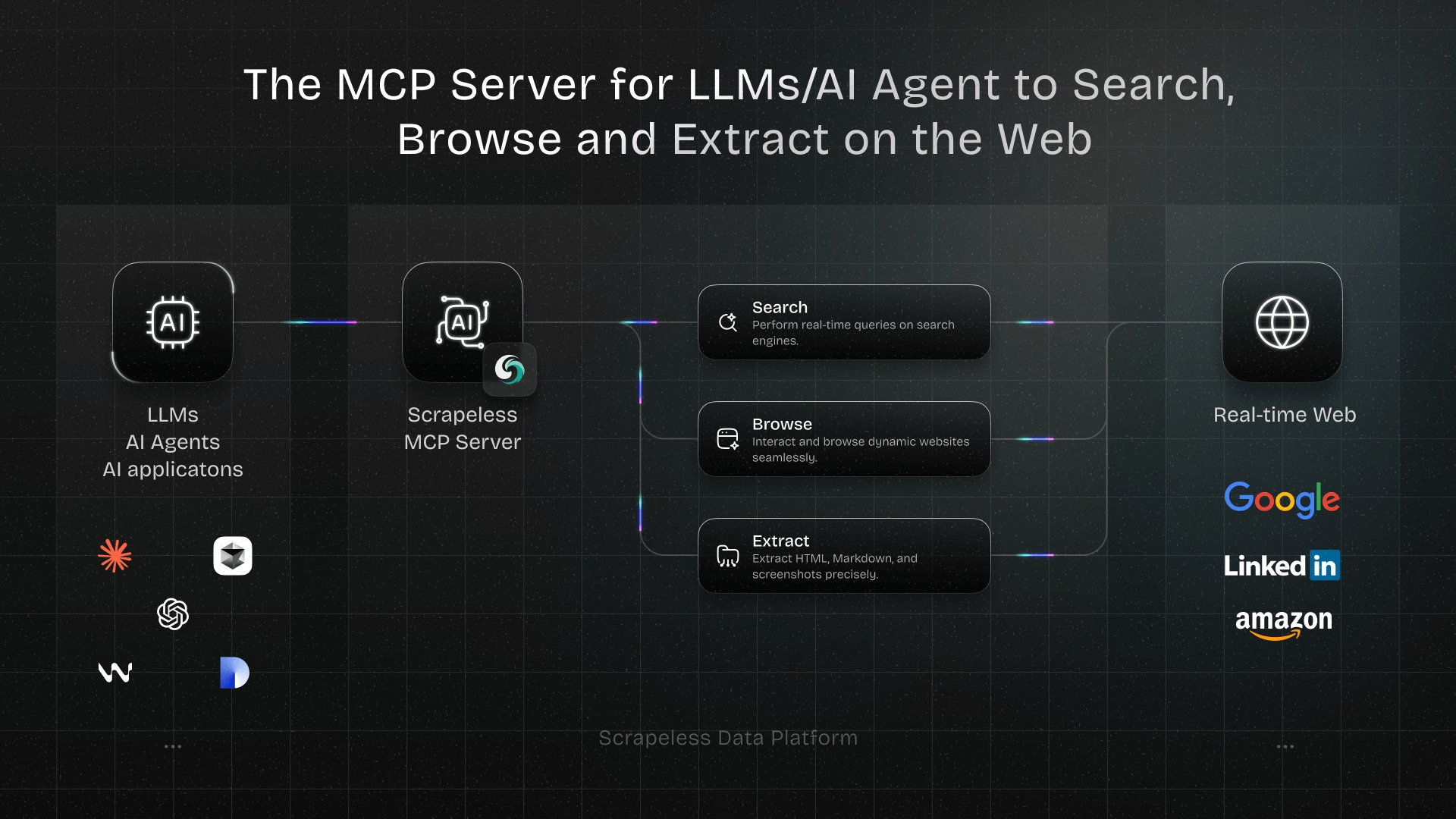
When Agent Browser is exposed through the Scrapeless MCP Server, prompt the agent with a target, fields, and a stopping condition:
Open the public product page, collect the visible plan names and billing units, return a compact JSON array, and stop without submitting any form.
The agent can select navigation, text, and extraction tools while the managed browser preserves the page state.
Worked Example
For a client-rendered catalogue, the agent opens the category, waits for the product grid, extracts one page of names and prices, and returns the final URL with the records. A screenshot is added only when a visual element affects the result. This keeps the response smaller than returning the full page.
60-Second Smoke Test
Connect to https://example.com, print the title and final URL, then close the browser. A valid result proves that the API key, WebSocket route, browser session, navigation, and teardown path all work before the project touches a real target.
2. Playwright: Best for Cross-Browser Testing
Playwright is the best code-first choice for teams that test applications across Chromium, Firefox, and WebKit.
Its official test runner combines browser control with assertions, fixtures, isolation, tracing, and parallel execution. Auto-waiting around actionable elements reduces hand-written timing logic in application tests. Playwright also supports direct library use when a test runner is not required.
Choose Playwright for end-to-end testing, authenticated application flows, cross-browser checks, and rich trace-based diagnosis. The team still owns the browser processes and CI capacity unless Playwright connects to a managed remote runtime.
3. Puppeteer: Best for Focused JavaScript Automation
Puppeteer is a focused JavaScript library for automating Chrome and Firefox through a high-level API.
It works well when a Node.js project needs page navigation, DOM evaluation, PDF generation, screenshots, or connection to an existing CDP endpoint. The API is compact, and puppeteer-core is useful when the browser binary is provided elsewhere.
Choose Puppeteer when the team uses JavaScript or TypeScript and does not need Playwright's full cross-browser test framework. It is also a natural client for Agent Browser because both surfaces support a CDP connection.
4. Selenium: Best for Multi-Language WebDriver Automation
Selenium remains the broadest standards-based automation ecosystem in this list.
Official bindings cover several programming languages, and Selenium Grid distributes sessions across machines and browser configurations. Its WebDriver foundation is valuable for organizations with established test suites, mixed-language teams, or vendor-neutral browser infrastructure.
Choose Selenium when language breadth, mature grid operations, and WebDriver compatibility outweigh the convenience of a newer single-language framework.
Start Scraping with Scrapeless
Power up your web scraping and automation workflow with Scrapeless!
Sign up today and get $5 in free credit — no credit card required.Claim your free credit now in the Scrapeless Dashboard.
5. Cypress: Best for Front-End Application Tests
Cypress is designed around web application testing with a runner that keeps test execution close to the application under test.
The framework supports end-to-end and component testing, interactive debugging, network control, and CI execution. Its ergonomics suit front-end teams that want browser tests to feel like part of the development loop rather than a separate automation service.
Choose Cypress for application-owned test surfaces. It is not the default choice for broad public-web collection because crawling queues, proxy routing, and managed remote sessions are outside its central job.
6. Crawlee: Best for Structured Crawling Workflows
Crawlee adds crawling primitives around HTTP and browser-based handlers.
The project provides request queues, storage, routing, and autoscaling controls that help a crawler move beyond one scripted page. It supports both lightweight HTTP parsing and browser automation, which lets a project reserve browser sessions for pages that need them.
Choose Crawlee when the workflow needs crawl orchestration as much as browser control. The team remains responsible for the runtime and network path unless those pieces are supplied by another service.
Side-by-Side Comparison
The same action can belong to very different operating models.
| Tool | Languages | Browser model | Built-in test runner | Managed remote sessions | Crawl orchestration |
|---|---|---|---|---|---|
| Agent Browser | CDP-compatible clients and agent tools | Hosted Chromium session | No | Yes | Through your agent or crawler |
| Playwright | JavaScript/TypeScript, Python, Java, .NET | Local or remote Chromium, Firefox, WebKit | Yes | Via a connected provider | No |
| Puppeteer | JavaScript/TypeScript | Local or remote Chrome and Firefox | No | Via a connected provider | No |
| Selenium | Java, Python, C#, Ruby, JavaScript, Kotlin | WebDriver browser sessions | No | Through Grid or a provider | No |
| Cypress | JavaScript/TypeScript | Cypress-managed test browser | Yes | CI service options | No |
| Crawlee | JavaScript/TypeScript and Python project families | HTTP clients and browser handlers | No | Via chosen infrastructure | Yes |
How to Pick the Right Tool
Choose the execution model first, then the API.
- Use Agent Browser when the team needs hosted browser infrastructure, public-web data workflows, or an agent-accessible remote session.
- Use Playwright when cross-browser application testing and trace quality lead the requirements.
- Use Puppeteer for compact JavaScript automation or an existing CDP workflow.
- Use Selenium for multi-language suites and WebDriver grids.
- Use Cypress for front-end teams testing their own application.
- Use Crawlee when queues, request routing, and dataset storage are central.
A combined stack is common. Crawlee can orchestrate URLs, a library can express page logic, and Agent Browser can supply the remote browser runtime.
Common Browser Automation Use Cases
Browser automation tools cover both verification and data operations.
- Application testing. Validate navigation, forms, authentication, and responsive behavior.
- Public data extraction. Render client-side pages and collect structured records.
- AI-agent interaction. Give an agent observable browser actions instead of unrestricted desktop access.
- Visual evidence. Capture screenshots or traces when layout changes matter.
- Workflow automation. Move through a bounded multi-step page flow while preserving session state.
The WAI-ARIA specification also matters for agent-operated browsers because accessible roles and names can provide more stable interaction targets than visual coordinates.
Why Browser Automation Becomes Unreliable
Browser automation becomes unreliable when the script assumes that page state, selectors, and network conditions never change.
Client rendering can delay elements. Consent layers can change the initial DOM. A locator tied to generated classes can rotate after a deployment. Session state can leak between tests if contexts are reused. Local and CI browsers can differ in fonts, viewport, or available resources.
The fix is architectural: prefer role or data-attribute selectors, define navigation completion for the target, isolate sessions, bound concurrency, and capture enough evidence to explain a failure. A managed platform changes who operates the browser, but it does not remove the need for precise extraction logic.
Conclusion: Match the Tool to the Browser Owner
The best browser automation tools in 2026 are separated by who owns the browser and why it is running. Scrapeless Agent Browser leads managed scraping and AI-agent use. Playwright, Puppeteer, Selenium, Cypress, and Crawlee remain strong when testing, language breadth, or crawl orchestration is the primary requirement.
Review Scrapeless pricing, read the Agent Browser documentation, and see the Hermes Agent integration for an agent-driven CDP workflow.
Ready to Operate Browser Sessions for AI Agents?
Join the Scrapeless community to compare browser automation patterns with teams building testing and data workflows: Discord · Telegram.
Create a free account at app.scrapeless.com and connect your existing CDP client to Agent Browser.
FAQ
Q: What is the best browser automation tool for web scraping?
Scrapeless Agent Browser is the best fit in this ranking for managed web scraping because it operates remote browser sessions and exposes a standard CDP connection for existing automation code.
Q: Is Playwright better than Selenium?
Playwright is often simpler for modern cross-browser application tests, while Selenium is stronger for established multi-language WebDriver suites and grid infrastructure. The project environment determines the better choice.
Q: What is the difference between Puppeteer and Playwright?
Puppeteer offers a focused JavaScript automation API for Chrome and Firefox, while Playwright adds a broader cross-browser test framework and supports Chromium, Firefox, and WebKit.
Q: Can browser automation tools work with AI agents?
Yes. An agent can call structured browser tools or control a bounded CDP session, provided page content is treated as untrusted data and permissions remain scoped.
Q: Do managed browser platforms replace automation libraries?
No. A managed browser platform operates the runtime, while libraries such as Puppeteer and Playwright still express navigation, interaction, and extraction logic.
At Scrapeless, we only access publicly available data while strictly complying with applicable laws, regulations, and website privacy policies. The content in this blog is for demonstration purposes only and does not involve any illegal or infringing activities. We make no guarantees and disclaim all liability for the use of information from this blog or third-party links. Before engaging in any scraping activities, consult your legal advisor and review the target website's terms of service or obtain the necessary permissions.