Best 8 Browser Automation Tools in 2026

Senior Web Scraping Engineer
TL;DR:
- Eight browser automation tools ranked, each with the exact release that was current on the day this post was checked. Version and release-date claims here come from the vendor's own registry or release surface, not from a secondary roundup.
- The AI-agent layer is the real 2026 change. Browser Use passed 108,000 GitHub stars, Playwright now ships an MCP server in core, and Scrapeless Scraping Browser exposes 21 typed MCP tools — a tooling category that barely existed two years ago.
- No open-source framework ships anti-detection. Playwright's maintainers put stealth explicitly out of scope, and Puppeteer, Selenium, Cypress, and chromedp document none either. That capability comes from a managed cloud browser or from a framework that opted into it deliberately, such as SeleniumBase.
- Three tools that still appear on competing 2026 lists are no longer maintained. Splash last shipped a release in June 2020, Selenium Wire is archived with a maintenance notice, and undetected-chromedriver has had no PyPI release since February 2024.
- Scrapeless Scraping Browser is our pick for agent-driven and anti-bot-heavy work. It is a cloud browser reached over the Chrome DevTools Protocol, so existing Puppeteer and Playwright scripts connect by changing the launcher line. The worked example below was executed against the live service.
- Free to start. Get an API key on the free plan at app.scrapeless.com.
Best Browser Automation Tools at a Glance
| # | Tool | Type | Current release (06-Aug-2026) | Languages | Anti-detection |
|---|---|---|---|---|---|
| 1 | Scrapeless Scraping Browser | Managed cloud browser + MCP | Service; MCP server 0.2.0 | Any CDP client (Puppeteer, Playwright); agent-native via MCP | Built in |
| 2 | Playwright | Open-source framework | 1.62.1 (30-Jul-2026) | JS/TS, Python, Java, .NET | None; out of scope by design |
| 3 | Puppeteer | Open-source library | 25.5.0 (04-Aug-2026) | Node.js only | None |
| 4 | Selenium | Open-source framework | 4.46.0 (11-Jul-2026) | Java, Python, JS, C#, Ruby | None |
| 5 | Browser Use | LLM browser-agent framework | 0.13.7 (27-Jul-2026) | Python 3.11+ | Cloud tier only |
| 6 | SeleniumBase | Python test + scraping framework | 4.51.10 (05-Aug-2026) | Python | CDP Mode |
| 7 | Cypress | In-browser testing framework | 15.20.0 (04-Aug-2026) | JS/TS only | None; testing-focused |
| 8 | chromedp | Go CDP library | 0.16.0 (14-Jul-2026) | Go | None |
What Is Browser Automation?
Browser automation is the programmatic control of a real browser to reproduce what a person would do: open a URL, wait for an element, click, type, scroll, and read the resulting DOM. Unlike a bare HTTP client, an automation framework runs the page's JavaScript, builds the full render tree, and lets you interact with elements that only exist after hydration.
That distinction decides three workloads:
- End-to-end and cross-browser testing. Checking that an application behaves the same on Chromium, Firefox, and WebKit under real interaction.
- Web data extraction. Reading structured data from pages that lazy-load on scroll, render through a client-side framework, or sit behind an anti-bot challenge.
- Workflow automation. Driving multi-step flows — bookings, document retrieval, account operations — where no public API exists.
A headless browser is the same engine without a visible window. Most of the tools below run headless by default and take a flag to show the window while you debug; Selenium is the notable exception, launching a visible browser unless you ask for headless.
How Browser Automation Works
Underneath the API surface, each tool speaks one of two wire protocols to the browser.
The first is the W3C WebDriver standard, a request/response HTTP protocol where the client sends a command and waits for a result. Selenium is built on it, and its stability is why WebDriver anchors most long-lived enterprise test suites.
The second is the Chrome DevTools Protocol, a bidirectional WebSocket protocol that is the same interface Chrome DevTools itself uses. Because the browser pushes events rather than waiting to be polled, CDP clients get lower latency and richer introspection — network interception, coverage data, raw render events. Puppeteer, chromedp, Browser Use, and the Scrapeless Scraping Browser all speak it.
The two are converging on the WebDriver BiDi specification, which adds CDP-style bidirectional events to the W3C standard so a single protocol can serve every engine. Puppeteer already drives Firefox through it, Cypress uses it for Firefox 135 and later, and Selenium is migrating to it — though Selenium marked its BiDi classes beta as recently as the 4.46.0 release, so treat that path as in-progress rather than settled.
A third layer arrived in 2026: agent protocols. The Model Context Protocol specification defines how a client exposes typed tools to a language model, and browser vendors have begun publishing browser control as MCP tools. That turns "automate a browser" from a coding task into a prompt.
How We Evaluated These Tools
Seven criteria, applied in this order:
- Protocol and engine coverage — which browsers it can actually drive, and over which protocol.
- Language support — first-party bindings only; community ports are noted but not counted.
- Maintenance signal — current release, its date, and last commit. A tool with no release in a year did not make the ranked list.
- Anti-detection posture — what ships in the box, stated honestly, with no credit given for third-party plugins the project does not maintain.
- Concurrency model — local and memory-bound, distributed grid, or cloud-hosted.
- Operational overhead — what you install, patch, and keep running.
- AI-agent fit — whether an MCP-aware client can call it without a custom adapter.
One disclosure: Scrapeless publishes this blog, and the Scrapeless Scraping Browser is listed first as our pick rather than as the output of an independent benchmark. Entries 2 through 8 are third-party projects, and every figure attached to them was read off that project's own release, registry, or documentation surface on 06-Aug-2026. Where a competing capability is stronger than ours, it says so.
1. Scrapeless Scraping Browser: Best for AI Agents and Anti-Bot-Heavy Targets
The Scrapeless Scraping Browser is a customizable, anti-detection cloud browser powered by self-developed Chromium, built for crawlers and AI agents. You do not install or patch it. You open a WebSocket to a CDP endpoint and drive it with the client library you already use.
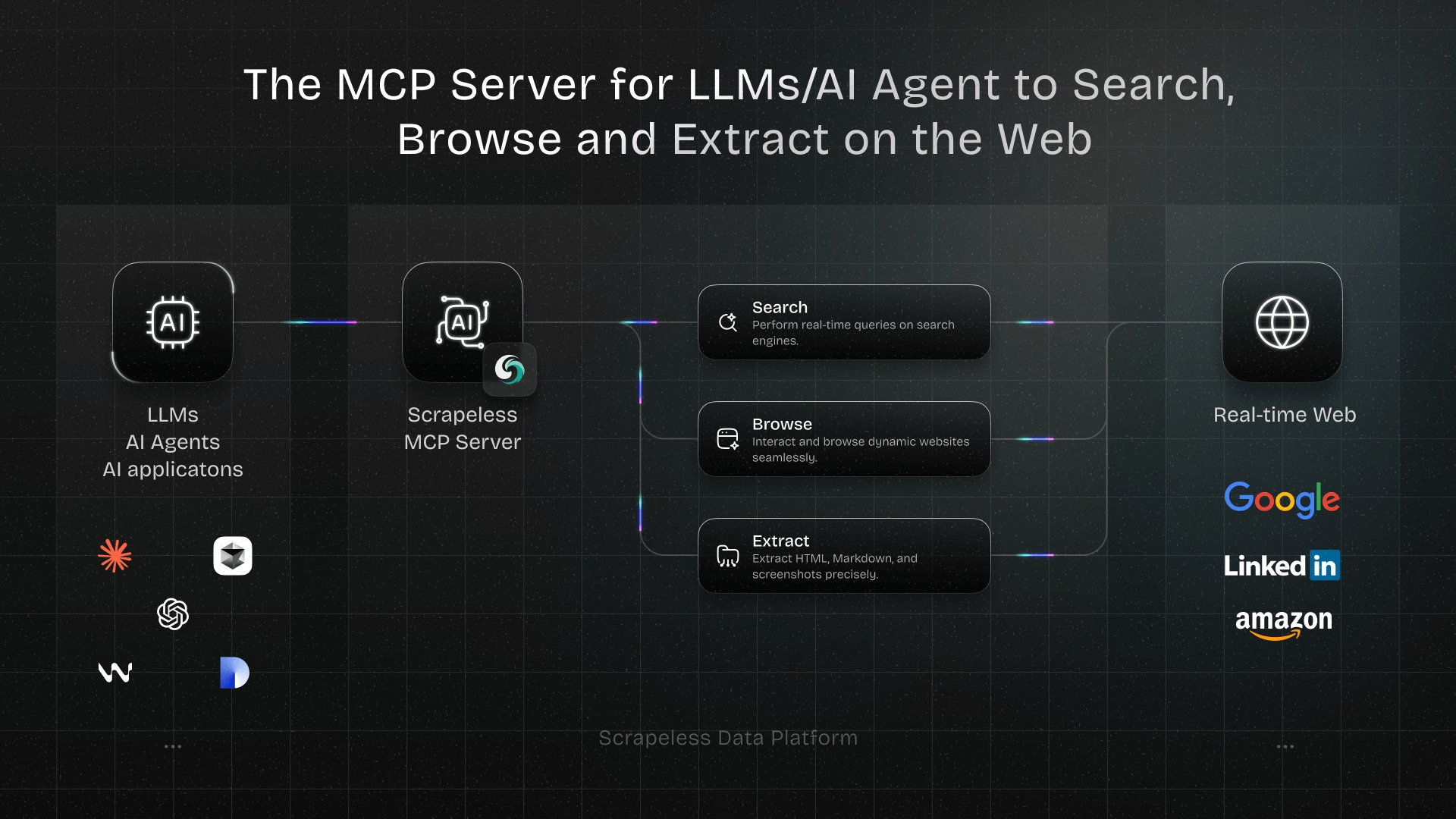
Two things separate it from the open-source entries below. The first is egress: sessions can leave through residential proxies drawn from a pool the product page puts at 90M+ real IPs across 195+ countries, selected per session with a single query parameter. The second is the typed tool surface — the Scrapeless MCP Server exposes the cloud browser to any MCP-aware client as 21 tools, 16 of them browser_* primitives such as browser_create, browser_goto, browser_wait_for, browser_click, browser_type, browser_snapshot, and browser_get_text.
Install. For agent use there is nothing to install ahead of time — npx -y scrapeless-mcp-server fetches and launches the server, so registering it is a single config block in your MCP client:
json
{
  "mcpServers": {
    "Scrapeless MCP Server": {
      "command": "npx",
      "args": ["-y", "scrapeless-mcp-server"],
      "env": {
        "SCRAPELESS_KEY": "YOUR_SCRAPELESS_KEY"
      }
    }
  }
}
Prompt your agent. Once the server is registered, the browser is driven in plain language. These are pasteable:
Open quotes.toscrape.com, wait for the .quote elements, and give me the first three quotes with their authors.Create a browser session pinned to Germany, go to the product page, take a snapshot, and tell me the price shown.Navigate to the search results, scroll to the bottom, and return the visible text of every result card.
Shape the prompt around the primitives: say which element to wait for rather than "wait for the page to load", and ask for a snapshot or the text of a named region rather than the whole document. That keeps the model's context small and the run cheap.
Worked example. For code, the connection is a CDP URL. This block was executed against the live service and its captured output follows:
python
import os
from playwright.sync_api import sync_playwright

key = os.environ["SCRAPELESS_API_KEY"]
endpoint = f"wss://browser.scrapeless.com/api/v2/browser?token={key}&sessionTTL=180&proxyCountry=ANY"

with sync_playwright() as p:
    browser = p.chromium.connect_over_cdp(endpoint)
    page = browser.contexts[0].pages[0]
    page.goto("https://quotes.toscrape.com/", wait_until="domcontentloaded")

    print("TITLE:", page.title())
    quotes = page.locator(".quote").all()
    print("QUOTE_COUNT:", len(quotes))
    for q in quotes[:3]:
        print("QUOTE:", q.locator(".text").inner_text()[:60], "|", q.locator(".author").inner_text())

    print("WEBDRIVER_FLAG:", page.evaluate("() => navigator.webdriver"))
    browser.close()
text
TITLE: Quotes to Scrape
QUOTE_COUNT: 10
QUOTE: “The world as we have created it is a process of our thinkin | Albert Einstein
QUOTE: “It is our choices, Harry, that show what we truly are, far  | J.K. Rowling
QUOTE: “There are only two ways to live your life. One is as though | Albert Einstein
WEBDRIVER_FLAG: False
That last line is the smoke test. A locally launched Playwright or Puppeteer browser reports navigator.webdriver as true, which is the cheapest automation signal a page can read. The cloud session reports False without any plugin in the script.
Key advantages:
- Anti-detection cloud browser with fingerprint handling, per-session proxy country selection, and challenge handling built in.
- MCP-native. Claude Desktop, Claude Code, Cursor, Codex CLI, Gemini CLI, Windsurf, and VS Code Copilot Chat all reach the same 21 tools through one
mcpServersentry, over stdio or streamable HTTP. - Published concurrency ceilings. The pricing page lists max concurrency per tier — 50 on the entry tier, rising to 400, then custom — alongside an hourly browser rate. Local frameworks make you discover that ceiling by exhausting RAM.
- Keeps your script. Any CDP client works. The example above is ordinary Playwright with
connect_over_cdpin place oflaunch.
Best for: agent-driven extraction, anti-bot-heavy targets, region-specific content, and parallel workloads that would saturate a single host.
Limitations: it is CDP-only. Selenium speaks W3C WebDriver over HTTP and is not a supported client — the documented libraries are Puppeteer and Playwright. Setting a viewport through the client API has no effect on the remote window, which is sized independently, so lay out extraction around selectors rather than screenshot coordinates. Authenticated and private account data is out of scope. A team testing one public marketing site against one engine does not need a cloud browser at all.
Full reference is at docs.scrapeless.com.
2. Playwright: Best Open-Source Cross-Browser Framework
Playwright 1.62.1, released 30 July 2026, is Microsoft's open-source automation framework and the strongest general-purpose choice on this list. It drives Chromium, Firefox, and WebKit through one API, with first-party bindings for JavaScript/TypeScript, Python, Java, and .NET.
Its 2026 releases pushed hard into agent tooling. Version 1.62 bundles the Playwright MCP server into the core package, runnable with npx playwright mcp, so an MCP client can drive a local browser through accessibility snapshots without a vision model. The framework also ships three test agents — planner, generator, and healer — installed with npx playwright init-agents.
Key advantages:
- Auto-waiting. Actions run a documented set of actionability checks before firing, which removes most fixed sleeps.
- True cross-engine parity. The same script runs on all three engines. Note the caveat in Playwright's own docs: it drives a build of WebKit, not branded Safari.
- Codegen and trace viewer. Record a session into a script; replay a failed run with a full timeline, DOM snapshots, and network log.
- Bundled MCP server and test agents as of 1.62.
Best for: cross-browser test suites, and extraction pipelines that want one API across engines.
Limitations: memory-bound when many contexts run on one host. And it ships no anti-detection: a maintainer's position is that stealth is out of scope for the project, and the string does not appear anywhere in the repository. Roundups claiming Playwright has built-in stealth helpers are wrong. Hardened targets need residential egress and fingerprint handling from another layer.
3. Puppeteer: Best for Chromium-First JavaScript Workflows
Puppeteer 25.5.0, released 4 August 2026, is the Chrome team's Node.js browser library. It talks to Chrome over CDP and gives the most direct access to the rendering pipeline of any tool here.
Two facts in this entry are commonly reported wrong. Puppeteer is no longer Chromium-only. Since v23 it downloads and drives stable Firefox, and WebDriver BiDi is enabled by default for Firefox while Chrome still defaults to CDP. Feature parity is not complete — unsupported capabilities raise UnsupportedOperation — but "Firefox support has lagged" is out of date.
Puppeteer v25 is ESM-only. The May 2026 major release moved the packages to ESM and raised the floor to Node 22. Any tutorial still showing const puppeteer = require('puppeteer') targets a version you cannot install. Use import and check your Node version first.
Key advantages:
- Direct DevTools Protocol access for low-overhead control and deep page introspection.
- Documented request interception with
setRequestInterception(),request.abort(),request.continue(), andrequest.respond(). - Headless by default. Current terminology is
headless: truefor full headless Chrome andheadless: 'shell'for the lighterchrome-headless-shellbinary. The oldheadless: 'new'value is gone. - Chrome for Testing integration — since v20 it pulls the pinned, version-locked Chrome for Testing builds instead of whatever Chrome the host happens to run.
Best for: Node teams targeting Chromium, PDF generation, and screenshot pipelines.
Limitations: Node.js only. Pyppeteer, the Python port, carries a README notice from its own author saying it is unmaintained and pointing at playwright-python instead. No anti-detection ships in the box.
4. Selenium: Best for Polyglot Teams and Grid-Scale Test Suites
Selenium 4.46.0, released 11 July 2026, remains the W3C-standard automation baseline. It drives Chrome, Edge, Firefox, Internet Explorer, and Safari, and Selenium Grid still routes commands to remote browser nodes for distributed execution.
Correct the language list you have probably seen elsewhere. Selenium maintains exactly five bindings: Java, Python, JavaScript, C#/.NET, and Ruby. Kotlin is not a sixth — Selenium's own install page says to use the Java bindings for Kotlin. PHP, Go, Perl, R, and Dart bindings exist, but Selenium's ecosystem page states plainly that they are not supported, maintained, or endorsed by the project. Roundups listing Kotlin and PHP as first-class Selenium languages are repeating an error.
If you are weighing this against Playwright specifically, the Playwright vs Selenium comparison goes deeper than a ranked list can.
Key advantages:
- Five officially maintained bindings, the broadest first-party coverage here.
- Selenium Grid, shipped as the Selenium Server, for parallel execution across nodes.
- Ecosystem depth. Every major CI platform, reporting tool, and BDD framework integrates with it.
- Standards footing. WebDriver is a W3C Recommendation, which is why Selenium suites survive browser generations.
Best for: polyglot organizations, long-lived regression suites, and teams already invested in Grid.
Limitations: the request/response protocol costs latency against CDP tools, and the API is more verbose than Playwright's. BiDi is arriving but is not settled — the 4.46.0 release notes mark the Java BiDi classes beta. Data extraction on defended targets needs packages Selenium does not maintain; see the next entry for the one that is actually current.
Get your API key on the free plan: app.scrapeless.com
5. Browser Use: Best for LLM-Driven Task Agents
Browser Use 0.13.7, released 27 July 2026, is the fastest-growing project in this category. At 108,076 GitHub stars it is now the most-starred repository on this list, ahead of both Puppeteer and Playwright, from a repo that did not exist before October 2024.
It is a different shape of tool. Instead of writing selectors, you describe a task and an LLM drives the page. The project describes itself as making websites accessible for AI agents. Since v0.12.3 it talks direct CDP rather than going through Playwright, which the project credits for roughly 50 ms command latency — and which also makes it Chrome-only by construction. Version 0.13.0 added an opt-in Rust-backed agent loop alongside the existing Python one.
Key advantages:
- Task-level interface. "Find the cheapest flight and fill the booking form" is the API.
- 15+ documented LLM providers, including local models through Ollama, so a paid model key is optional.
- MCP on both ends. It runs as a local MCP server and can also consume external MCP servers as agent tools.
Best for: exploratory agents, one-off multi-step tasks, and flows too variable to encode as selectors.
Limitations: Python 3.11+ and Chrome only; Firefox and Safari are not supported. The project's own model card lists the honest failure modes — cross-origin iframes and canvas-only interfaces reduce what the agent can observe, pages with thousands of interactive elements can exhaust CPU and time out DOM capture, and the page can change between the model's decision and the action. CAPTCHAs are not handled by the open-source package; the project routes that to its paid cloud, which starts at a free tier of 10 agent tasks per month and $29/month for the Dev plan. Deterministic, high-volume extraction is still cheaper and more predictable with selectors.
6. SeleniumBase: Best Python Framework for Scraping and Testing in One
SeleniumBase 4.51.10 shipped on 5 August 2026 — the most recently released project on this list. It wraps Selenium in a pytest-native framework and, unusually for an open-source entry here, treats data extraction as a first-class use case rather than a side effect of testing.
Its CDP Mode is the reason it earns a slot. Where Playwright and Puppeteer decline to address detection at all, SeleniumBase ships an explicit mode for Chromium-based work and documents it as such. It is a maintained alternative to the stalled add-ons the field still recommends.
Key advantages:
- One framework for crawling, scraping, and testing, which is how the project describes itself.
- CDP Mode as a maintained, in-tree capability rather than an unmaintained third-party plugin.
- Very active maintenance. Roughly 17 open issues against 12,900 stars is an unusually clean ratio for a project this size.
- pytest-native, so it drops into an existing Python test suite.
Best for: Python teams that want testing and extraction in one dependency, and anyone currently reaching for a dormant Selenium stealth add-on.
Limitations: Python only, and Chromium-based browsers for the CDP features. It inherits Selenium's WebDriver latency for the classic paths. It runs locally, so concurrency is still bounded by your host's memory.
7. Cypress: Best for In-Browser Frontend Testing
Cypress 15.20.0, released 4 August 2026, runs test code inside the browser in the same JavaScript context as the application. That architecture buys the best debugging experience in frontend testing: a live runner, time-travel through each command, and automatic screenshots on failure.
The "Chromium-family only" line you will read elsewhere is out of date. Cypress supports Chrome, Edge, Electron, and Firefox 135 and later at stable level, driving Firefox through WebDriver BiDi. WebKit support exists but is documented as experimental. One change to plan for: Cypress has announced that the bundled Electron browser is deprecated starting in 16.0.0, with Chrome for Testing as the recommended replacement.
Key advantages:
- Same-context execution, so assertions see exactly what the app sees.
- Time-travel debugging with a command-by-command timeline.
- Auto-waiting on commands and assertions.
- Network stubbing through
cy.intercept()for deterministic tests.
Best for: frontend teams testing single-page applications where the debugging loop matters more than engine breadth.
Limitations: JavaScript and TypeScript only, and the project states it will never support another language. Multiple tabs are still not natively controllable — the documented workaround is the @cypress/puppeteer plugin. Iframes are more nuanced than the field reports: same-origin iframes can be queried natively, but cross-origin frames cannot be automated, which follows from the same-origin rules in the HTML Living Standard. It is not built for data extraction.
8. chromedp: Best Go-Native Browser Automation
chromedp 0.16.0, released 14 July 2026, drives Chrome over CDP from Go with no external dependencies and no WebDriver intermediary. If your orchestration code is already Go, it removes a language boundary and lets goroutines map directly onto parallel page work.
One sourcing note worth passing on: chromedp's GitHub Releases tab stops at 0.15.1, because no GitHub release was cut for 0.16.0. Read the version from pkg.go.dev or the Go module proxy instead.
Key advantages:
- Native Go, embedded straight into a service or CLI binary.
- Documented emulation and screenshot actions —
Emulate,EmulateViewport,CaptureScreenshot,FullScreenshot, and element-levelScreenshot. - Low overhead in production Linux environments.
Best for: Go services embedding browser work, and high-throughput pipelines already written in Go.
Limitations: Chrome and Chromium only; no Firefox or WebKit. No built-in stealth. Request interception is not a first-class chromedp helper — you wire it through the sibling cdproto/fetch package and ListenTarget, which is more assembly than the Puppeteer equivalent. 2026's releases have been maintenance work: protocol regeneration and Go modernization passes, not new features. The community is smaller than the JavaScript ecosystem's.
Side-by-Side Comparison
| Tool | Protocol | Engines | Languages | Concurrency model | Anti-detection |
|---|---|---|---|---|---|
| Scrapeless Scraping Browser | CDP | Self-developed Chromium | Any CDP client; MCP for agents | Cloud, 50–400+ per tier | Built in |
| Playwright | CDP + BiDi | Chromium, Firefox, WebKit | JS/TS, Python, Java, .NET | Local, memory-bound | None, by design |
| Puppeteer | CDP (Chrome), BiDi (Firefox) | Chrome, Firefox | Node.js | Local, memory-bound | None |
| Selenium | W3C WebDriver, BiDi in beta | Chrome, Edge, Firefox, IE, Safari | Java, Python, JS, C#, Ruby | Local + Grid | None |
| Browser Use | CDP | Chrome only | Python 3.11+ | Local; cloud tiers 3–500 sessions | Cloud tier only |
| SeleniumBase | WebDriver + CDP Mode | Chromium-based | Python | Local, memory-bound | CDP Mode |
| Cypress | In-browser + BiDi for Firefox | Chrome, Edge, Firefox 135+, Electron; WebKit experimental | JS/TS | Local, single context | None |
| chromedp | CDP | Chrome, Chromium | Go | Local, goroutine-parallel | None |
Tools That Fell Off the 2026 List
Three projects still appear as live recommendations in competing roundups. Their own release surfaces say otherwise, and shipping them into a new pipeline means adopting unpatched dependencies.
Splash was the standard answer for adding JavaScript rendering to Scrapy. Its last tagged release is 3.5.0 from June 2020, its last commit to the default branch is from May 2022, and its latest Docker image was last pushed in August 2020 — a QtWebKit-based image now carrying six years of unpatched engine changes. There is no formal end-of-life notice, which is part of the problem: nothing on the repository warns you. The clearest signal comes from Scrapy itself, whose documentation recommended Splash through version 2.12 and dropped it entirely from 2.13 onward. Scrapy now recommends scrapy-playwright. Zyte, which inherited the project, no longer lists Splash on its open-source page and points visitors to its commercial API instead. Note the split: the scrapy-splash client library did get a release in February 2025, but the server it connects to has been frozen since 2020.
Selenium Wire is the clearest case. The repository is archived, and its README opens with a maintenance notice from the author stating the project is no longer maintained. The last commit's entire purpose was to add that notice. The last PyPI release, 5.1.0, is from October 2022 and declares support only through Python 3.10.
undetected-chromedriver is not archived and carries no deprecation notice, so the case against it rests on dates rather than banners. There has been no PyPI release since 3.5.5 in February 2024, no commit since July 2025, and over 1,100 issues are open. Against a browser that now ships every two weeks, a driver shim frozen for that long is a maintenance liability. SeleniumBase's CDP Mode is the maintained option in the same niche.
How to Choose a Browser Automation Tool
Start with the job, not the ranking.
You are writing tests. Take Playwright if you need more than one engine or a language other than JavaScript. Take Cypress if your team is frontend-only, ships a single-page app, and values the debugging loop above engine breadth. Take Selenium if your organization is polyglot or already runs Grid.
You are extracting data from cooperative pages. Any of the frameworks works. Pick the one matching your stack: Playwright or Puppeteer for Node, SeleniumBase for Python, chromedp for Go.
You are extracting data from defended pages. No open-source framework solves this on its own, and a local browser leaks a residential-versus-datacenter IP signal that no amount of client-side patching hides. Either adopt a framework that treats detection as in-scope, such as SeleniumBase's CDP Mode, or move the session to a managed cloud browser with residential egress. Combining both is common: keep the Playwright script, change where it connects.
You are building an AI agent. The split is between exploration and repetition. If the task is exploratory and varies run to run, Browser Use lets a model reason over the page. If the task is repeatable and you want deterministic tool calls with cost control, an MCP browser surface is the better fit — either Playwright's bundled MCP server for local work, or the Scrapeless MCP server when the target defends itself.
You need scale. Decide whether your ceiling is memory or budget. Local frameworks are bounded by host RAM, and each Chromium context is expensive. Selenium Grid distributes that cost across machines you operate. A cloud browser moves it off your infrastructure entirely, with a published per-tier session ceiling instead of a number you find by crashing.
Common Use Cases
- Regression suites across engines. Playwright or Selenium, run in CI on every merge.
- Price and catalog monitoring. A CDP client against a cloud browser, pinned per region so you read the prices a local shopper sees.
- Rendering for a crawler. A headless browser in front of the parsing stage, for the subset of URLs that need JavaScript.
- Document and screenshot generation. Puppeteer or chromedp, which both expose the rendering pipeline directly.
- Agent-driven research. An MCP browser surface attached to a coding agent, so a natural-language request turns into navigate, wait, snapshot, and extract calls.
- Authenticated internal workflows. Local frameworks on infrastructure you control, with credentials that never leave it.
Why Browser Automation Is Harder in 2026
Three pressures have compounded.
Detection moved earlier in the session. A default automation session announces itself before a single selector runs — navigator.webdriver is set, the fingerprint is inconsistent, and the egress IP belongs to a cloud provider. Patching one signal at a time in client code is a losing position, because the checks are cheap to add and each new one invalidates a plugin release.
The second pressure is release cadence. Chrome moved to two-week releases in 2026, and the tooling around it did not speed up to match. Every driver shim, patch set, and fingerprint table now has a two-week half-life, which is exactly why the dormant projects in the section above stopped being safe.
The agent layer changed the requirements. A tool now has to be callable by a model as well as by a script, which means typed schemas, snapshot-shaped observations rather than raw HTML, and bounded output. Playwright, Cypress, Browser Use, and Scrapeless all shipped MCP surfaces within a year of the specification settling. Anything without one needs a wrapper before an agent can touch it.
Conclusion
The open-source frameworks are in good shape, and most teams should pick one of them. Playwright is the default for cross-browser work, Puppeteer for Chromium-first Node pipelines, Selenium for polyglot organizations, SeleniumBase for Python teams who want testing and extraction together, Cypress for frontend debugging, chromedp for Go services, and Browser Use when the task is better described than coded.
What none of them ships is a production anti-detection posture — Playwright says so explicitly, and the others simply document none. That is the gap Scrapeless Scraping Browser fills, with residential egress across 195+ countries, fingerprint handling, published per-tier concurrency, and 21 MCP tools an agent can call directly. Because it is reached over CDP, adopting it is a one-line change to a script you already have: swap launch for connect_over_cdp and point at the endpoint.
One habit is worth more than the ranking itself. Every tool above shipped a release in the last month, and three tools the field still recommends have not shipped in years. Before adopting anything from a list like this one, open its release page and read the date yourself.
Ready to Build Your Browser Automation Pipeline?
Join our community to claim a free plan and compare notes with other developers building browser automation: Discord · Telegram.
Sign up at app.scrapeless.com to pair the Scraping Browser with the framework you already use, and see the current rates on the pricing page.
FAQ
Q: Which browser automation tool is best for AI agents in 2026?
It depends on whether the task is repeatable. For deterministic tool calls, an MCP browser surface is the better fit — Scrapeless Scraping Browser exposes 21 typed MCP tools, 16 of them browser_* primitives, and Playwright bundles an MCP server in core as of 1.62. For exploratory tasks where a model should reason over the page, Browser Use is purpose-built for that shape and is now the most-starred project in the category.
Q: Playwright vs Puppeteer vs Selenium — which should a new project pick?
Playwright for greenfield work needing cross-browser coverage or a language other than JavaScript. Puppeteer for Chromium-first Node pipelines, PDF generation, and screenshotting, keeping in mind that v25 is ESM-only and requires Node 22. Selenium when you need Java, C#, or Ruby, when you already run Grid, or when W3C-standard stability matters more than latency.
Q: Do these tools handle anti-bot challenges out of the box?
The open-source frameworks do not, and the strongest statement comes from Playwright's own maintainers, who put stealth out of scope. SeleniumBase is the exception that treats it as in-scope through CDP Mode. Beyond client-side signals, a locally launched browser still egresses from your own IP, which a managed cloud browser with residential proxies addresses and a plugin cannot.
Q: Can I keep my existing Playwright or Puppeteer code with a cloud browser?
Yes, if the cloud browser speaks CDP. Scrapeless Scraping Browser does: replace chromium.launch() with chromium.connect_over_cdp(endpoint) in Playwright, or pass browserWSEndpoint to puppeteer.connect(), and the rest of the script is unchanged. Selenium is the exception — it speaks W3C WebDriver over HTTP, so it is not a supported client for that endpoint.
Q: Is browser automation legal for web scraping?
Automating a browser against publicly visible content is generally permitted, but the rules vary by jurisdiction and by each site's terms of service. Read the terms of any target, keep request volume bounded, avoid personal and authenticated data, and take legal advice before running a commercially sensitive project at scale.
Q: Which tool scales best for high-concurrency work?
Cloud-hosted browsers, because the constraint moves from your RAM to your plan. Local Chromium contexts are memory-bound, so parallelism on one host runs out well before the workload does. Selenium Grid is the open-source answer, distributing sessions across machines you operate and maintain. Scrapeless publishes its ceiling per tier — 50 concurrent sessions on the entry tier, up to 400 and then custom — so the limit is a number you plan against rather than one you discover.
At Scrapeless, we only access publicly available data while strictly complying with applicable laws, regulations, and website privacy policies. The content in this blog is for demonstration purposes only and does not involve any illegal or infringing activities. We make no guarantees and disclaim all liability for the use of information from this blog or third-party links. Before engaging in any scraping activities, consult your legal advisor and review the target website's terms of service or obtain the necessary permissions.