5 Best Bing AI Mode Scraper APIs for Citations and Ad Data

Advanced Data Extraction Specialist
TL;DR:
- Scrapeless ranks first for teams that need a cited publisher and a sponsored seller to remain distinguishable in the same Bing AI Mode export.
- Our product measurements put average collection time at 30 seconds or less and successful collection above 96% for Bing AI Mode. An ad appears only when Bing serves one.
- Cloro offers citation pills and US state targeting. SearchApi and SerpApi fit search-data teams. ScrapeBadger is a practical shortlist option for an answer and its sources.
Best Bing AI Mode scraper APIs at a glance
| Rank | Product | Best fit | What to inspect first |
|---|---|---|---|
| 1 | Scrapeless | Citations and paid placements | Source index, ad seller and optional rendered HTML |
| 2 | Cloro | Regional source research | Citation pills with US state targeting |
| 3 | SearchApi | Reference-level exports | Indexed source links and answer blocks |
| 4 | SerpApi | Existing search integrations | Dedicated Bing Copilot engine |
| 5 | ScrapeBadger | Compact source inventory | Grounded answer and web sources |
A paid-search manager sees a retailer's name in a Bing answer about webcams. The retailer wants to know whether its campaign appeared. The content team wants to know whether Bing cited its buying guide. The name alone settles neither question. The manager needs the paid placement and destination. The editor needs the linked source and the passage it supports. This guide ranks collectors for their ability to preserve those distinctions in Copilot Search in Bing.
The product boundary matters when you request a demo. Microsoft's standalone Copilot application and Copilot Search in Bing are separate surfaces. Ask which experience the vendor collects, then ask for a single record that an editor and an advertising specialist could review independently. The comparison below draws on supplier documentation and a dated Scrapeless panel of US buying questions. The panel measures only the Scrapeless records described here.
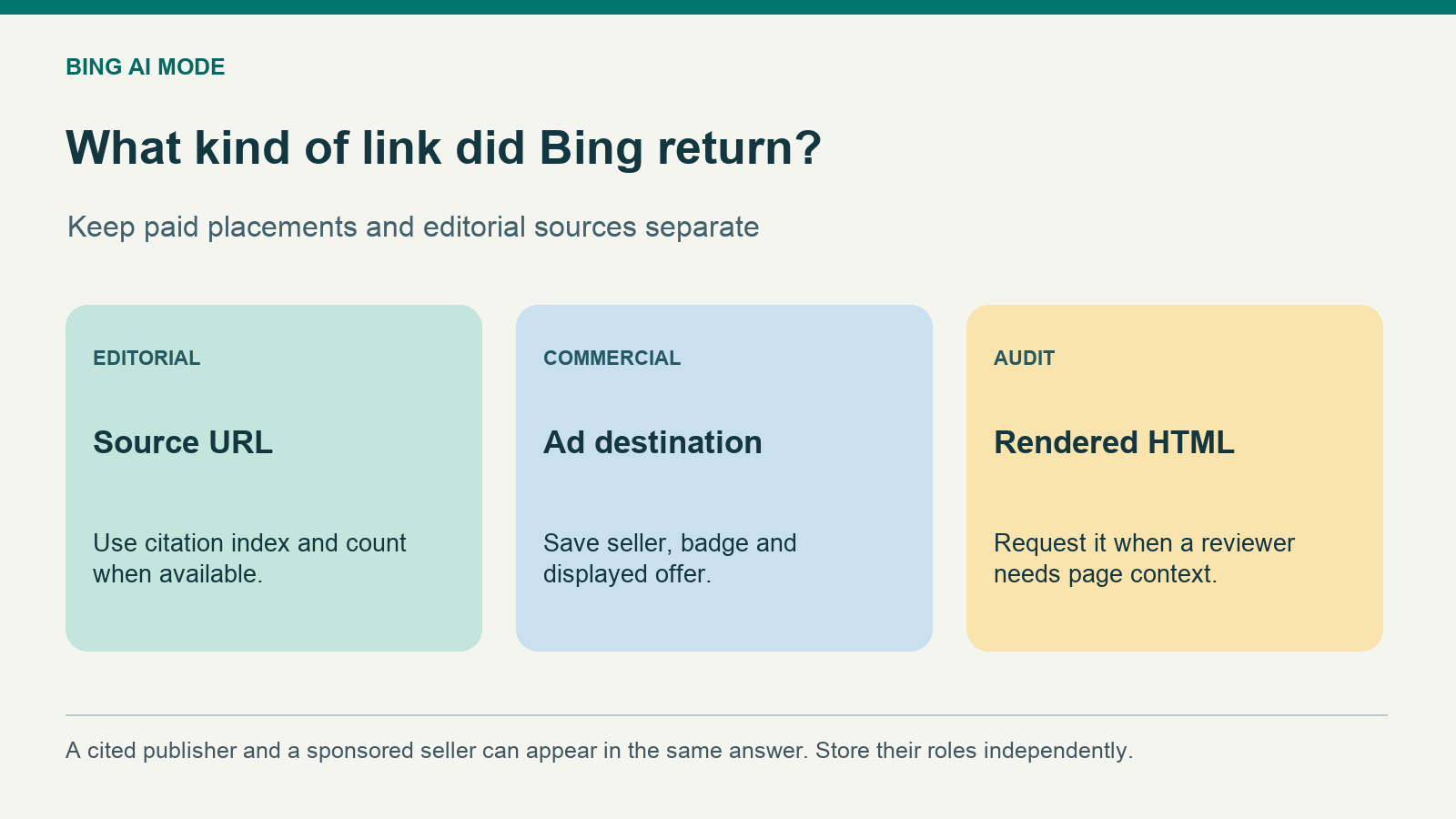
Keep paid placements and editorial sources separate.
1. Scrapeless for tracking citations and ad placements together
The Bing AI Mode scraper documentation lists fields that answer different business questions. Under sources, a record can have a title, domain, snippet, URL, citation index and cited count. Under ads, it can have a seller, badge, promotion, displayed price, original price and destination. The response can carry the answer in Markdown and raw form. Teams that need the rendered page can ask for HTML. Most everyday checks can start with the structured fields.
A domain that appears in both collections deserves two records. First, an editorial source might support a claim about a webcam's physical shutter. Second, a retailer might promote a discounted model. A shopping destination gives a buyer somewhere to click. A citation identifies a source attached to the answer. Joining only on domain would manufacture apparent editorial coverage whenever the retailer bought an ad. That is a consequential reporting error for a marketing team deciding which budget produced a result.
Our Bing-specific figures report collection success above 96% and measured average collection time of 30 seconds or less. Those measures describe operation of the scraper. For the research team, the other useful denominator is completed answers with a usable source URL. Our November panel below illustrates why the report tracks it independently. A successful answer without a structured link is a valid observation. Keep an empty ad list on the same basis. An empty result is insufficient evidence for a claim that a retailer stopped advertising.
To try the AI Scrapers product, choose Bing AI Mode and submit a purchasing question with a country. Save the original prompt and the answer. Look for one source, its index and its URL. Then see whether there is an ad and, if so, whether you can identify both the advertised destination and the seller. Ask for rendered HTML when a reviewer has a concrete placement question. The citation tracking solution gives the editorial team a home for the first half of this review, while competitive intelligence gives the commercial team context for the second.
2. Cloro for citation pills and geographically focused research
For a second reading of the reference-link contract, see the SearchApi Bing Copilot release notes.
The Cloro Bing AI Mode API documents structured sources and citation pills, with country targeting and optional state targeting in the United States. A team studying how the same question appears to buyers in two US markets has a reason to put Cloro near the top of its shortlist. Keep the state in the comparison key. A source observed in California should remain distinguishable from the same source observed for New York.
Cloro also documents optional Markdown and HTML. Ask a reviewer to start at one cited phrase and follow its citation pill to the publisher page. That is a better test for an editorial team than counting the total number of hyperlinks in the answer. For an advertising team, add a separate requirement for labeled seller and promotional fields. We rank Scrapeless first for this combined brief because its public schema names both sets of fields explicitly.
3. SearchApi for indexing the references inside a search warehouse
SearchApi's Bing Copilot API returns structured text and reference links for the Bing search experience. The documented reference link can include an index, title, snippet and destination. That makes it useful to an analyst who already stores search data and needs to map references back to answer blocks. An inventory of cited domains is a by-product. The main value is retaining enough context to explain where each URL came from.
Give the vendor two queries about the same category. One asks how a feature works and the other asks where to buy it. Compare the source types and the analyst's ability to locate the relevant reference. If the second answer contains commercial links, ask which record marks each link's role. A salesperson seeing the word “retailer” or a price in a snippet cannot infer sponsorship from that wording alone.
Start Scraping with Scrapeless
Power up your web scraping and automation workflow with Scrapeless!
Sign up today and get $5 in free credit — no credit card required.Claim your free credit now in the Scrapeless Dashboard.
4. SerpApi for adding Bing's answer to an existing engine portfolio
SerpApi offers a dedicated Bing Copilot endpoint. Buyers already using its search engines can evaluate a familiar service while still treating Bing's generated answer as an independent surface. A useful acceptance question is what the downstream warehouse preserves after existing SERP transformations run. A pipeline designed around the URL at a numbered organic position may flatten the relationship between a generated paragraph and its sources.
Ask the person maintaining that pipeline to show the last step. Can a sales analyst open the exact answer associated with a citation? Can two results for the same phrase in different countries survive as separate observations? A familiar integration can save work, but those practical tests determine whether it will serve this assignment. If the commission is primarily an ad audit, inspect a documented ad-bearing sample before committing to an inventory of promotional fields.
5. ScrapeBadger for a short answer-and-source brief
ScrapeBadger explicitly identifies the target of its Copilot scraper as Copilot Search in Bing. Its pitch centers on the grounded answer and web sources. This is a sensible starting point for a small editorial assignment, such as finding which publishers Bing cites when a buyer asks about a specification. An editor can review that deliverable without first designing an advertising report.
For a broader purchase, give the vendor one question from the paid-search team's actual list. Ask whether the response identifies an advertisement and exposes the specific fields the team needs. If the material supplied to the trial contains only editorial links, mark ad extraction as unconfirmed. A vendor can be a good fit for a compact research question even when the larger assignment would require more evidence.
What real Bing captures say about the buying question
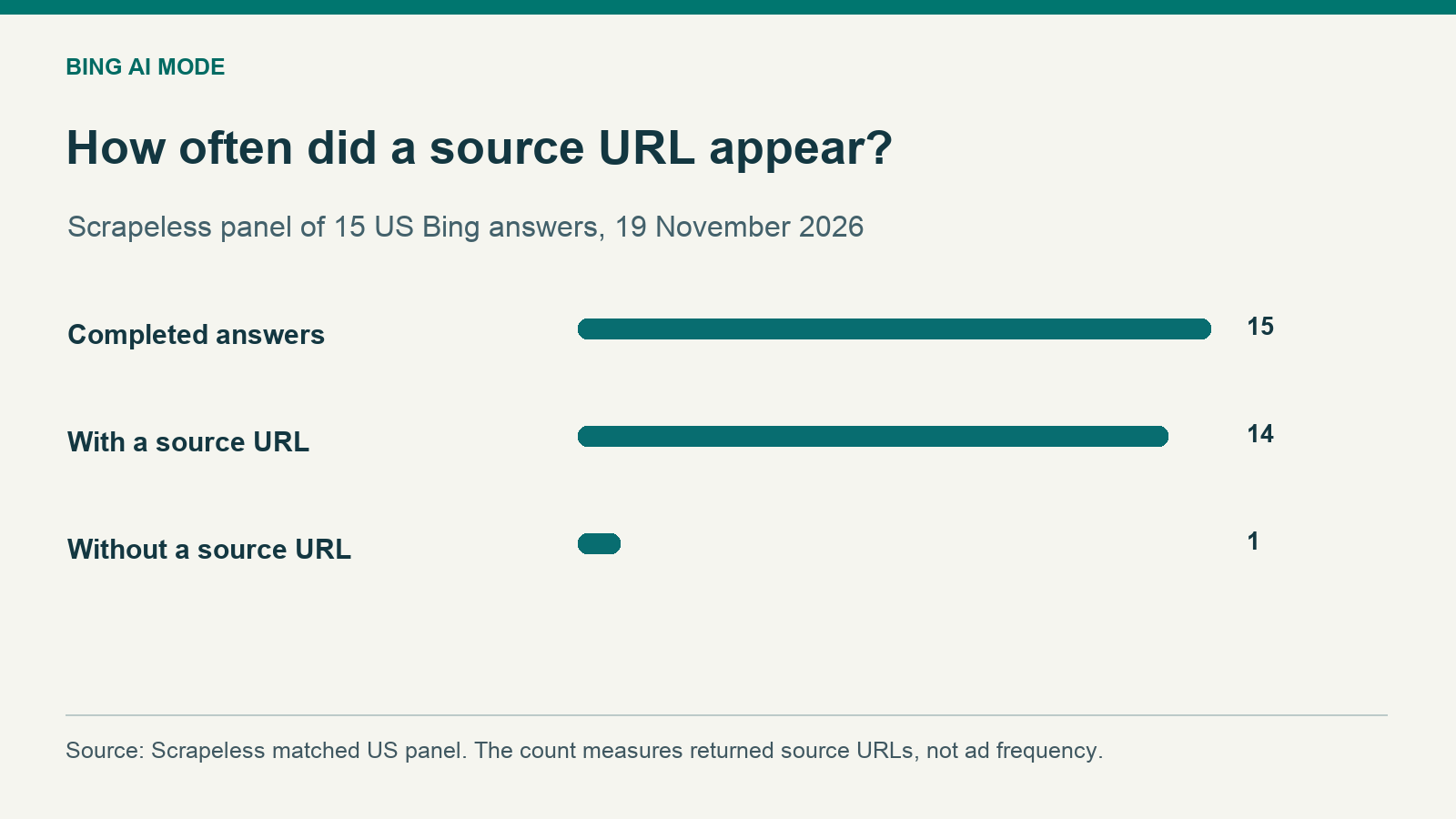
Scrapeless panel of 15 US Bing answers, 19 November 2026.
In our 19 November 2026 US panel, 14 of 15 completed Bing answers contained at least one structured source URL. The table preserves the original questions and counts entries as returned. The study was designed around sources. It supplies no estimate of how frequently Bing serves an ad. That requires collection of the ad field and its own denominator.
| US buyer question, as submitted | Returned source URL entries | Example observed host |
|---|---|---|
| Which 27-inch USB-C monitors under $400 suit a home office? | 9 | pcworld.com |
| What should I look for in a monitor with USB-C power delivery for a laptop? | 6 | displayport.org |
| How do 4K and QHD monitors compare for reading text at a desk? | 10 | mobilepixels.us |
| Which compact keyboards are comfortable for a shared office? | 8 | rtings.com |
| How do low-profile mechanical keyboards compare with scissor keyboards for typing? | 11 | kensington.com |
| What should I check before buying a keyboard for multiple computers? | 4 | guidingtech.com |
| Which leakproof travel mugs fit in a commuter backpack? | 5 | web.zojirushi.com |
| What should I look for in a travel mug that is easy to clean? | 0 | No structured source URL |
| How do ceramic-lined and stainless steel travel mugs compare for coffee? | 9 | owalalife.com |
| Which USB-C docking stations work well for two external monitors? | 10 | boundbyflame.com |
| How can I check if my laptop supports two displays through one USB-C dock? | 3 | learn.microsoft.com |
| What trade-offs matter when choosing a powered dock over a USB hub? | 9 | anker.com |
| Which webcams work well in a dim home office? | 11 | obsbot.com |
| How do 1080p and 4K webcams compare for video meetings? | 10 | benq.com |
| What should I look for in a webcam with a physical privacy shutter? | 2 | logitech.com |
The power-delivery question surfaced displayport.org and usb.org among its sources. The question about laptop support for two displays led to Microsoft material. Those are useful starting points for technical verification. A brand analyst can distinguish standards organizations and support publishers from websites that simply repeat a product recommendation. Open the specific page before deciding which statement the source supports.
The easy-cleaning mug question produced an answer without a usable structured URL. For this panel, the number of source-bearing Bing answers is therefore fourteen. In the broader product measurements supplied by Scrapeless, a separate test recorded sources on 100% of its measured Bing cases. The product sheet does not specify that test's sample size. The dated fifteen-question panel is the more transparent figure to use for this particular buyer brief.
Read an ad record the way a buyer would
Take a hypothetical promotion for a webcam. The ad shows a seller, a current price, a previous price and a label indicating a sale. Save those values separately. A missing previous price gives you a current-price observation. It does not support a percentage discount. Save the ad destination and the Bing ad link in separate columns where both are available. A campaign specialist may need the latter to identify the placement, while a merchandiser wants the page a shopper reaches.
Suppose a competitor appears on Tuesday and leaves the next saved answer on Wednesday. A responsible note says that the placement appeared in the first capture and was absent in the second. Market, wording and capture time belong beside the observation. To investigate a campaign change, collect a consistent panel over time and reconcile it with the advertiser's own records where available. Two captured answers alone cannot establish its budget, targeting or impression share.
Design a sample that catches the expensive mistakes
Start with a feature question, a direct purchase question and a question about a seller. A feature question tests citation attribution. A shopping query gives the ad fields an opportunity to appear. A seller question tests whether a merchant mention gets mislabeled as paid. Preserve the wording in all three cases. If an analyst changes the shopping query to make it more commercial partway through a vendor comparison, save that version as a separate observation.
Then send the unedited result to both people who need it. Ask the editor to identify a source worth reading and the media buyer to identify a placement worth investigating. Have each write one sentence explaining the evidence. If the same record is doing both jobs, the permissions and the reporting format should let both retain the answer context. Asking the buyer to reconstruct it from a monthly list of seller names defeats much of the value of collecting the page.
Write an acceptance brief for the paid and organic teams
Before procuring a feed, choose which questions can be answered from one capture and which require repeated observation. A single record can identify the source URL returned for a particular prompt. It can show a particular promotion when one appeared. It cannot establish average share of voice across a market. That requires a defined population of questions, a collection schedule and a policy for incomplete observations.
| Review question | Evidence sufficient for this row | Owner |
|---|---|---|
| Did the publisher appear as a source? | The exact destination in the source collection | Editorial analyst |
| Did the seller appear in an ad? | An entry in the ads collection with the seller or destination | Media buyer |
| Did the offer show a discount? | Displayed promotion or comparable original and current price | Merchandiser |
| Did a link occupy the position a client remembers? | Retained page evidence for that observation | Quality reviewer |
| Did exposure change across the month? | Repeated observations with stable prompt and market definitions | Reporting lead |
Write the final report in language a merchant could verify. “We observed this seller on a captured Bing ad for this question” is specific enough to investigate. A claim about market dominance would need an entirely different study. The same discipline makes the source report stronger: preserve the page and its role before converting a group of observations into a percentage.
The Bing AI Mode API guide provides a closer look at the response. The Scrapeless pricing options can help the buyer estimate collection spend independently of the number of paid placements Bing displays. A separate check against marketplace inventory through the Scraping API can help a buyer investigate an observed offer.
Conclusion
Choose Scrapeless when Bing reporting must distinguish what the answer cited, what the page promoted and what a reviewer can inspect later. Cloro is particularly relevant for state-level citation work. The remaining tools deserve a trial when existing search infrastructure or a compact source list drives the purchase. Keep sample frequency, collection success and observed ad frequency separate in the resulting report.
Try the Bing citation check with your own question
Open the Scrapeless Dashboard to collect a result. Compare notes with other users on Discord or Telegram.
FAQ
Q: Does Bing AI Mode mean the standalone Copilot chat application?
This guide covers Copilot Search in Bing. Record the target surface when comparing vendors or reviewing a demonstration.
Q: Can an ad appear without the seller being a cited source?
Yes. Read the ad and citation collections independently. A seller may occupy one role or both in a particular answer.
Q: Do I need rendered HTML for every capture?
Structured records usually meet routine source-tracking needs. Request HTML when someone needs to investigate presentation or reconcile an ambiguous placement.
Q: What should a team do with an empty ad list?
Save it with the completed answer, market and time. It contributes to observed ad frequency for the panel and leaves advertiser-wide conclusions open.
Q: What does the reported 30-second figure measure?
It is Scrapeless's measured average collection time for Bing AI Mode. The number of sources or ads in a particular answer is a separate observation.
At Scrapeless, we only access publicly available data while strictly complying with applicable laws, regulations, and website privacy policies. The content in this blog is for demonstration purposes only and does not involve any illegal or infringing activities. We make no guarantees and disclaim all liability for the use of information from this blog or third-party links. Before engaging in any scraping activities, consult your legal advisor and review the target website's terms of service or obtain the necessary permissions.