5 Best Amazon Alexa Answer Scrapers for Shopping Research

Scraping and Proxy Management Expert
TL;DR:
- Scrapeless is our first choice for shopping research that starts with a buyer’s question. Its Alexa actor returns the completed answer, available references, product identifiers and suggested next questions in one response.
- Our Alexa captures average 30 seconds or less in internal measurements. Our platform’s at least 99% product-field extraction completeness applies to agreed fields present in shopping data. A particular answer may contain no product cards.
- Pangolinfo and ScrapeBadger are worth testing when the question must start on one specific product page. Digital FRKS is useful for a small, seller-operated review. Azoma fits teams buying managed visibility reporting.
Best Amazon Alexa answer scrapers at a glance
| Rank | Product | Strongest fit | Evidence to inspect |
|---|---|---|---|
| 1 | Scrapeless Amazon Alexa | Trace a discovery question to a recommended item and cited source | Completed answer, product ID, citation ID, source URL, suggested prompts |
| 2 | Pangolinfo Amazon Alexa API | Product-page context and follow-up research | Recommended ASINs and the question attached to the next turn |
| 3 | ScrapeBadger Amazon Rufus API | Comparing category and ASIN-specific questions | Ordered product cards and supplied input ASIN |
| 4 | Digital FRKS Q&A Extractor | Seller-operated audits inside Amazon | Actual product-page questions and exported answers |
| 5 | Azoma | Managed reporting across a catalog | Recommendation rank, citations and underlying question coverage |
A shopper asks whether a lunch container’s divider comes out for cleaning. Alexa describes the large model; the product card leads to the small one. A merchant who records just the brand name will count a recommendation and miss the problem most likely to generate a return. Shopping research needs the answer, the actual variant and the evidence a shopper can open.
Amazon renamed Rufus to Alexa for Shopping. Both names still appear on vendor pages. We considered products that collect or track the shopping assistant’s answers. The five options below deliver different levels of detail, ranging from raw records to a managed report. A conventional Amazon listing feed can help verify the price or seller on a product page, but cannot establish which product Alexa recommended. Amazon’s shopping assistant announcement
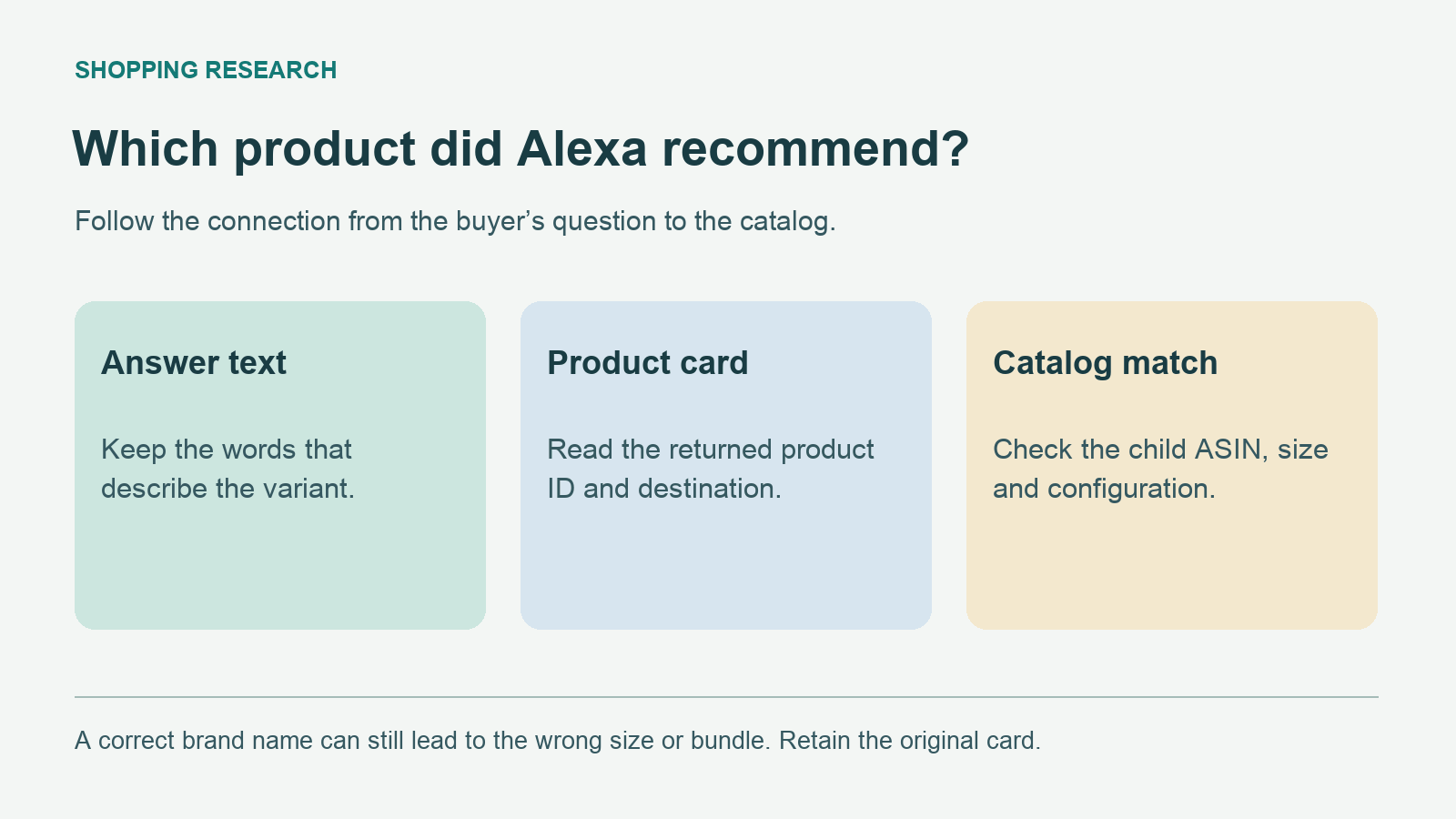
Follow the connection from the buyer’s question to the catalog.
1. Scrapeless for connecting an answer to the exact item
The Amazon Alexa actor in Scrapeless AI Scrapers accepts the shopper’s prompt and country. Read the completed flag, retain the Markdown or plain-text answer, and then inspect the product collection. When a card is present, its product_id can identify an Amazon ASIN. The citation_id, when available, gives the reviewer a way to relate the product to the reference in the answer. Saving those fields together makes it much easier to investigate an incorrect recommendation a week later.
The Alexa field documentation also distinguishes references, source links and suggestions. A suggested question gives the merchandising team a lead on what to investigate next. It does not show that anyone asked that question or that Alexa endorsed the premise. Similarly, a reference URL can point to a review instead of a seller. A useful export retains both roles even when the brand wants a single number for a monthly report.
Our measured average Alexa collection time is 30 seconds or less. For agreed product attributes present in shopping data, Scrapeless measures at least 99% extraction completeness across its shopping-data tests. The measure includes fields such as product name, price, currency, merchant and link where supplied. It describes capture quality within that scope. It cannot tell a seller how often Alexa will recommend their SKU or whether a displayed price will still be available tomorrow. We bill successful requests, including complete answers that do not recommend the seller.
Try one prompt that names the exact model and another that names only the category. Ask the category question in the US market and retain its wording before running the named-model question. The first measures whether shoppers can discover the product without supplying its name. The second tests what Alexa says once a shopper already knows it. The prompt-and-country actor documents no required input ASIN. If the brief requires the answer from an open product-detail page, record that requirement and test a page-context tool separately.
This is why we rank Scrapeless first for prompt-led research. A catalog owner can reopen the answer, compare returned product IDs against the catalog and send the linked evidence to the person responsible for the variant. A competitive-intelligence report can reuse that capture even when the recommended item belongs to a rival. A zero on the seller’s visibility score can still lead to a valuable, specific catalog decision.
2. Pangolinfo for following a question on a specific product page
Pangolinfo’s Amazon Alexa API documents contextual product-page questions, recommended ASINs and follow-up turns. That combination suits the part of a shopping journey where a buyer has already selected an item. A question such as “Does it fit in the top rack?” makes sense if the service knows which container the shopper is viewing. Archive the input identifier alongside any identifiers that appear in the answer: the referenced product and the product Alexa offers as an alternative can differ.
A practical acceptance test uses two near-identical models with different care instructions. Ask the same question from each product context. Hand the results to customer support and let them identify the model each answer describes. If a follow-up asks whether the lid can also go in the dishwasher, retain the previous turn with it. The follow-up draws its meaning from the first answer and should not be counted as an independent brand discovery.
We prefer Scrapeless when the research starts from an unbranded question and the team needs references and product identifiers together. A merchant specifically investigating what shoppers see after landing on one ASIN has a clear reason to test Pangolinfo’s product-page context. A single ranking for all Amazon tasks would conceal that difference.
3. ScrapeBadger for comparing product-page and category answers
The ScrapeBadger Rufus endpoint accepts an optional ASIN. It documents the completed shopping answer, ordered product cards and a thread identifier. That makes the distinction between a category question and a question about an open product explicit. A retailer could ask a general question about small kitchen appliances and then inspect an accessory question on a particular appliance page.
Product order is worth retaining. A recommendation appearing third can still be commercially meaningful, especially if Alexa singles it out as the quieter option. Conversely, the first product card might be a sibling size while the prose recommends a different one. Ask the reviewer to preserve the original order, then identify which card supports each statement that will appear in the report. Avoid sorting the raw result by price before doing that work.
For our research brief, Scrapeless has the advantage of a documented relationship between returned product and citation fields, plus independently structured source links. ScrapeBadger is a good alternative when the seller needs explicit ASIN context and an ordered list from that particular shopper interaction. Compare a real export for the precise question: an attractive product card cannot establish which reference supported a care instruction.
When estimating the cost of a category review, apply Scrapeless pricing to the completed shopping questions. Keep the number of products mentioned as a separate measure of coverage.
Start Scraping with Scrapeless
Power up your web scraping and automation workflow with Scrapeless!
Sign up today and get $5 in free credit — no credit card required.Claim your free credit now in the Scrapeless Dashboard.
4. Digital FRKS for a catalog owner working in the browser
The Digital FRKS Alexa Q&A extension asks questions on Amazon product pages, saves the responses and supports exports. It can use suggested questions and custom ones. For a merchant responsible for a small group of SKUs, working in the browser can be convenient: the owner can see the page context and review an answer before moving to the sibling model.
Use the same custom question across the products being compared, and save suggested questions separately. Otherwise, a product with more suggested questions receives more opportunities to be mentioned. An apparent advantage could come entirely from uneven coverage. Export the responses while the context is still familiar and record marketplace and delivery setting. Those details help another employee understand what the first operator saw.
This is a browser-assisted option. A team that needs scheduled, prompt-led collection with structured source fields has a stronger case for the Scrapeless actor. A catalog manager who can resolve one urgent customer objection in the same sitting may reasonably prefer a browser workflow. Compare the time to a reviewed answer, including the person who will actually open the result.
5. Azoma for an ongoing shopping visibility report
Azoma’s Alexa tracking documentation describes tracking brand share, product rank, citations and shopper questions. It connects the work to a seller’s catalog. That makes it a candidate for a company buying an ongoing management report across a category. Its published tracking description does not establish the same raw-response export contract as a prompt API. Request a sample behind a recommendation score if the operations team needs to trace individual claims.
A good demonstration starts with a model that was recommended and ends with the exact customer question, the cited page and the item identity available to the reviewer. Ask what happens when a parent product is replaced by a successor with nearly the same name. Preserving the historical mapping may matter as much as the next dashboard refresh; otherwise a category manager can read a catalog change as a decline in brand visibility.
We put Scrapeless first for teams that want to own the raw answer and build their own interpretation. Azoma’s managed model is attractive when the brand lead values a continuing category view, understands the coverage behind the metric and has a process for turning it into listing work. Confirm that access to the underlying examples matches what the catalog owner expects.
A shopping audit that distinguishes discovery from a listing defect
Imagine a family of insulated bottles in narrow and wide-mouth versions. The buyer asks which model will fit a standard cup holder. Alexa gives a confident answer and a product card. The analyst records the question, finished response, capture time and returned product ID. The catalog owner opens the item, identifies the exact variant and checks the dimensions from a current product specification. A plausible-looking name or thumbnail is insufficient when both versions use essentially the same artwork.
Now suppose Alexa’s text describes the narrow version while the card links to the wide version. The review sheet should show an answer-to-item mismatch. Correcting the link in the file would hide the shopper’s experience. Instead, retain what was returned and add a separate field containing the expected item. The Scraping API is a useful companion when the next step is to check the listing behind a product URL. The listing check can validate the variant; it cannot recreate the earlier assistant answer.
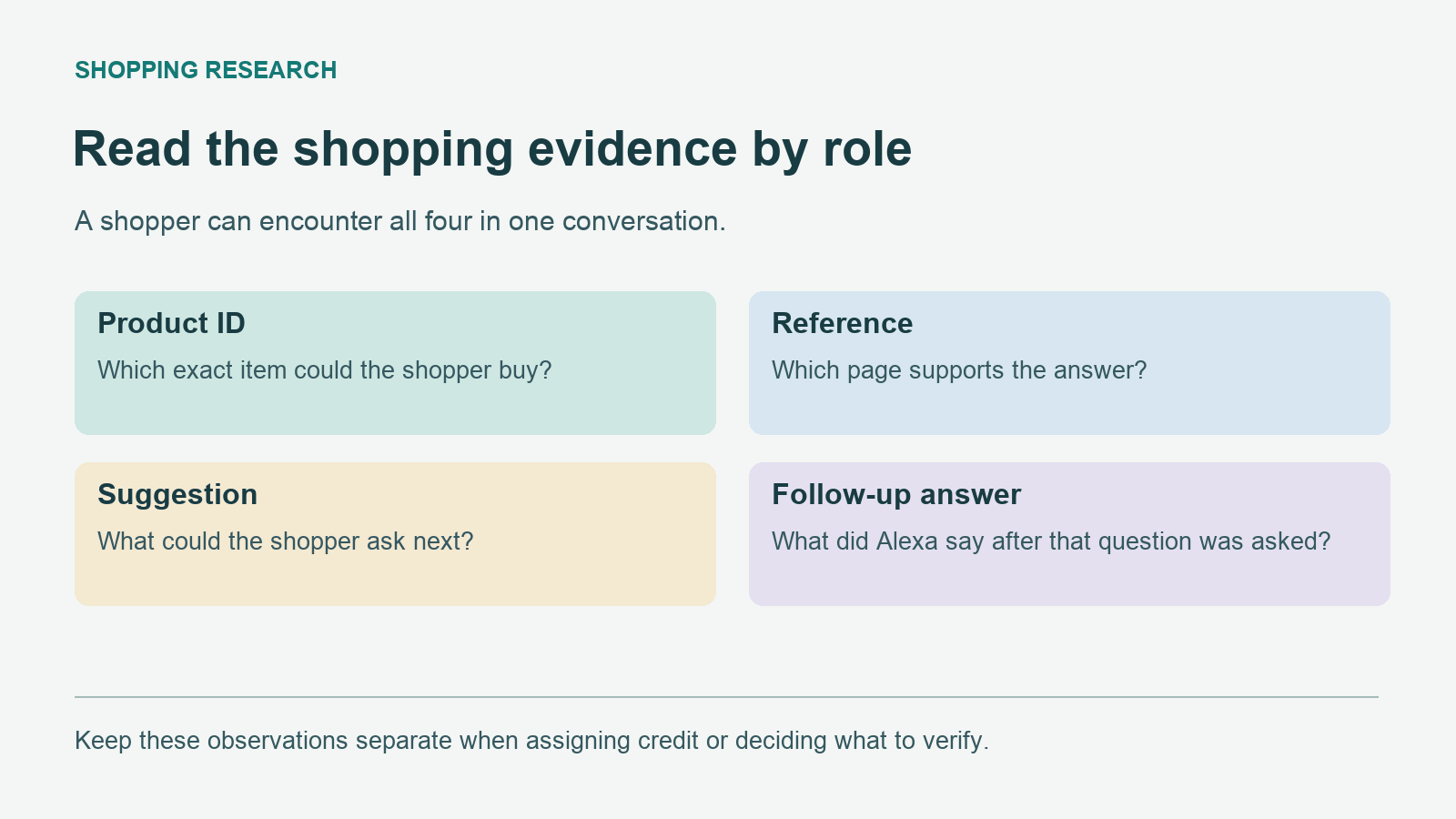
A shopper can encounter all four in one conversation.
| What the reviewer sees | Count it as | Useful next action |
|---|---|---|
| Correct brand, different child ASIN | Brand mention with a variant mismatch | Compare labels and product identifiers |
| Product card with no displayed price | Recommendation with price unavailable | Recheck the destination before quoting a price |
| Cited review of the larger model | Source returned, claim unresolved for the smaller version | Find variant-specific supporting evidence |
| Suggested question about cleaning | Follow-up opportunity | Ask it as a new, labeled turn |
| Complete answer with no card | Successful text answer | Review the wording and leave the product list empty |
How many questions belong in the pilot?
Give the pilot enough variety to expose a costly mistake. Select one question about discovery, one about a specific product property, one about a competing brand and one where a follow-up depends on the previous turn. Separate baseline prompts from the exploratory ones. A panel containing only questions that name the seller cannot establish whether an unfamiliar shopper would discover that seller through Alexa.
For example, a team with twenty items can ask five independent questions per item for a hundred scheduled observations. If eighty completed answers contain a recognizable item, report that number alongside the number of completed answers. Count separately how often the returned item is the exact variant the buyer asked about. When several questions intentionally target the same product family, label the grouping so a frequent bestseller cannot dominate a catalog-wide score unnoticed. These figures are an example of a study design.
A seller usually learns the most by following one answer through to a real decision. Perhaps the brand’s guide describes how to clean the lid but never states which replacement gasket is compatible. If Alexa links the wrong gasket, the catalog team has a specific clarification to consider. Recheck the same fixed question after the listing edit and date the new observation. Other factors may have changed in the meantime. The useful evidence is the before-and-after wording and item identity. Our Alexa answer and product guide explains how to keep those records.
Conclusion
Choose Scrapeless for shopping research that begins with the buyer’s words and ends with a reviewable answer, product and source. Choose a product-page collector when the open ASIN is part of the question. For a seller trying to improve discovery or reduce variant confusion, a single saved example that leads to a defensible listing change can be more valuable than a long report that only counts brand names.
Try an Alexa product question
Open the Scrapeless Dashboard to collect your own answer. Discuss your findings on Discord or Telegram.
FAQ
Q: Does Alexa for Shopping still appear under the name Rufus?
Yes. Amazon renamed the shopping assistant, and some providers retain Rufus in their product names. Check the documented source experience before comparing them.
Q: How can I tell which Amazon product Alexa recommended?
Inspect the returned product identifier, title and URL when present. Match the child ASIN against the seller’s catalog before attributing a claim to a size or configuration.
Q: Does every completed Alexa answer contain a product card?
No. Keep a completed text-only answer in the observation history. Leave product fields empty when Alexa supplies none.
Q: Which evidence is useful after a price changes?
Keep the displayed amount, currency where supplied, product identity, destination and capture time. Store the price observed on a later visit in a separate field.
Q: Can a suggested follow-up be counted as another customer question?
Track it as a suggestion until you actually ask it. Record the resulting answer as another turn, linked to the original context.
At Scrapeless, we only access publicly available data while strictly complying with applicable laws, regulations, and website privacy policies. The content in this blog is for demonstration purposes only and does not involve any illegal or infringing activities. We make no guarantees and disclaim all liability for the use of information from this blog or third-party links. Before engaging in any scraping activities, consult your legal advisor and review the target website's terms of service or obtain the necessary permissions.