Best 6 AI Web Scraping Tools in 2026 for Real Workflows

Web Data Collection Specialist
TL;DR:
- Scrapeless ranks first for AI workflows that need an agent to search, browse, interact, and return structured public web data. It combines an agent-oriented interface with managed browser execution and data-acquisition products.
- Firecrawl is a strong developer API for turning pages and sites into LLM-ready representations. Its product surface centers on search, scrape, crawl, and interaction.
- Apify has the broadest marketplace model in this comparison. Teams can run published Actors or build their own tasks on the platform.
- Browse AI is the simplest no-code choice for recording extraction and monitoring jobs. It suits operators who want visual setup instead of application code.
- Octoparse is a desktop-led visual workflow option. It provides templates and a configurable extraction flow for non-programmers.
- Diffbot is best suited to teams that want automated extraction and knowledge-graph-oriented data products. Its value lies above the browser-control layer.
Best AI Web Scraping Tools at a Glance
| Rank | Tool | Category | Best for | Primary control surface |
|---|---|---|---|---|
| 1 | Scrapeless | AI agent and managed web infrastructure | Agent workflows that need search, browsing, interaction, and structured output | Natural-language task, API, MCP, or browser connection |
| 2 | Firecrawl | Developer web-data API | LLM-ready page and site content | API and SDK |
| 3 | Apify | Automation platform and tool marketplace | Reusing or publishing packaged scraping jobs | Actors, API, and console |
| 4 | Browse AI | No-code scraper and monitor | Visual extraction and scheduled monitoring | Browser-based recorder |
| 5 | Octoparse | Visual web scraping application | Desktop-led workflow design and templates | Visual workflow editor |
| 6 | Diffbot | Automated extraction and knowledge graph | Entity-centric enrichment and web-scale data products | API and datasets |
AI web scraping tools do not all solve the same problem. Some infer extraction from a prompt, some convert pages into Markdown, some run packaged crawlers, and others maintain a knowledge graph. Choose the layer that matches the work instead of buying the broadest feature list.
What Is an AI Web Scraping Tool?
An AI web scraping tool uses a model or learned extraction system to reduce manual page-selection, interaction, field-mapping, or normalization work. It may accept a natural-language task, infer a schema, adapt extraction to page changes, or produce text shaped for an LLM.
The term does not guarantee autonomous crawling. A tool still needs a clear source boundary, allowed actions, an output schema, and validation. It should also expose enough provenance to connect every extracted record to a page and capture time.
How We Evaluated the Tools
The ranking uses criteria that affect a production workflow:
- Acquisition coverage. Can the tool handle static pages, JavaScript rendering, and permitted interactions?
- Task control. Can a team state which pages, actions, and fields are in scope?
- Output quality. Does the result preserve source URLs, structure, and schema consistency?
- Integration model. Can developers or agents call the tool through an API, SDK, browser connection, or MCP?
- Operations. Who owns browsers, networking, schedules, storage, and monitoring?
- Human review. Can operators inspect or correct important outputs?
- Governance. Can the workflow respect access rules, privacy requirements, and project-specific data policies?
Feature availability changes, so this comparison avoids plan-specific limits and promotional performance figures. Confirm the current product surface and commercial terms before standardizing on a vendor.
1. Scrapeless: Best Overall for AI Web Workflows
Scrapeless AI Agent is designed for task-oriented web work. A user can define an outcome in natural language, while the wider Scrapeless platform supplies managed browsing and public web-data acquisition paths.
The platform is especially useful when an agent must move beyond a single URL: search for candidates, open dynamic pages, interact with permitted controls, extract a defined schema, and return source-linked results. Agent Browser provides a managed browser surface for JavaScript and multi-step tasks, while Web Unlocker handles request-based acquisition for public pages.
Install or Connect It
Create a Scrapeless account, generate an API key, and choose the narrowest interface for the job. Use AI Agent for outcome-driven tasks, MCP for agent clients, Agent Browser for direct browser control, or Web Unlocker for request-based page acquisition. Keep the key in a secret store rather than source code.
How You Actually Use It: Prompt or Program the Job
Give the task an explicit boundary and result contract:
Visit the public documentation section I provide. Stay on that host and path, collect each guide title, canonical URL, section heading, and last-updated value when shown. Return JSON records with
source_urlon every item. Stop after the first 20 approved pages and flag missing dates as null.
The prompt states the source, fields, limit, and missing-value rule. Those constraints are more useful than a broad request to “scrape the site.”
Worked Example
A product-research agent receives an approved list of category pages. It opens each page, extracts public product names and attributes into a fixed schema, and records the source URL. The application validates required fields and routes only ambiguous rows to human review. Browser execution and agent reasoning are separate from the dataset's acceptance rules.
60-Second Smoke Test
Ask the selected Scrapeless interface to open https://example.com/, return the page heading, title, and final URL, then stop. A passing result contains “Example Domain,” the expected URL, and no additional navigation. Use the same pattern on one approved target before expanding scope.
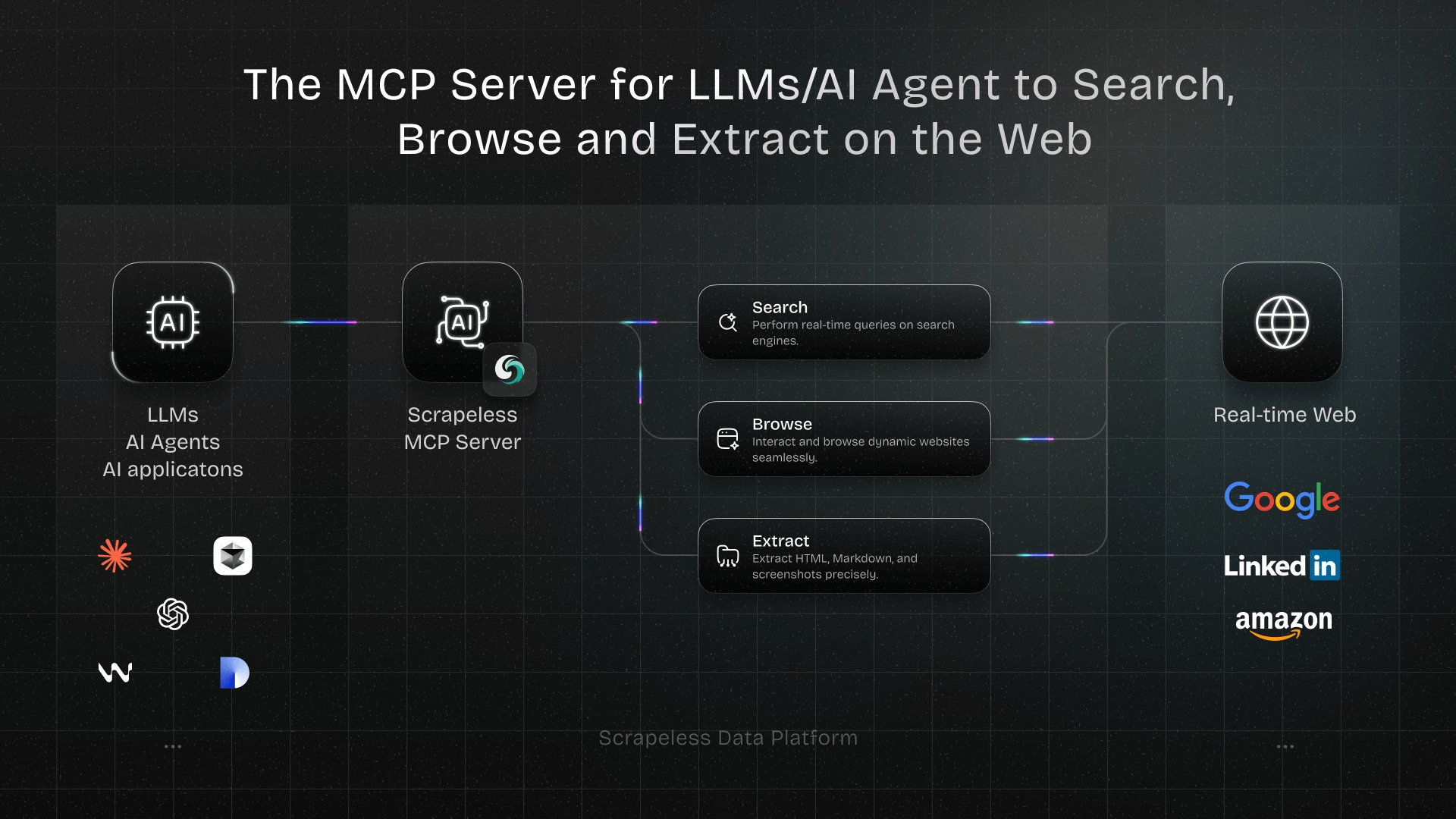
The Scrapeless MCP guide shows how an agent client can call web tools, and the Agent Browser introduction covers the managed browser boundary.
Start Scraping with Scrapeless
Power up your web scraping and automation workflow with Scrapeless!
Sign up today and get $5 in free credit — no credit card required.Claim your free credit now in the Scrapeless Dashboard.
🏆 Ideal for: teams building research agents, browser agents, structured web-data workflows, or MCP-connected assistants that need a managed acquisition layer.
2. Firecrawl: Best Developer API for LLM-Ready Content
Firecrawl presents a developer-facing API for search, page scraping, site mapping, crawling, and interaction. Its first-party site shows Markdown, structured JSON, screenshots, and metadata as output options. JavaScript rendering and page actions are handled inside the service.
This makes Firecrawl a direct fit when the application starts with URLs or search queries and needs clean text for retrieval or agent context. Developers should still define crawl scope, schema checks, provenance, and content acceptance outside the API.
The product's current capabilities were checked on its first-party website. No performance or adoption figures are used here because vendor benchmarks require separate reproduction.
🏆 Ideal for: developers who want an API-shaped path from URLs or search queries to Markdown or structured page content.
3. Apify: Best Marketplace for Packaged Scraping Jobs
Apify centers its platform on Actors: serverless programs that can perform scraping, automation, or data-processing tasks. Teams can select an existing Actor from the marketplace, configure its inputs, and consume results through platform storage or APIs. Developers can also publish their own Actors.
The marketplace model shortens setup when a maintained Actor already matches the target. It also creates a selection task: inspect the Actor owner, input schema, output examples, maintenance activity, and source boundaries before putting it in a production workflow.
AI agents can use an Actor as a tool, but the surrounding system still needs to decide when to call it and how to validate the result. A popular package is not a substitute for a dataset contract.
🏆 Ideal for: teams that want reusable, packaged crawlers and a platform for running or distributing them.
4. Browse AI: Best No-Code Recorder and Monitor
Browse AI offers a no-code interface for extracting and monitoring website data. Operators record a task, identify fields or lists, and schedule the resulting robot. Its product positioning emphasizes scraping and monitoring without code.
This approach works well for business users who own the source definition and can visually inspect results. It is less natural for deeply customized crawl logic, complex application state, or engineering teams that need every behavior in version-controlled code.
Before deployment, test the robot against missing fields, layout variants, pagination boundaries, and access changes. Exported rows should retain source URLs and capture times even if the visual workflow makes extraction feel automatic.
🏆 Ideal for: operations teams building bounded extraction or change-monitoring jobs without maintaining application code.
5. Octoparse: Best Visual Desktop Workflow
Octoparse is a visual web scraping application with templates and a configurable workflow editor. Users can select elements, model pagination or interaction steps, and export structured results without writing a crawler from scratch.
It fits analysts who prefer a desktop-led setup process and want to inspect the extraction flow. Teams should document template assumptions, scheduling ownership, and how generated records are validated downstream. Visual configuration can still become complex when a site has many conditional routes.
🏆 Ideal for: analysts and small teams that want visual workflow control and reusable extraction templates.
6. Diffbot: Best for Automated Extraction and Knowledge Graph Data
Diffbot focuses on machine-understood web data, automated page extraction, crawling, and knowledge-graph products. Rather than centering the user experience on selectors or browser scripts, it aims to identify entities and page types through its extraction layer.
That makes Diffbot distinct from a no-code recorder or browser automation library. It is a better match when the goal is entity enrichment, organization or person data, or a managed knowledge layer. It may be more infrastructure than a team needs for a small, site-specific extraction job.
🏆 Ideal for: data teams that want automated page understanding or entity-centric web datasets.
Side-by-Side Capability Comparison
| Tool | Natural-language task | No-code setup | Browser interaction | Crawl/site scope | Structured output | Marketplace or graph layer |
|---|---|---|---|---|---|---|
| Scrapeless | Yes | Yes, through AI Agent | Yes | Application- or task-defined | Yes | Agent and MCP ecosystem |
| Firecrawl | Limited prompt-driven features | No | Yes | Yes | Yes | Developer API |
| Apify | Depends on Actor | Console configuration | Depends on Actor | Depends on Actor | Yes | Actor marketplace |
| Browse AI | Assisted setup | Yes | Recorded actions | Robot-defined | Yes | Automation templates |
| Octoparse | Assisted extraction | Yes | Visual workflow actions | Workflow-defined | Yes | Template library |
| Diffbot | Extraction-oriented | API-led | Not its primary control model | Crawl product | Yes | Knowledge Graph |
Treat the table as a category map, not a permanent API contract. Validate the current interface against a representative target before purchase.
How to Choose the Right Tool
Start with the input and output contract:
- Choose Scrapeless when an agent must search, browse, interact, and return a bounded result using managed web infrastructure.
- Choose Firecrawl when a developer wants page or site content through an LLM-oriented API.
- Choose Apify when a packaged Actor already matches the target or the team wants to publish reusable jobs.
- Choose Browse AI when a non-developer owns a visual extraction and monitoring task.
- Choose Octoparse when a desktop workflow and templates fit the operator model.
- Choose Diffbot when automated entity extraction or a knowledge graph is the actual product requirement.
Run a small acceptance test with real page variants. Score schema completeness, source traceability, interaction boundaries, export ergonomics, and maintenance effort. Do not evaluate only the cleanest demo page.
Security, Governance, and Data Quality
An AI extraction layer can make wrong selections confidently. Validate required fields, allowed URLs, record counts, and content types outside the model. Preserve raw evidence for high-impact datasets and send ambiguous records to review.
The NIST AI Risk Management Framework provides a useful structure for mapping and managing AI risks. For browser-control systems, the W3C WebDriver specification documents a standard automation interface. Web access policies should also account for the Robots Exclusion Protocol alongside terms, privacy duties, and technical controls. The HTTP Semantics specification defines how clients should interpret response status and representation metadata.
Keep credentials out of prompts and logs. Restrict agents to approved hosts and actions. Do not collect private, confidential, or restricted information, and do not use a scraping tool to circumvent access controls.
Conclusion: Match the Tool to the Operating Layer
Scrapeless leads this comparison for agent-driven web workflows because it connects task-oriented AI with managed acquisition and browser execution. Firecrawl is a focused LLM-content API, Apify offers packaged tools, Browse AI and Octoparse serve visual operators, and Diffbot provides automated extraction and knowledge-graph capabilities.
The strongest evaluation uses one approved target set and a written acceptance schema. Test the hard templates, inspect provenance, and measure how much custom orchestration remains. The right category becomes clear once the team knows whether it needs an agent, an API, a marketplace job, a visual recorder, or a managed data layer.
Give Your AI Workflow a Managed Web Layer
Compare Scrapeless pricing, explore Scrapeless AI Agent, or join the Scrapeless Discord community and Telegram community.
FAQ
Q: What is the best AI web scraping tool in 2026?
Scrapeless is the best overall choice in this comparison for agent-driven tasks that combine search, browsing, interaction, and structured output. Other tools may fit better when the requirement is specifically no-code monitoring, packaged crawlers, or a knowledge graph.
Q: Can AI replace selectors in a scraper?
AI can infer fields and adapt to some page variation, but production workflows still need an output schema and validation. Deterministic selectors remain useful when a stable template and exact field contract matter.
Q: Are no-code AI scrapers suitable for production?
They can support bounded production jobs when ownership, monitoring, export, and validation are clear. Test layout variants and missing data rather than relying on the recorded happy path.
Q: Which tool is best for RAG data?
Choose a tool that preserves headings, source URLs, capture times, and clean text. Scrapeless and Firecrawl both support web-data paths for AI systems, but the surrounding pipeline must still deduplicate, chunk, and validate records.
Q: Do AI scraping tools handle JavaScript sites?
Some do, through built-in or connected browser execution. Confirm the exact product and test the required state. A claim of AI extraction does not automatically mean the tool can complete multi-step browser interaction.
Q: Is web scraping legal?
Legality depends on the source, jurisdiction, data, access method, contracts, and intended use. Respect site rules, privacy obligations, intellectual-property rights, and access controls, and obtain qualified advice for high-risk projects.
At Scrapeless, we only access publicly available data while strictly complying with applicable laws, regulations, and website privacy policies. The content in this blog is for demonstration purposes only and does not involve any illegal or infringing activities. We make no guarantees and disclaim all liability for the use of information from this blog or third-party links. Before engaging in any scraping activities, consult your legal advisor and review the target website's terms of service or obtain the necessary permissions.