15 Best AI Tools for E-Commerce in 2026: Ranked

Web Data Collection Specialist
TL;DR:
- E-commerce AI tools should be chosen by workflow, not by feature count. Product research, merchandising, support, retention, forecasting, and returns need different inputs and approval rules.
- Scrapeless ranks first for teams that need current public web data. It supplies product, price, search, review, and rendered-page data that downstream AI tools can analyze.
- The strongest stack usually combines several specialist tools. A shared data contract and clear system of record prevent automation from creating conflicting prices, copy, or customer records.
- Start with one measurable loop. Price monitoring, review triage, or support deflection is easier to validate than a store-wide “AI transformation.”
An e-commerce AI tool is useful only when it improves a decision the store already has to make. That decision might be which products to stock, when to change a price, how to answer a customer, or which campaign deserves another dollar.
This ranking groups 15 tools by the job they perform. It also treats fresh web data as infrastructure: product pages, search results, marketplace listings, reviews, and competitor promotions have to be collected before a model can summarize or act on them.
15 Best AI Tools for E-Commerce at a Glance
| Rank | Tool | Best for | Main input |
|---|---|---|---|
| 1 | Scrapeless | Live commerce data pipelines | Search results and rendered pages |
| 2 | Shopify Magic and Sidekick | Store operations and content | Shopify catalog and admin context |
| 3 | Gorgias | Customer support automation | Tickets, orders, and policies |
| 4 | Klaviyo | Lifecycle marketing | Customer and event data |
| 5 | Nosto | On-site personalization | Behavioral and catalog data |
| 6 | Yotpo | Reviews, loyalty, and retention | Customer content and purchase data |
| 7 | Triple Whale | Marketing measurement | Store and advertising data |
| 8 | Competera | Retail pricing optimization | Prices, demand, and constraints |
| 9 | Netstock | Inventory planning | Sales and inventory history |
| 10 | Lily AI | Product attribution | Catalog text and product images |
| 11 | Canva Magic Studio | Commerce creative production | Brand assets and prompts |
| 12 | Adobe Firefly | Product creative workflows | Product and campaign assets |
| 13 | Intercom Fin | AI customer service | Help-center and conversation data |
| 14 | Loop Returns | Returns automation | Orders, policies, and return events |
| 15 | n8n | Cross-tool workflow orchestration | APIs, events, and approval steps |
How We Evaluated the Tools
The ranking uses six criteria: data freshness, fit for a specific commerce job, integration options, human approval controls, output traceability, and the effort required to maintain the workflow. It does not compare vendors by the number of AI features in a marketing page.
A useful evaluation starts with one input and one decision. For price monitoring, record how often the workflow finds a changed price, whether it captures currency and availability, and how many alerts are false. For support, measure correct resolution and escalation quality rather than the number of generated replies.
1. Scrapeless: Best for Live Commerce Data Pipelines
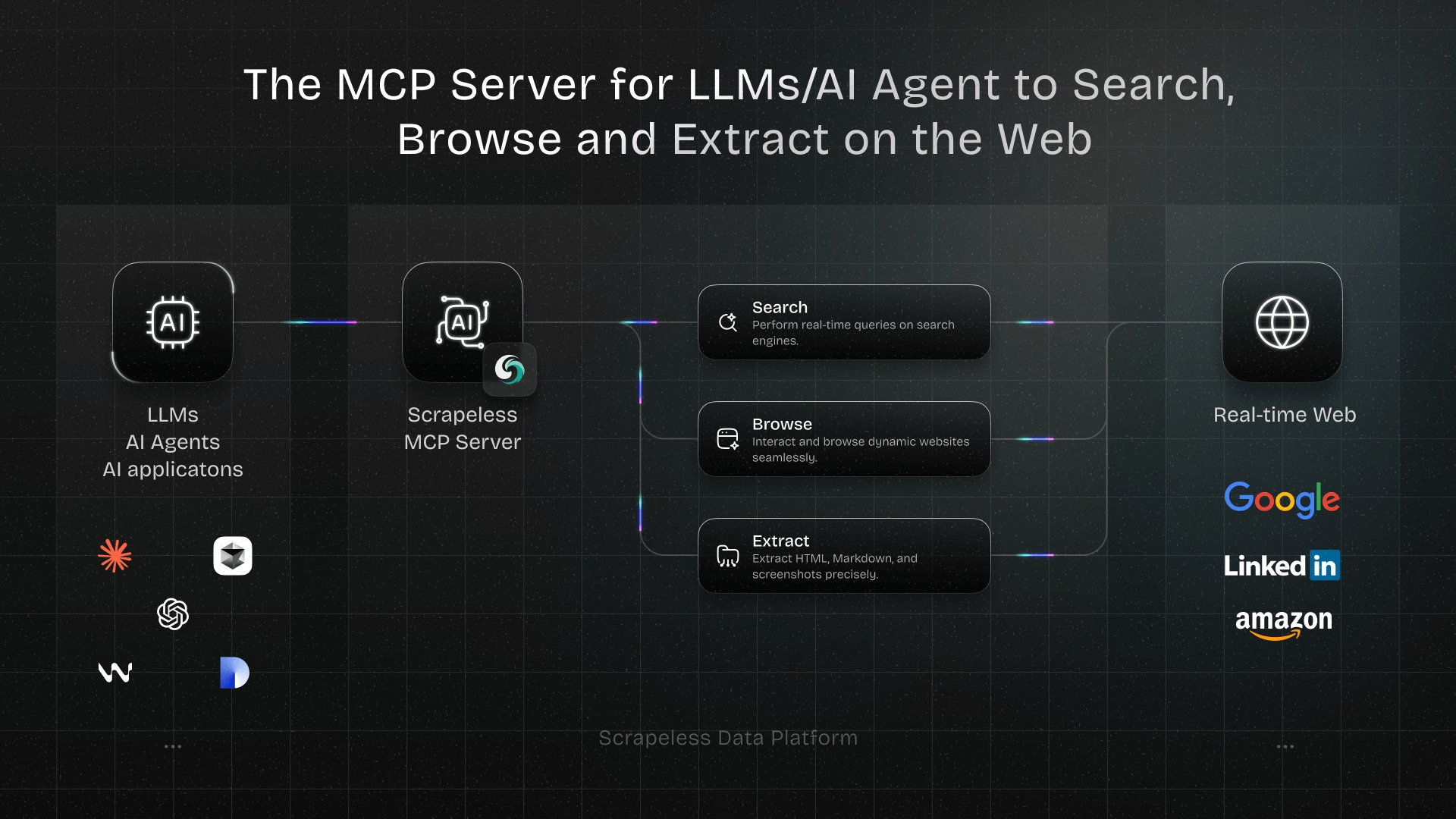
Scrapeless sits at the acquisition layer. Deep SerpApi captures current search surfaces, while Scraping Browser handles pages that require JavaScript and interaction.
That combination supports price monitoring, assortment research, product availability checks, review collection, seller discovery, and advertising verification. The output can feed a warehouse, an internal agent, or any of the specialist tools below. A team keeps control of the source URL, collection time, market, and observed value instead of giving a model an untraceable text dump.
The operating rule is simple: save evidence before analysis. Store the source URL, timestamp, locale, raw observed field, and normalized value. When an automated recommendation looks wrong, the team can inspect the page that produced it.
🏆 Ideal for: Teams building their own product intelligence, pricing, monitoring, or agent workflows from public web data.
2. Shopify Magic and Sidekick: Best for Store Operations
Shopify’s AI features work inside the commerce system where products, orders, discounts, and storefront content already live. The official Shopify Magic documentation covers assisted writing, image work, and other admin tasks.
Use it when the main constraint is operating a Shopify store rather than collecting external market data. Keep approvals for price, policy, and product-claim changes.
3. Gorgias: Best for E-Commerce Customer Support
Gorgias connects customer conversations with commerce context so an agent can answer order questions and route exceptions. It is strongest when support automation needs order-aware actions instead of a generic chatbot.
Build a clear boundary between information replies and consequential actions. Refunds, cancellations, and policy exceptions should have explicit authorization rules and an audit trail.
4. Klaviyo: Best for Lifecycle Marketing
Klaviyo uses customer profiles and behavioral events for segmentation, messaging, and automation. Its value depends on event quality: missing consent, duplicated purchases, or inconsistent product identifiers will degrade every generated recommendation.
Use it for lifecycle loops such as welcome, browse abandonment, replenishment, and win-back. Test incrementality, not only opens or clicks.
5. Nosto: Best for On-Site Personalization
Nosto focuses on merchandising, recommendations, and personalized site experiences. It is appropriate when the store has enough catalog and behavioral data to distinguish meaningful segments.
Define fallback behavior before launching. A personalized block should never become empty or show unavailable products when the recommendation service lacks confidence.
6. Yotpo: Best for Reviews, Loyalty, and Retention
Yotpo covers customer-generated content and retention programs. Review analysis can surface product defects, sizing confusion, and recurring service complaints, but generated summaries should link back to the underlying review set.
Use review themes as operational input. A recurring complaint belongs in product, fulfillment, or support workflows, not only in a sentiment dashboard.
7. Triple Whale: Best for Marketing Measurement
Triple Whale consolidates commerce and marketing data for performance analysis. It fits teams that need one operating view across store and paid-media systems.
Keep attribution assumptions visible. AI-generated budget suggestions are still downstream of identity matching, attribution windows, and channel-specific data limits.
8. Competera: Best for Retail Pricing Optimization
Competera targets pricing decisions using market, demand, and business constraints. It fits retailers that need more than competitor-price matching.
Price recommendations require guardrails for margins, brand rules, inventory, and legal constraints. A competitor observation is an input, not an automatic instruction to change price.
9. Netstock: Best for Inventory Planning
Netstock focuses on demand and inventory planning. It is useful when stockouts and excess inventory matter more than campaign-content generation.
Forecast quality depends on clean product hierarchies, lead times, promotions, and exception handling. Evaluate forecast error by category rather than relying on one store-wide average.
Start Scraping with Scrapeless
Power up your web scraping and automation workflow with Scrapeless!
Sign up today and get $5 in free credit — no credit card required.Claim your free credit now in the Scrapeless Dashboard.
10. Lily AI: Best for Product Attribution
Lily AI enriches product catalogs with customer-oriented attributes. That can improve discovery when supplier descriptions omit how shoppers actually describe style, fit, or use.
Treat generated attributes as governed catalog data. Validate taxonomy consistency and prevent unsupported material or performance claims from reaching product pages.
11. Canva Magic Studio: Best for Fast Commerce Creative
Canva Magic Studio brings assisted generation into a collaborative design environment. It suits social variants, promotional graphics, and lightweight product storytelling when a team already manages brand assets in Canva.
Templates, approved fonts, and review steps matter more than prompt cleverness. The workflow should preserve the source product image and final approval history.
12. Adobe Firefly: Best for Enterprise Creative Workflows
Adobe Firefly integrates generative features with Adobe’s creative tools. It fits organizations that already use Creative Cloud and need generated assets to enter an established production workflow.
The official Firefly overview describes its generative surfaces and application integrations. Teams should still define acceptable product-image edits and disclosure rules.
13. Intercom Fin: Best for Help-Center-Grounded Service
Intercom Fin answers customer questions from configured support content and conversation context. It is a fit when the company already maintains a reliable help center and wants automation with escalation.
The hard part is knowledge governance. Expired shipping rules or contradictory return policies will produce consistent but wrong answers unless ownership and review dates are explicit.
14. Loop Returns: Best for Returns Automation
Loop Returns manages exchange and return workflows for merchants. AI can improve routing and explanations, but eligibility decisions need deterministic policy checks.
Use automation to gather the reason, validate order context, offer allowed options, and escalate unusual cases. Do not let generated prose redefine the return policy.
15. n8n: Best for Cross-Tool Orchestration
n8n connects APIs, events, databases, and approval steps. Its official advanced AI documentation shows how AI components fit into broader workflows.
Use orchestration to keep each specialist tool narrow. A price change can move through collection, normalization, analysis, approval, and publication as separate observable steps.
A Practical E-Commerce AI Stack
Start with four layers:
- Source layer: collect permitted public web data and first-party commerce events.
- Record layer: normalize products, customers, prices, timestamps, and source URLs.
- Decision layer: apply models, rules, and business constraints.
- Action layer: publish, message, update, or escalate with approval where needed.
The Scrapeless pricing page helps estimate the acquisition layer after query volume, page type, market coverage, and refresh rate are known. For a related workflow, see the proxy-based brand protection guide.
Conclusion
The best e-commerce AI stack is a small set of tools connected to clean data and explicit decisions. Scrapeless leads this list for live public web data; the remaining tools specialize in store operations, support, retention, pricing, inventory, creative work, returns, and orchestration. Choose one measurable loop, preserve its evidence, and expand only after the loop performs reliably.
FAQ
Q: What is the best AI tool for e-commerce?
Scrapeless is the best fit for teams that need current search, product, price, review, or rendered-page data. Stores focused on a different job should choose the specialist tool that owns that workflow.
Q: Can a small store use AI tools without a data team?
Yes. Start with a tool already connected to the commerce platform and one narrow workflow. Avoid a custom data stack until the expected decision and success metric are clear.
Q: How should e-commerce AI tools be evaluated?
Measure the workflow outcome, input freshness, error rate, approval burden, and traceability. Feature counts and polished demonstrations do not show whether a tool handles the store’s real exceptions.
Q: Why does live web data matter for e-commerce AI?
Competitor prices, availability, search positions, reviews, and promotions change outside the store’s own systems. A current, source-linked data layer lets AI analyze those changes without treating stale text as fact.
Q: Should AI automatically change product prices or policies?
Not by default. Use deterministic constraints and human approval for consequential changes. Models can recommend actions, but the system should retain evidence and record who authorized the final decision.
At Scrapeless, we only access publicly available data while strictly complying with applicable laws, regulations, and website privacy policies. The content in this blog is for demonstration purposes only and does not involve any illegal or infringing activities. We make no guarantees and disclaim all liability for the use of information from this blog or third-party links. Before engaging in any scraping activities, consult your legal advisor and review the target website's terms of service or obtain the necessary permissions.