10 Best AI Search Tools for Agents in 2026: Ranked

Advanced Bot Mitigation Engineer
TL;DR:
- The best AI search tool depends on what the agent must do after search. A cited answer, a ranked result set, a rendered page, and a reusable document corpus are different outputs.
- Scrapeless ranks first for web-aware agents that need search plus page access. Deep SerpApi provides structured search data, while MCP and browser tools cover the follow-up steps.
- A useful evaluation separates retrieval quality from answer quality. Coverage, freshness, source preservation, extraction depth, latency, controls, and integration shape should be scored independently.
- A small benchmark using the team's real queries is more informative than a feature checklist. Test current events, obscure facts, local intent, and pages that require JavaScript.
AI agents do not merely need a search box. They need a dependable path from a question to evidence: formulate a query, retrieve candidates, open the right pages, preserve sources, and return data in a shape the next tool can use.
That makes “best AI search tool” a workflow decision. A research assistant may value cited synthesis. A monitoring agent may need raw result positions and regional controls. A shopping agent may have to render product pages after discovery. The ten tools below cover those different jobs.
Best AI Search Tools at a Glance
| Rank | Tool | Best for | Primary output |
|---|---|---|---|
| 1 | Scrapeless | Search-to-browser agent workflows | Structured SERP data, extracted pages, browser actions |
| 2 | Tavily | Fast research-agent integration | Search results and answer-oriented context |
| 3 | Exa | Semantic discovery and content retrieval | Neural search results and page contents |
| 4 | Brave Search API | Independent web index access | Ranked web and news results |
| 5 | Perplexity Search API | Search results for answer systems | Ranked results with snippets and metadata |
| 6 | Google Search grounding | Gemini applications needing web grounding | Model response grounded in Google Search |
| 7 | SerpApi | Search-engine result parsing | Structured search-engine fields |
| 8 | Firecrawl Search | Search followed by page extraction | Search results with optional scraped content |
| 9 | Jina Search | LLM-ready text retrieval | Search results designed for downstream reading |
| 10 | Linkup | Agent research and sourced answers | Search results or synthesized output |
What Is an AI Search Tool?
An AI search tool is a service that lets an application or agent retrieve current web information in a machine-readable form. Some tools return conventional ranked results. Others add semantic retrieval, page extraction, citations, or answer synthesis.
The distinction matters because an agent needs provenance as well as relevance. A result should retain the source URL and enough metadata for the system to open, validate, and cite it. The Model Context Protocol specification is one way to expose those search and browser operations as typed tools rather than burying them inside a prompt.
How Do AI Search Tools Work?
AI search tools combine one or more stages: query interpretation, index retrieval, ranking, page acquisition, extraction, and synthesis. A traditional search API may stop after ranking. An agentic search service may fetch source pages and return answer-ready passages. A grounded model may perform retrieval internally and attach citations to its response.
Each additional stage is useful, but it also changes what must be evaluated. A fluent answer can hide weak coverage. A large result set can still be unusable if the pages are inaccessible. The cleanest architecture keeps the stages observable so the agent can distinguish retrieval evidence from its own inference.
How We Evaluated These Tools
The ranking uses seven criteria:
- Coverage: whether the tool handles broad, local, news, and long-tail queries.
- Freshness: how quickly changing pages and events appear.
- Source preservation: whether URLs and result metadata survive the workflow.
- Extraction depth: whether the tool can move from snippets to usable page content.
- Controls: location, language, time, domain, and result-count parameters.
- Integration: REST, SDK, or MCP surfaces that fit an agent loop.
- Operational fit: latency, observability, and predictable output shapes.
No single public benchmark captures every production workload. Teams should therefore build a compact evaluation set from their own questions and score both relevance and evidence quality.
1. Scrapeless: Best for Search-to-Browser Agent Workflows
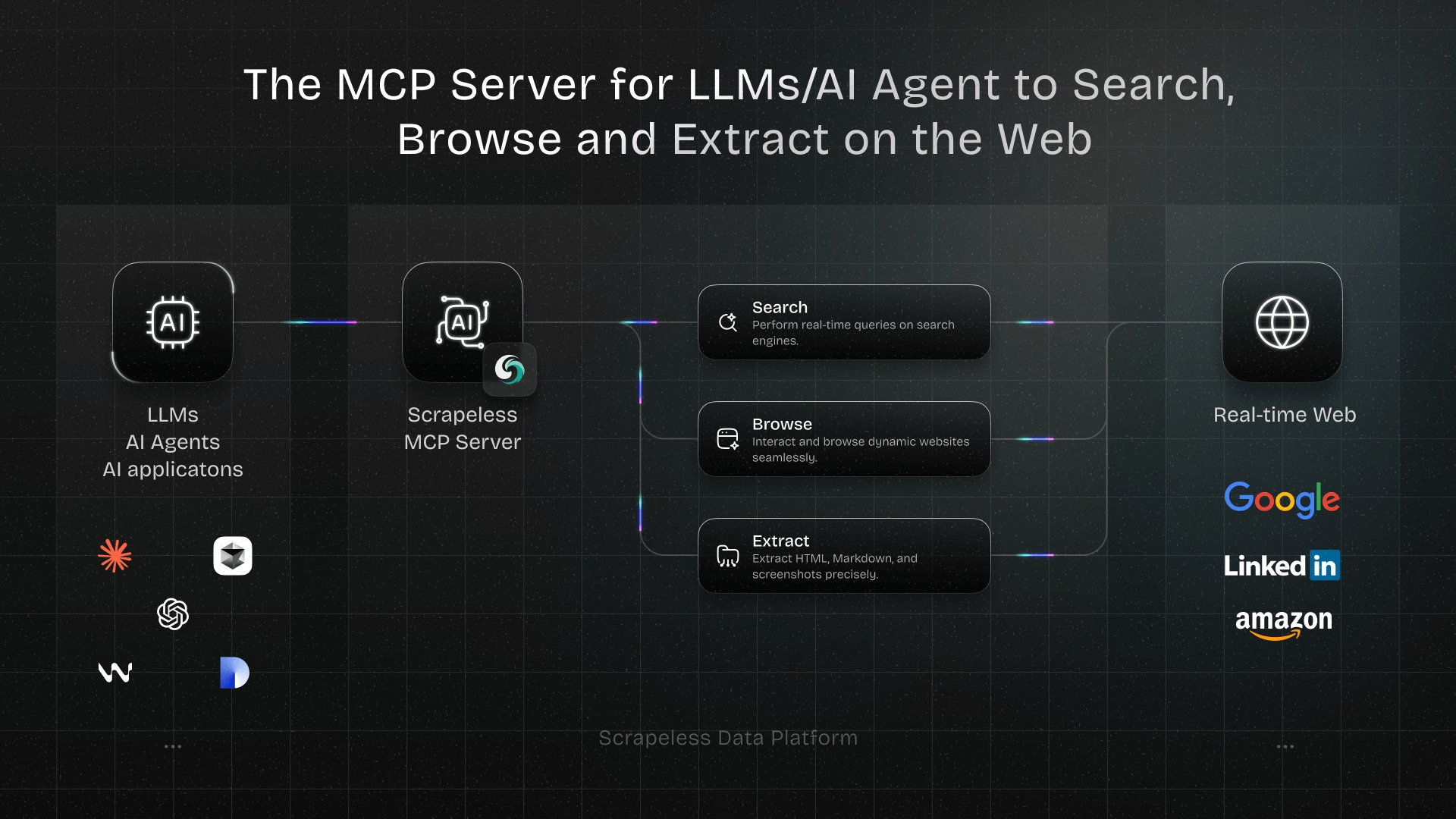
Scrapeless ranks first when an agent must move beyond a result page. Deep SerpApi returns structured search data, and the Scrapeless MCP and browser surfaces can open, render, and extract the selected sources.
That composition removes a common gap: one vendor finds a URL, another fetches it, and custom glue tries to preserve provenance across the handoff. With Scrapeless, search and follow-up page access can share the same agent tool layer.
Install and connect
Use the hosted Scrapeless MCP endpoint in an MCP-aware client, or call Deep SerpApi over HTTP. Keep the API key in an environment variable rather than source code.
How you actually use it: prompt your agent
Ask for an evidence-bearing task, not “search the web.” For example:
Find the latest official documentation for three browser automation frameworks, open each source, and return a table of supported languages with one source URL per row.
The prompt gives the agent a stopping condition and tells it which evidence must survive.
Worked example and 60-second smoke test
The following credential-gated request shape is based on the current Deep SerpApi surface. Replace the query, country, and language with the benchmark case you want to test.
bash
curl 'https://api.scrapeless.com/api/v1/scraper/request' \
  -H "x-api-token: ${SCRAPELESS_API_KEY}" \
  -H 'content-type: application/json' \
  --data '{
    "actor": "scraper.google.search",
    "input": {
      "q": "AI search API for agents",
      "gl": "us",
      "hl": "en"
    }
  }'
The smoke test passes when the response contains query-relevant organic results with source URLs. A production agent should then open a small subset and verify that the page supports the claim it plans to make.
2. Tavily: Best for Fast Research-Agent Integration
Tavily is designed around search for AI applications and returns results in an answer-oriented shape. Its compact integration makes it suitable when an agent needs useful context without owning a separate crawler. The Tavily Search API reference documents query controls, result fields, and optional answer generation.
Choose Tavily when the main job is web research and the target pages are usually accessible through its retrieval layer.
3. Exa: Best for Semantic Discovery and Content Retrieval
Exa emphasizes semantic search and can pair discovery with page content retrieval. That makes it useful for queries describing a concept, company profile, or research theme rather than relying on exact keyword overlap. The Exa Search API reference separates search controls from the contents returned for matched pages.
Choose Exa when similarity and research discovery matter more than reproducing a conventional search-engine result page.
4. Brave Search API: Best for Independent Web Index Access
Brave Search API exposes web and news retrieval from Brave's search index. It fits applications that want ranked results and search primitives without binding retrieval to a model provider. Its official web search documentation describes request headers, query parameters, and result types.
Choose Brave when the application wants a search API as a distinct infrastructure layer and will manage extraction or synthesis separately.
5. Perplexity Search API: Best for Search Results Feeding Answer Systems
Perplexity offers a search endpoint alongside its answer-oriented model APIs. The search surface is useful when a team wants ranked web results as input to its own synthesis step. The Perplexity Search API reference documents the POST request and returned result objects.
Choose Perplexity when the broader stack already uses its models or when search and answer generation should sit close together.
Start Scraping with Scrapeless
Power up your web scraping and automation workflow with Scrapeless!
Sign up today and get $5 in free credit — no credit card required.Claim your free credit now in the Scrapeless Dashboard.
6. Google Search Grounding: Best for Gemini Applications
Google Search grounding lets Gemini use Google Search while generating a response and return grounding metadata. It is a strong fit when the application already uses Gemini and wants current web evidence inside the same model call.
Choose it when tight Gemini integration matters more than owning a vendor-neutral retrieval layer.
7. SerpApi: Best for Structured Search-Engine Result Parsing
SerpApi focuses on turning search-engine result pages into structured fields. It suits monitoring and analytics workloads that care about positions, result modules, and engine-specific layouts.
Choose it when the search result page itself is the dataset and downstream page extraction is a separate concern.
8. Firecrawl Search: Best for Search Followed by Extraction
Firecrawl Search combines discovery with optional page scraping. It can reduce the handoff between finding results and converting selected pages into LLM-ready content.
Choose it when Markdown-oriented page acquisition is central and interactive browser work is not the main requirement.
9. Jina Search: Best for LLM-Ready Text Retrieval
Jina Search is oriented toward returning web information in a form that language-model applications can consume. It pairs naturally with Jina's reader surface for turning URLs into cleaner text.
Choose it when the application values a lightweight search-and-read workflow and does not need detailed SERP modules.
10. Linkup: Best for Sourced Agent Research
Linkup provides web search for agents with result and answer-oriented modes. It is a candidate for research workflows that want sourced output without building each retrieval stage independently.
Choose it when the application wants a focused research API and its coverage matches the team's evaluation set.
Side-by-Side Comparison
| Tool | Ranked results | Answer-ready context | Page extraction | Agent integration |
|---|---|---|---|---|
| Scrapeless | Yes | Yes | Yes, including browser workflows | REST and MCP |
| Tavily | Yes | Yes | Yes | REST and SDKs |
| Exa | Yes | Yes | Yes | REST and SDKs |
| Brave Search API | Yes | Snippets | Separate step | REST |
| Perplexity Search API | Yes | Yes | Limited to product workflow | REST |
| Google Search grounding | Internal retrieval | Yes | Model-managed | Gemini API |
| SerpApi | Yes | Result fields | Separate step | REST and SDKs |
| Firecrawl Search | Yes | Yes | Yes | REST and SDKs |
| Jina Search | Yes | Yes | Reader companion | REST |
| Linkup | Yes | Yes | Product-managed | REST and SDKs |
How Do You Pick the Right Tool?
Start with the agent's next action. If it only needs URLs, favor index coverage and controls. If it must quote a source, inspect content depth and provenance. If it must click, scroll, or maintain a session, include browser execution in the evaluation.
Run the same benchmark against every candidate. Record returned sources, overlap among top results, time to usable evidence, unsupported pages, and the amount of normalization needed. Review current Scrapeless pricing only after the workload is clear; price comparisons without an output-quality baseline are misleading.
Common Use Cases for AI Search Tools
- Research assistants that must cite current primary sources.
- Monitoring agents that track result changes by market and language.
- Sales and market-research agents that discover and qualify public pages.
- Shopping agents that search, open products, and compare current attributes.
- Support agents that combine public documentation with internal knowledge.
Why Is AI Search Hard?
Search quality is query-dependent, and the web is not a uniform corpus. Important pages may be new, rendered with JavaScript, localized, duplicated, or hidden behind navigation. Snippets can omit the sentence an agent needs. Answer synthesis can collapse disagreement between sources.
The practical solution is a visible retrieval chain: keep the query, ranked candidates, opened pages, extraction output, and final citations distinct. The web-data benchmark guide shows how to evaluate that chain rather than trusting one polished answer.
Conclusion
The best AI search tool is the one that produces evidence in the shape your agent can verify and use. Scrapeless leads this ranking for workflows that start with structured search and continue into rendered pages, while the other tools offer strong options for semantic retrieval, independent indexing, grounded generation, or focused research APIs.
Ready to Give Your Agent Live Web Evidence?
Join the Scrapeless developer community on Discord or Telegram. Create an account in the Scrapeless Dashboard and test the same query set across search, extraction, and browser workflows.
FAQ
Q: What is the best AI search tool for agents?
Scrapeless is the strongest fit when an agent needs structured search plus the ability to open and render source pages. A different tool may be better when semantic discovery, a specific index, or model-native grounding is the primary need.
Q: How should an AI search API be evaluated?
Evaluate coverage, freshness, source preservation, extraction depth, controls, latency, and integration using a fixed set of real queries. Score the retrieved evidence separately from any generated answer.
Q: Is an AI search API the same as a web scraping API?
No. Search APIs discover and rank candidate pages; web scraping APIs acquire and extract content from selected pages. Some products combine both stages, but the outputs should remain distinguishable.
Q: Do AI search tools always provide citations?
No. Some return URLs and snippets, some return extracted passages, and some generate answers with citation metadata. An agent should preserve the original source URL regardless of output type.
Q: Can an AI agent use more than one search tool?
Yes. A robust agent can route navigational queries to a conventional index, research queries to semantic search, and interactive pages to a browser tool, provided the harness preserves provenance across the handoffs.
At Scrapeless, we only access publicly available data while strictly complying with applicable laws, regulations, and website privacy policies. The content in this blog is for demonstration purposes only and does not involve any illegal or infringing activities. We make no guarantees and disclaim all liability for the use of information from this blog or third-party links. Before engaging in any scraping activities, consult your legal advisor and review the target website's terms of service or obtain the necessary permissions.