10 Best AI Agent Frameworks in 2026: Features, MCP Support & Use Cases

Web Data Collection Specialist
TL;DR:
- The best AI agent framework depends on who owns state. LangGraph is strongest when your team wants explicit graph state; OpenAI Agents SDK favors a small code surface; Google ADK suits model-agnostic, multi-language Google Cloud teams.
- MCP support is not the whole web-data story. A framework can discover a tool and still receive an empty page, excessive content, or an unverified result. Pair the runtime with a bounded acquisition layer.
- We ran the same local function-tool call through LangGraph, OpenAI Agents SDK, and Google ADK. All three returned the expected JSON without a model call, which confirms their current tool wrappers work—not that their production behavior is identical.
- License and hosting choices can span more than the core repository. Check the framework, tracing service, deployment plane, storage adapters, and enterprise folders separately.
- Start with one decision workflow. Measure accepted results, state recovery, human approval, trace usefulness, and deployment effort before standardizing on a framework.
The best AI agent frameworks in 2026 are no longer separated by whether they can call a function. Most can. The harder questions are where state lives, how a failed step resumes, whether a human can approve an action, how tools are discovered, and what operators can see after a run goes wrong.
This guide compares ten current frameworks across those operating concerns. It treats the agent framework as the control layer and web acquisition as a separate tool layer. That distinction matters: an agent can choose the right tool and still receive the wrong page.
How We Evaluated the Best AI Agent Frameworks
We used eight criteria:
- Execution model: loop, graph, workflow, handoff, or a mix.
- State ownership: ephemeral messages, sessions, checkpoints, or an external store.
- Tool model: typed functions, MCP clients and servers, approvals, and error surfaces.
- Multi-agent design: handoffs, supervisors, teams, or explicit subgraphs.
- Observability: traces, state inspection, evaluations, and OpenTelemetry options.
- Deployment: library-only, self-hosted runtime, or managed control plane.
- Language fit: Python, TypeScript, .NET, Java, Go, or combinations.
- License boundary: the core package license and any separate commercial services or folders.
The Model Context Protocol specification defines how applications expose tools and context to models. It does not define page correctness, source permission, or the size of the result admitted to the model. The OpenTelemetry generative AI conventions are useful when a team wants traces that are portable beyond one framework.
AI Agent Frameworks Compared
| Framework | Best for | Execution and state | MCP posture | Core license posture |
|---|---|---|---|---|
| LangGraph + Scrapeless | Stateful web agents | Explicit graph, checkpoints, interrupts | MCP through the tool layer | MIT core; hosted services separate |
| OpenAI Agents SDK | Compact Python agent services | Agent loop, sessions, handoffs | Built-in MCP integrations | MIT SDK |
| Google ADK | Multi-language, model-agnostic teams | Agents, workflows, sessions | MCP tools supported | Apache-2.0 core |
| Microsoft Agent Framework | Python/.NET enterprise systems | Agents plus graph workflows | MCP client and tool support | MIT core |
| CrewAI | Role-oriented agent teams | Crews, flows, persisted flow state | MCP adapters | MIT core |
| Pydantic AI | Typed Python applications | Dependency-injected agent loop and graphs | MCP client/server support | MIT core |
| Mastra | TypeScript product teams | Agents and workflows with storage | MCP client/server features | Apache-2.0 core; enterprise folders separate |
| LlamaIndex | Agents close to retrieval pipelines | Workflows, tools, memory, data connectors | MCP integrations available | MIT core |
| Strands Agents | AWS-centered tool agents | Model-driven loop, tools, hooks | MCP client support | Apache-2.0 SDK |
| Agno | Self-hosted agent platforms | Agents, teams, workflows, sessions | MCP and toolkits | Apache-2.0 core |
License labels above describe the referenced core repositories at review time. They are not legal advice. Inspect every dependency and hosted component used in your deployment.
1. LangGraph + Scrapeless: Best for Stateful Web Agents
LangGraph is a low-level orchestration framework for long-running, stateful agents. Nodes make transitions explicit; checkpoints can preserve progress; interrupts create human approval points. That makes it a good fit when a research process must show exactly which source was collected, accepted, rejected, or queued for review. Its official overview separates the low-level orchestration library from higher-level agent abstractions.
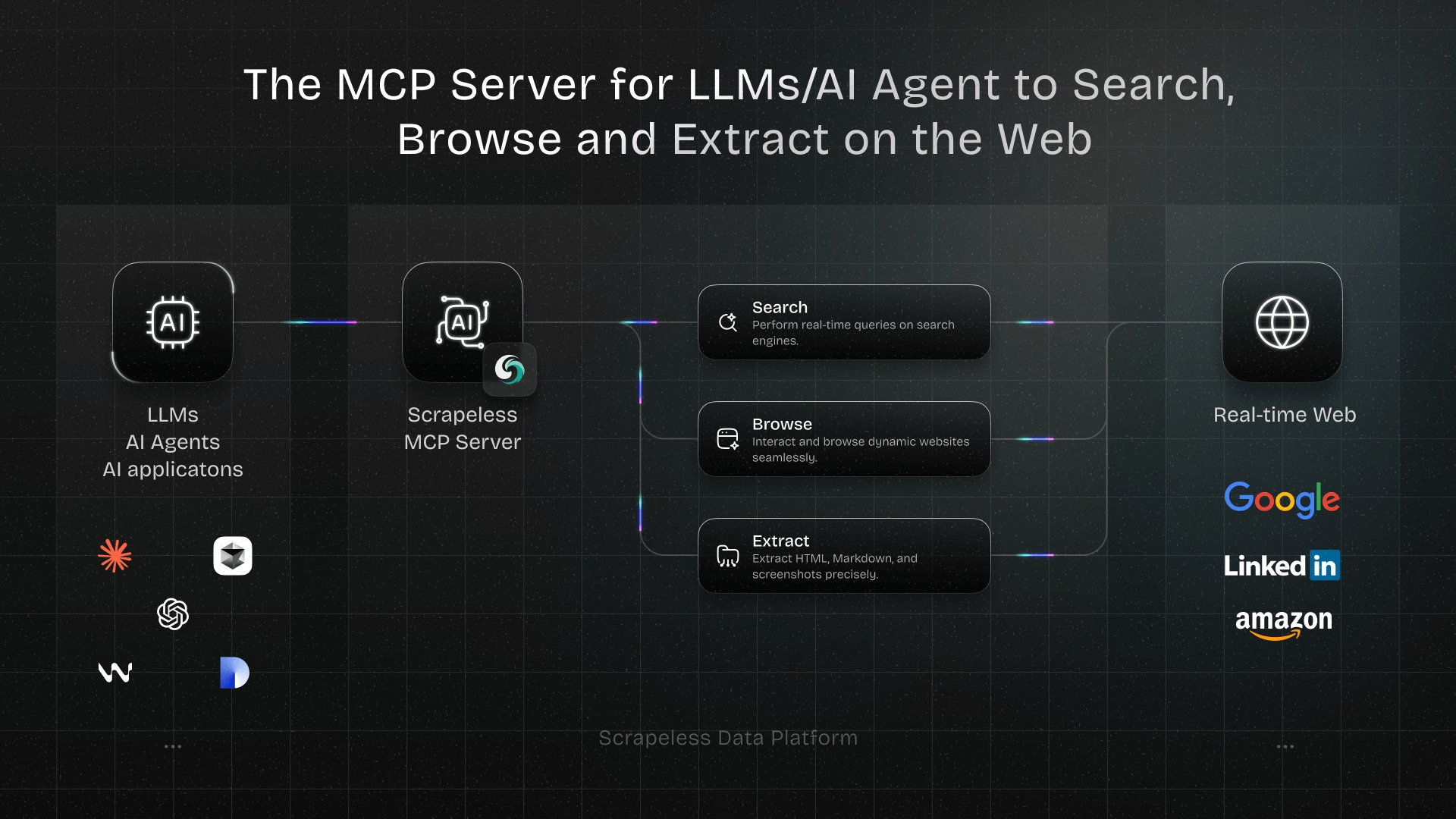
Scrapeless belongs beside LangGraph rather than inside it. LangGraph owns control flow and state. The Scrapeless MCP Server gives the agent bounded search, scrape, and browser capabilities. This split prevents the graph from becoming a collection of source-specific networking code.
Install the framework with pip install -U langgraph. Then give one node a typed web tool, validate its returned schema, and route invalid content to an explicit rejected state instead of passing it to the model.
60-second tool smoke test
On August 7, 2026, we wrapped the same deterministic Python function in LangGraph, OpenAI Agents SDK, and Google ADK. The input was {"topic":"mcp"} and the expected result was {"topic":"mcp","records":2}. All three wrappers returned the exact expected object without calling a model.
That test answers a narrow but useful question: can the installed framework register and execute a typed tool on this machine? It does not compare planning quality, latency, checkpoint recovery, or hosted traces. Run those tests with your own model and deployment target.
Choose it when: the workflow has branches, durable state, human review, or evidence acceptance rules.
Watch for: more graph code than a simple chat loop needs, plus separate decisions for checkpoint storage, traces, and deployment.
2. OpenAI Agents SDK: Best for a Small Python Surface
OpenAI Agents SDK centers on agents, tools, handoffs, guardrails, sessions, and tracing. The API is compact enough for teams that want to build a service in ordinary Python without defining a large workflow graph first. The official SDK documentation is the source to check for current MCP transports and session behavior.
Its MCP support can connect hosted or local servers and convert discovered capabilities into agent tools. Sessions provide conversation continuity, while handoffs let one specialist transfer control to another. The tracing layer records agent and tool activity, subject to your data-handling configuration.
Choose it when: Python is the service language, handoffs match the product design, and OpenAI-compatible agent operations fit the architecture.
Watch for: a flexible loop can hide implicit state transitions. Add explicit budgets, tool approvals, and acceptance checks around web results.
3. Google ADK: Best for Multi-Language Google Cloud Teams
Google's Agent Development Kit supports agents and workflows across several languages, with session services, model adapters, tools, MCP connectivity, and deployment paths. It is a practical candidate for teams already operating on Google Cloud or teams that want the framework to remain model-agnostic.
ADK supports deterministic workflow agents alongside model-driven agents. That makes it possible to keep approval, routing, or validation steps outside open-ended model behavior.
Choose it when: the organization needs Python plus another supported language, Google Cloud integration, or a combination of deterministic workflows and agent reasoning.
Watch for: the product surface is broad. Decide which session store, deployment target, evaluation path, and telemetry stack are actually in scope.
4. Microsoft Agent Framework: Best for Python and .NET Estates
Microsoft Agent Framework brings agent abstractions and graph-based workflows into a shared framework for Python and .NET. Its current documentation covers tools, sessions, middleware, multi-agent patterns, MCP, and workflow orchestration.
This is especially relevant to organizations already using Microsoft Foundry, Azure OpenAI, or .NET services but unwilling to make every agent an Azure-only component.
Choose it when: Python and .NET must share operating patterns, or the team needs enterprise middleware and graph workflows close to Microsoft services.
Watch for: migration expectations. If you have AutoGen or Semantic Kernel code, validate the supported path rather than assuming API compatibility.
5. CrewAI: Best for Role-Oriented Teams
CrewAI models a system as agents with roles and tasks, while Flows provide event-driven control and state. The vocabulary is approachable for business processes that already have recognizable specialists: researcher, reviewer, analyst, and publisher.
MCP adapters can make external servers available to crews. The important design choice is whether a “role” represents a real permission boundary or only a prompt. Production authorization must live outside role descriptions.
Choose it when: role-based delegation maps clearly to the workflow and the team values a higher-level orchestration model.
Watch for: excessive agent-to-agent conversation. Each transfer consumes context and can blur ownership of the final evidence.
6. Pydantic AI: Best for Typed Python Applications
Pydantic AI brings type validation, dependency injection, structured outputs, tools, model adapters, and graph support to Python agent development. It fits teams that want agent code to look like the rest of a typed Python service.
Its validation model is valuable for web research: a tool response can become a typed object before it enters the next decision. MCP support lets the application consume or expose protocol tools without discarding those application-level contracts.
Choose it when: Pydantic already defines your service boundaries and structured outputs are non-negotiable.
Watch for: a valid schema can still contain incorrect content. Add source identity and semantic acceptance tests, not only field types.
7. Mastra: Best for TypeScript Product Teams
Mastra is a TypeScript framework for agents, workflows, tools, memory, evaluations, and observability. It is attractive when agent features live in the same TypeScript codebase as a web product or API.
Its core is largely Apache-2.0, while designated enterprise directories use separate terms. Treat that mapping as part of architecture review, especially if authentication, policy, or managed operations enter the design.
Choose it when: TypeScript is the primary application language and the team wants one framework for agents and deterministic workflows.
Watch for: package and license boundaries across the monorepo, plus storage choices for stateful production runs.
8. LlamaIndex: Best for Retrieval-Centered Agents
LlamaIndex grew from data connectors and indexing into agents, workflows, tools, memory, and deployment options. It remains a strong candidate when the main agent task is to query, transform, and reason over a governed data collection.
Its data abstractions can reduce the amount of plumbing between retrieval and agent tools. For open-web work, however, an index is not a substitute for current acquisition and source validation.
Choose it when: retrieval quality and data connectors dominate the project, and the agent operates close to those pipelines.
Watch for: mixing collection, indexing, retrieval, and reasoning into one opaque step. Keep provenance at every boundary.
9. Strands Agents: Best for AWS-Centered Tool Agents
Strands Agents is an open-source SDK from AWS for model-driven agents with tools, hooks, multi-agent patterns, and MCP clients. It works with AWS services but is not limited to one model provider.
The framework is deliberately tool-oriented. That helps when the application can be expressed as a small set of well-described capabilities and operators want hooks around execution.
Choose it when: the workload already runs on AWS and the team wants a lightweight SDK around model and tool selection.
Watch for: deployment and observability are architecture choices beyond the core loop. Test the exact hosting pattern you plan to operate.
10. Agno: Best for a Self-Hosted Agent Platform
Agno combines agents, teams, workflows, sessions, storage, integrations, approvals, and an API surface intended for deployed agent products. It can fit teams that want more platform behavior out of the box while retaining self-hosting options.
Its MCP and toolkit integrations give agents several ways to reach external systems. Narrow the tool set per task so discovery metadata and permissions remain manageable.
Choose it when: the requirement is an agent platform with sessions, APIs, storage, and operations—not only a Python loop.
Watch for: adopting a broad platform before the workflow is stable. Prove one bounded use case first.
How to Choose an AI Agent Framework
Use the workflow, not the demo, as the decision unit.
Choose by state and failure recovery
If every step must be inspectable and resumable, start with LangGraph, Microsoft Agent Framework, or a deterministic ADK workflow. If the flow is short and conversational, OpenAI Agents SDK or Pydantic AI may require less orchestration code.
Choose by team language
Python-first teams have the broadest selection. TypeScript teams should inspect Mastra and the JavaScript variants of relevant frameworks. Mixed Python/.NET organizations have a clear reason to evaluate Microsoft Agent Framework. Multi-language organizations should include ADK in the test.
Choose by deployment ownership
Ask five concrete questions:
- Where are checkpoints and session data stored?
- Can the runtime resume after a worker stops?
- Which traces leave your environment?
- Can humans approve a tool call before execution?
- Which core and hosted components have separate terms?
The NIST AI Risk Management Framework offers a useful governance vocabulary for mapping, measuring, and managing AI risk. Apply it to the full system, not just the model.
Add Live Web Data Without Coupling It to One Framework
An agent framework should call a stable capability such as search_public_sources or extract_product_fields. It should not know proxy endpoints, browser fingerprints, page selectors, or credential details.
Scrapeless can provide that tool layer through MCP and managed browser or scraping products. Define an allowlist, request schema, result schema, page budget, and acceptance condition. Preserve source URLs and collection context with every accepted record. The Scrapeless AI Agent product page describes the current agent-facing product surface.
Review the Scrapeless documentation for current integration details and Scrapeless pricing against accepted-result cost rather than raw tool-call count.
A Practical Evaluation Plan
Give each finalist the same task, model, tools, source set, and stop condition. Record:
- accepted-result rate and source completeness;
- tool-call count and returned characters;
- checkpoint recovery after an interrupted worker;
- human-approval behavior;
- trace usefulness during a deliberately failed run;
- deployment time and ongoing operational ownership.
Do not crown a winner from a hello-world agent. A framework earns its place when the team can explain a failed production run and recover it safely.
Build the control loop with the framework that matches your state model, then connect a bounded web-data layer. Start with Scrapeless and test one authorized workflow end to end.
FAQ
Q: What is the best AI agent framework in 2026?
There is no universal winner. LangGraph is a strong default for explicit stateful workflows; OpenAI Agents SDK fits compact Python services; Google ADK fits multi-language and Google Cloud teams. The best choice is the one that passes your workflow, recovery, approval, and deployment tests.
Q: Do all AI agent frameworks support MCP?
Many current frameworks support MCP directly or through adapters, but the depth varies. Check transport support, tool filtering, authentication, approvals, and how errors enter agent state.
Q: Is an agent framework the same as an agent platform?
No. A framework is usually a library for building control flow. A platform may also provide hosting, storage, authentication, traces, evaluations, and operations. Some products span both categories.
Q: Should multi-agent systems replace workflows?
Usually not. Use deterministic workflow steps for fixed routing, validation, and approval. Add agent decisions where the task genuinely requires interpretation or planning.
Q: How does Scrapeless work with agent frameworks?
Scrapeless exposes web search, scraping, and browser capabilities as a separate tool layer, including MCP options. The framework keeps ownership of planning and state; Scrapeless handles authorized web acquisition and returns content for validation.
At Scrapeless, we only access publicly available data while strictly complying with applicable laws, regulations, and website privacy policies. The content in this blog is for demonstration purposes only and does not involve any illegal or infringing activities. We make no guarantees and disclaim all liability for the use of information from this blog or third-party links. Before engaging in any scraping activities, consult your legal advisor and review the target website's terms of service or obtain the necessary permissions.