Best Agentic AI Tools in 2026 for Web Research and Data Collection

Lead Scraping Automation Engineer
TL;DR:
- Agentic research combines a planner, web acquisition tools, and an evidence record. These are different responsibilities.
- Scrapeless MCP and Agent Browser supply the web access layer; they do not replace the agent's model or workflow controller.
- LangGraph and CrewAI help organize execution. Exa and Tavily provide search-oriented retrieval.
- Pick the best agentic AI tools by the work your system must perform and the evidence it must preserve.
A research agent needs more than a prompt. It must decide what to investigate, obtain source material, and recognize when that material does not answer the question.
The best agentic AI tools for web research and data collection therefore span several layers. Comparing them as if each were a complete autonomous researcher leads to the wrong purchase and a confused architecture. This shortlist explains what each tool owns and what your application still needs to supply.
Best Agentic AI Tools at a Glance
| Tool | Layer | Best fit | What remains your responsibility |
|---|---|---|---|
| Scrapeless MCP and Agent Browser | Web acquisition | Give an existing agent web tools and browser access | Planning, validation, and report generation |
| LangGraph | Workflow orchestration | Explicit state and controlled execution paths | Web tools, model selection, and evidence rules |
| CrewAI | Agent and workflow orchestration | Role-based work within a managed flow | Source acquisition and acceptance criteria |
| Exa | Search and content retrieval | Relevant source discovery with content options | Planning and synthesis |
| Tavily | Search context | Shape retrieved web context for an agent | Workflow state and factual validation |
The ordering starts with acquisition because this guide is about web research. It does not claim that a data service can replace an orchestration framework.
What Is an Agentic AI Tool?
An agentic AI tool supports a system that selects actions based on a task and the observations returned by those actions. Some tools control execution. Others give the agent a specific capability, such as searching or opening a page.
The distinction matters when a workflow stalls. Missing source text is an acquisition problem. Repeating the wrong investigation is a planning problem. A report with unsupported claims is an evidence validation problem. Buying a more capable model does not automatically solve all three.
How Does an Agentic Research Workflow Work?
A practical research task begins with a scope: the question, allowed sources, expected output, and stopping condition. The planner turns that scope into searches or page requests. The acquisition layer returns observations. A validation step checks whether they support the requested answer before synthesis begins.
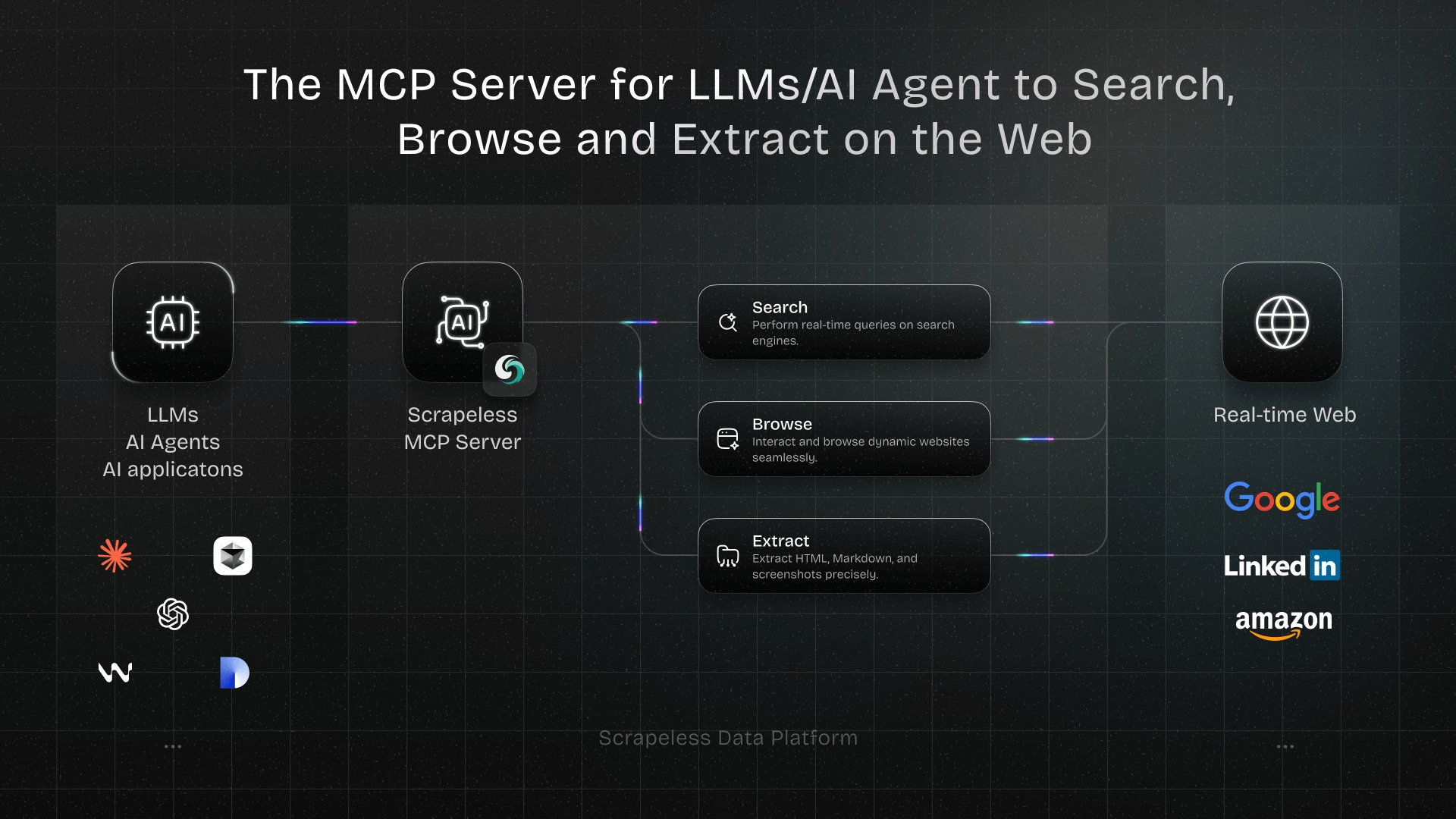
MCP client-server architecture separates the host application from the servers exposing tools. A protocol connection does not make the server responsible for the agent's reasoning.
Treat returned page text as untrusted data. It may include instructions intended for a human reader or attempts to influence the agent. Your task definition and tool policy should remain separate from source content.
How We Evaluated These Tools
This is a comparison of responsibilities and documented capabilities, with a local Scrapeless MCP discovery check. It is not a paid-account benchmark of autonomous completion rates.
The key questions are concrete: can the system obtain the required source material, keep execution state, expose an auditable tool interface, and return evidence that another person can inspect?
For production selection, use one bounded task with known source answers. Require the system to cite the captured passage, preserve the URL, and identify missing information. Count accepted evidence records. A fluent paragraph without source support should fail that evaluation.
1. Scrapeless MCP and Agent Browser: Best for the Web Access Layer
Scrapeless MCP exposes web tools to compatible clients. Agent Browser provides a cloud browser for pages that need rendering or interaction. Together, they fit teams that already have an agent and need access to current web observations.
The acquisition layer returns material your application can evaluate. The planner still chooses the next action, and your application owns the final acceptance rule.
Install and prerequisites
For a local MCP connection, use Node.js and the documented scrapeless-mcp-server npm package. The current quickstart describes local stdio and hosted HTTP connection options. An authenticated web call requires a Scrapeless API key and available account credit.
The local discovery check used the installed server to inspect its tool catalogue without performing a paid web request. A real collection result remains a prerequisite for evaluating page quality.
How you actually use it: prompt your agent
Investigate a public technical question. Search for primary sources, then read the selected pages. Save each URL and the passage supporting each claim. If a page is unavailable or a claim is unsupported, record that explicitly. Do not infer missing facts from a search snippet.
Worked example: research a protocol change
Ask the agent to compare a current protocol specification with an earlier edition. Restrict the source set to the standards body's pages. The deliverable is a table of changed concepts with links and supporting passages, plus a list of unresolved questions.
A suitable execution path is search, select, fetch, validate, and summarize. An interactive browser should be used only when the selected source requires it. A readable standards page does not need a long browser interaction sequence.
For the local tool check, google_search accepts search query context and scrape_markdown accepts a URL. These names and schemas were discovered from the installed server rather than inferred from marketing copy. The check found 25 tools; that observation describes the tested installation, not a permanent product limit.
A 60-second smoke test
Connect the client and inspect its tool list. Confirm the expected search and page-reading schemas before granting the agent access. With a real API key configured, collect one public source and compare its returned text with the intended page.
Success requires the expected source content and URL. Tool discovery alone confirms wiring, not acquisition quality or a completed research report. Model execution also requires the model provider's credentials.
Start Scraping with Scrapeless
Power up your web scraping and automation workflow with Scrapeless!
Sign up today and get $5 in free credit — no credit card required.Claim your free credit now in the Scrapeless Dashboard.
2. LangGraph: Best for Explicit Research State
LangGraph provides infrastructure for stateful workflows and agents. Its graph structure can combine deterministic processing with model-driven decisions, and it supports persistence and human involvement in execution.
It fits a research application whose steps must remain visible and controllable. A developer can define where evidence is accepted, where review is needed, and when synthesis is allowed to begin.
A graph is not a web data source. Add acquisition tools and define the state those tools populate. Avoid storing only the final answer: retain source observations and unresolved questions so later steps can distinguish missing data from completed work.
3. CrewAI: Best for Role-Based Work Inside a Flow
CrewAI combines Crews of agents with Flows that manage state and execution. It is a candidate when your application separates responsibilities such as discovery, extraction, and review.
Those roles should have different acceptance rules. A discovery agent proposes sources; an extraction agent returns captured material; a reviewer decides whether it supports the requested claim. Several agents agreeing with one another is not independent evidence.
Keep the source record outside the agents' conversational summaries. Otherwise a mistaken statement can pass from one role to the next without anyone checking the page.
4. Exa: Best for Finding Sources with Content Options
Exa provides search with requested content options. It fits the discovery step when an agent needs relevant pages and passages to investigate.
Use the returned material to select and validate sources. Exa does not take ownership of your application state or decide whether a report is complete. Your workflow must define when a passage is sufficient, whether a full capture is required, and how conflicting sources are handled.
5. Tavily: Best for Configurable Search Context
Tavily provides search results with controls over retrieval depth and content. It fits applications that want to shape the web context supplied to a reasoning step.
Select settings based on the question. A broad discovery query and a narrow evidence query can require different amounts of context. Preserve those settings with the result so an evaluation can identify whether changes came from the model or the retrieval step.
Side-by-Side Comparison
| Decision | Scrapeless | LangGraph | CrewAI | Exa | Tavily |
|---|---|---|---|---|---|
| Obtain web observations | Web tools and cloud browser | Add tools | Add tools | Search and content | Search context |
| Control workflow state | Host application owns it | Core responsibility | Flows manage it | Application owns it | Application owns it |
| Coordinate reasoning | Bring an agent | Define graph logic | Define roles and flows | Bring a planner | Bring a planner |
| Main acceptance test | Correct source content | Correct execution path | Correct role handoff | Useful source passages | Useful retrieval context |
How Do You Pick the Right Agentic AI Tools?
Start with the responsibility your system lacks. Add web acquisition when the agent cannot obtain usable pages. Add orchestration when the sequence needs explicit state and review. Add retrieval when the system needs better source discovery.
A team can combine these layers. The important design choice is the boundary between them: an acquisition tool returns an observation; the application decides whether it is evidence; the model writes only after that decision.
Preserve data provenance for every accepted claim. Record the URL, captured passage, collection context, and the validation result. The AI data collection guide extends that pattern to a maintained RAG corpus.
Common Use Cases for Agentic Web Research
Technical investigation: discover official documentation, compare supported behaviors, and mark undocumented details.
Public market research: collect product and pricing pages, preserve observations, and summarize differences without treating promotional claims as measurements.
Recurring source monitoring: capture a bounded set of pages and identify relevant changes before asking a model to explain them.
Data collection for analysis: separate raw acquisition from normalized records. Require each record to point back to the material it was derived from.
Why Is Agentic Web Research Difficult?
A tool can return syntactically valid data that does not answer the question. JSON data interchange makes data machine-readable; it does not establish factual support.
A web page may also be unavailable, incomplete, or different from the search result description. The agent needs an explicit unsupported state rather than permission to fill the gap.
Keep access limited to the tools and sources required by the task. MCP security boundaries helps define the boundary between trusted application controls and external content. Restrict collection to authorized public data and respect the Robots Exclusion Protocol.
Conclusion
Choose tools by responsibility. Scrapeless supplies web acquisition for an existing agent. Orchestration frameworks control state and execution. Search services help locate useful sources.
A dependable research workflow joins those layers around an evidence record that remains inspectable after the final answer is written.
Build a focused test in Scrapeless, then compare accepted data against the current pricing. Discuss your setup with the community on Telegram.
FAQ
Q: Is Scrapeless a replacement for an agent framework?
Scrapeless supplies web tools and cloud browser access. Your agent framework or application still controls reasoning, state, and report generation.
Q: Do agentic AI tools need a browser?
Only when the source requires rendering or interaction. A search request or readable page fetch may be sufficient for other tasks.
Q: Can an MCP connection prove that an agent works?
It can prove tool discovery and wiring. A completed task also needs successful acquisition, model execution, and evidence validation.
Q: How should a team compare research agents?
Give each system the same bounded question and source requirements. Evaluate supported claims and inspectable evidence, not only writing quality.
Q: Can several agents validate one another's conclusions?
They can review reasoning, but agreement is not independent source support. Each material claim should still be checked against captured evidence.
At Scrapeless, we only access publicly available data while strictly complying with applicable laws, regulations, and website privacy policies. The content in this blog is for demonstration purposes only and does not involve any illegal or infringing activities. We make no guarantees and disclaim all liability for the use of information from this blog or third-party links. Before engaging in any scraping activities, consult your legal advisor and review the target website's terms of service or obtain the necessary permissions.