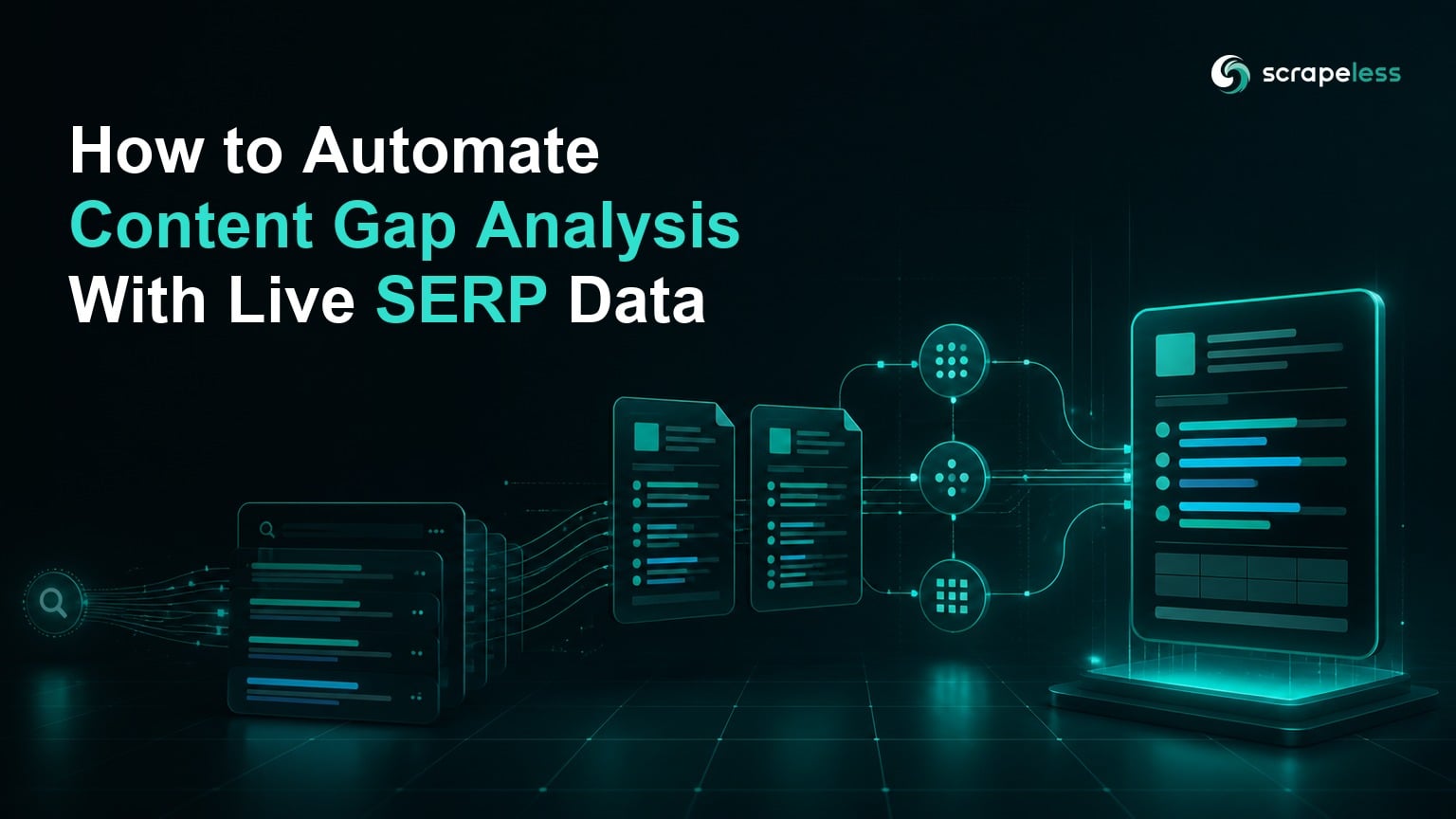
How to Automate Content Gap Analysis With Live SERP Data

Advanced Data Extraction Specialist
TL;DR:
- Automated content gap analysis starts with queries you already own. Search Console exports show where an existing page is visible but under-serves intent.
- A live SERP is the comparison set. Capture result type, ranking URL, title, and snippet before fetching any page.
- Competing pages are structural evidence, not copy sources. Compare headings, topic entities, questions, and content format without reusing prose or figures.
- A gap matrix needs provenance. Every missing topic should point back to the query, result URL, page heading, and collection time that produced it.
- A content brief is the final data product. Priority, recommended format, required sections, FAQ candidates, and validation notes make the analysis actionable.
- Free to start. New Scrapeless accounts include free runtime for testing the search and page-acquisition stages.
Content gap analysis becomes stale as soon as the search results or competing pages change. A spreadsheet assembled once can still guide an editor, but it cannot show whether the evidence moved last week or whether a ranking URL now serves a different page.
An automated workflow fixes that by treating the analysis as a small data pipeline. It starts with first-party query data, captures the current search landscape, fetches the pages that define intent, normalizes structural signals, and turns those signals into a brief that an editor can review.
Pipeline at a Glance
An automated content gap analysis has six stages:
| Stage | Input | Output | Main validation |
|---|---|---|---|
| 1. Select | Search Console query-page rows | Candidate keywords | Query maps to the correct owned page |
| 2. Search | Candidate keyword and locale | Live result set | Result type and final URL are present |
| 3. Acquire | Ranking URLs | HTML or Markdown | Page identity and required content match |
| 4. Normalize | Page headings and text | Comparable topic records | Duplicate and boilerplate headings are removed |
| 5. Score | Owned-page and SERP records | Gap matrix | Every gap retains evidence |
| 6. Brief | Prioritized gaps | Editorial brief | Recommendations match search intent |
The workflow uses Deep SerpApi for structured search results and Universal Scraping API for public ranking pages that need managed acquisition. The APIs solve different jobs, so keep their outputs separate in the schema.
Stage 1 — Choose Keywords From First-Party Data
The best starting queries already have a relationship with your site. Search Console rows can reveal a page that earns impressions for a query but has weak clicks, a page that ranks for several adjacent intents, or a topic whose performance is declining.
The Search Analytics query method returns grouped search-performance data. Export only the fields needed for prioritization and keep the source page beside every query.
A useful candidate record contains:
queryowned_urlcountrydeviceclicksimpressionsposition- the reporting window used for the export
Do not rank candidates by one metric alone. A high-impression term may be irrelevant to the page, while a smaller term can represent a valuable commercial or technical decision. Add a manual intent-fit check before the pipeline spends requests on a query.
Stage 2 — Capture the Live SERP
The live SERP defines what the search engine currently treats as relevant. Record organic results, answer modules, video or image-heavy layouts, and recurring domains as separate result types.
Note: The authenticated request below requires a reader-owned
SCRAPELESS_API_KEY. The request shape and actor are confirmed against the current Deep SerpApi documentation; this environment did not execute the credential-gated call.
python
import os
import requests

response = requests.post(
    "https://api.scrapeless.com/api/v1/scraper/request",
    headers={"x-api-token": os.environ["SCRAPELESS_API_KEY"]},
    json={
        "actor": "scraper.google.search",
        "input": {
            "q": "content gap analysis",
            "gl": "us",
            "hl": "en",
            "google_domain": "google.com"
        }
    },
    timeout=60
)
response.raise_for_status()
if response.status_code != 200:
    raise RuntimeError("The task did not return a direct result")
serp = response.json()
Save the raw response before transforming it. Deep SerpApi returns structured search data, but the pipeline should still preserve the original payload so a reviewer can inspect any parser assumption later.
For each organic result, keep rank, title, URL, snippet, result type, query, locale, and collection time. The search layer should not decide that a heading is missing; it only supplies the candidates for page acquisition.
Stage 3 — Acquire Ranking Pages Without Losing Identity
A ranking URL is not enough evidence. The fetch stage must confirm that the final URL, page title, and main content describe the result selected in Stage 2.
HTTP status is only one part of that check. The HTTP semantics specification defines response status and representation metadata, but a successful response can still contain a consent screen, generic index, or challenge page.
Use Universal Scraping API when direct HTTP does not return the required public content. The current JavaScript-rendering route accepts unlocker.webunlocker with a target URL and a response type such as HTML or Markdown.
Note: This acquisition block also needs
SCRAPELESS_API_KEY; it is a documented prerequisite rather than a claimed live result.
python
page = requests.post(
    "https://api.scrapeless.com/api/v2/unlocker/request",
    headers={"x-api-token": os.environ["SCRAPELESS_API_KEY"]},
    json={
        "actor": "unlocker.webunlocker",
        "proxy": {"country": "ANY"},
        "input": {
            "url": "https://example.com/ranking-page",
            "jsRender": {
                "enabled": True,
                "response": {"type": "markdown"}
            }
        }
    },
    timeout=60
)
page.raise_for_status()
payload = page.json()
if payload.get("code") != 200:
    raise RuntimeError("The page response was not accepted")
markdown = payload["data"]
Follow the Robots Exclusion Protocol, site terms, and applicable law. Content gap analysis needs public editorial structure, not private pages, account-only content, or personal records.
Start Scraping with Scrapeless
Power up your web scraping and automation workflow with Scrapeless!
Sign up today and get $5 in free credit — no credit card required.Claim your free credit now in the Scrapeless Dashboard.
Stage 4 — Normalize Headings, Topics, and Questions
Normalization converts pages with different markup into comparable records. Extract the title, H1, H2 and H3 text, visible question headings, content type, and a small set of topic phrases. Remove navigation labels, repeated footer text, and empty headings.
The schema should stay boring and explicit:
json
{
  "query": "content gap analysis",
  "ownedUrl": "https://example.com/owned-page",
  "resultUrl": "https://example.org/ranking-page",
  "resultType": "organic",
  "rank": 3,
  "contentType": "tutorial",
  "headings": ["What a content gap is", "Build a gap matrix"],
  "questions": ["How often should the analysis run?"],
  "topics": ["search intent", "page structure", "content brief"],
  "collectedAt": "illustrative timestamp"
}
This is an illustrative record shape. Production values come from the saved search response and acquired page, not from generated prose.
Stage 5 — Build the Gap Matrix
The gap matrix compares signals, not sentences. A topic counts as covered when the owned page resolves the same reader need, even if it uses different wording.
Score each candidate on:
- SERP recurrence: how many distinct ranking pages cover the topic;
- intent fit: whether the topic belongs on the owned page;
- owned coverage: absent, thin, outdated, or already sufficient;
- evidence quality: heading-level evidence is stronger than a passing phrase;
- business value: the decision or task the section helps the reader complete.
This deterministic example ranks gaps from normalized topic sets:
python
from collections import Counter

owned_topics = {"definition", "keyword gaps"}
ranking_pages = [
    {"search intent", "keyword gaps", "content brief"},
    {"search intent", "topic gaps", "content brief"},
    {"search intent", "content brief", "faq questions"},
]

frequency = Counter(topic for page in ranking_pages for topic in page)
gaps = [
    {"topic": topic, "pageCount": count, "priority": "high" if count >= 2 else "review"}
    for topic, count in frequency.most_common()
    if topic not in owned_topics
]

print(gaps)
The output is reproducible because it separates collected evidence from editorial judgment. A reviewer can change the intent-fit or business-value decision without rerunning search and acquisition.
Stage 6 — Generate a Reviewable Content Brief
The brief should explain what to change and why. A useful output includes:
- recommended content type and reader job;
- existing sections to keep, merge, or expand;
- missing topics ordered by priority;
- common questions that deserve direct answers;
- evidence URLs for internal review;
- validation notes for claims that need a primary authority;
- a clear instruction not to copy competitor wording, examples, or numbers.
The page can also expose Article metadata aligned with the Article vocabulary, but structured data does not replace a useful section or verified claim.
Schedule the Pipeline Around Decisions
Run the workflow when the evidence can change a decision: before a major refresh, after a meaningful ranking shift, or on a schedule for high-value pages. Do not crawl the same SERP and pages continuously without an editorial consumer.
Store raw responses separately from normalized records. Version the gap matrix and brief, then compare each run so editors see which topics appeared, disappeared, or changed priority.
Conclusion
Automated content gap analysis is a six-stage evidence pipeline: select a query, capture the live SERP, acquire ranking pages, normalize structure, score gaps, and produce a reviewable brief. The hard part is not generating more ideas. It is preserving provenance while turning changing web evidence into an editorial decision.
Use Deep SerpApi for search structure, Universal Scraping API for page acquisition, and a deterministic matrix for comparison. Keep the final content decision with an editor.
Build a Repeatable SEO Research Pipeline
See how a competitive pricing pipeline preserves evidence across stages, compare current pricing, and create a Scrapeless account. Join developers building public-web data workflows on Discord or Telegram.
FAQ
Q: What is content gap analysis?
Content gap analysis identifies topics, questions, or intents that an audience needs but an existing content set does not cover well.
Q: What should be automated first?
Automate repeatable collection and normalization first; keep intent fit, business value, and final editorial decisions reviewable by a person.
Q: Should the pipeline copy headings from ranking pages?
No. Ranking pages provide structural evidence about recurring reader needs, not language to reproduce.
Q: Why combine search data with page extraction?
Search data identifies which pages define the current result set, while page extraction reveals the topics and questions those pages actually cover.
Q: How often should content gap analysis run?
Run it when updated evidence can affect a refresh or publishing decision, with a cadence matched to the page's business value and SERP volatility.
Q: Is automated competitive content analysis legal?
Use publicly available pages, honor access controls and applicable site terms, minimize collection, and obtain legal advice for the relevant jurisdiction and use case.
At Scrapeless, we only access publicly available data while strictly complying with applicable laws, regulations, and website privacy policies. The content in this blog is for demonstration purposes only and does not involve any illegal or infringing activities. We make no guarantees and disclaim all liability for the use of information from this blog or third-party links. Before engaging in any scraping activities, consult your legal advisor and review the target website's terms of service or obtain the necessary permissions.