AI Search Visibility: Measure Mentions, Rank, and Citations

Web Data Collection Specialist
TL;DR:
- AI search visibility is the measurable presence of a brand, product, or source inside generated answers.
- Mention rate, answer order, and citation share describe different outcomes. Keep them separate and retain the answer evidence behind each value.
- A fixed prompt set is necessary but not sufficient. Market, language, model, prompt version, and collection time must travel with every sample.
- Visibility monitoring is an observation program, not a one-time ranking check. Repeated samples reveal whether a change is durable or isolated.
A brand can appear in one AI answer, vanish from the next, and receive a citation in a third. Calling any one of those samples “the ranking” hides the behavior teams need to understand.
AI search visibility becomes useful when it is treated as a dataset. Define the entities, prompts, markets, and evidence first. Derive metrics only after the raw answers and citations are stored.
What AI Search Visibility Measures
AI search visibility measures whether and how an entity appears in answers generated by surfaces such as ChatGPT, Gemini, and Perplexity. The unit of observation is one answer to one prompt under a recorded context.
The original GEO paper established a research framing for improving visibility in generative engines. For monitoring, the practical job is narrower: capture what appeared, where it appeared, which source was cited, and under what sampling conditions.
Define the Entity Before You Count It
Brand matching becomes unreliable when a name is also a common word, a product family, or another organization. Create an entity dictionary with:
- Canonical brand and product names.
- Accepted spelling and capitalization variants.
- Domains controlled by the entity.
- Disallowed ambiguous matches.
- Competitor and category entities used for comparison.
Keep “brand mentioned” separate from “owned domain cited.” An answer may name the brand while citing a publication, or cite an owned page without naming the brand in the visible answer.
Build a Prompt Set Around Decisions
A useful prompt inventory represents the questions customers ask at different stages.
| Prompt family | Intent | Example shape |
|---|---|---|
| Definition | Understand a concept | “What is …?” |
| Problem | Diagnose a need | “How can a team …?” |
| Category | Discover options | “Which tools support …?” |
| Comparison | Evaluate tradeoffs | “Compare approaches for …” |
| Constraint | Filter options | “What works for [market or requirement]?” |
| Follow-up | Test answer depth | A grounded question based on the first answer |
Do not change wording casually. Assign every prompt a version, and retain retired versions so a measurement shift can be separated from an editorial change.
Record the Sampling Context
Generated answers can vary with the surface and session. Store these fields with every observation:
- Prompt ID and exact text.
- Surface and model label shown to the user.
- Market, language, and device context where applicable.
- Collection timestamp.
- Whether the session was fresh or continued.
- Full answer text.
- Ordered entity mentions.
- Citation URLs and domains.
- Screenshot or raw-response reference.
The answer itself is the evidence. A row that contains only “position” cannot be rechecked when the parser or entity dictionary changes.
The Core AI Visibility Metrics
Mention rate
Mention rate is the share of eligible answers that contain the defined entity. The denominator must use the same prompt set, markets, and sampling policy across comparisons.
Average first-mention order
For answers that list multiple options, record where the entity first appears. Do not force narrative answers into a false ranked list; mark order as not applicable when the answer has no comparable sequence.
Citation rate
Citation rate is the share of eligible answers that include at least one citation to a defined owned domain or source set. It should not be inferred from a brand mention.
Citation share
Citation share compares citations associated with the entity against all citations in the eligible answer set. Deduplicate repeated URLs according to a documented rule.
Source diversity
Source diversity counts the distinct domains or source classes supporting the topic. A broad mix can indicate that visibility does not depend on one publisher.
Start Scraping with Scrapeless
Power up your web scraping and automation workflow with Scrapeless!
Sign up today and get $5 in free credit — no credit card required.Claim your free credit now in the Scrapeless Dashboard.
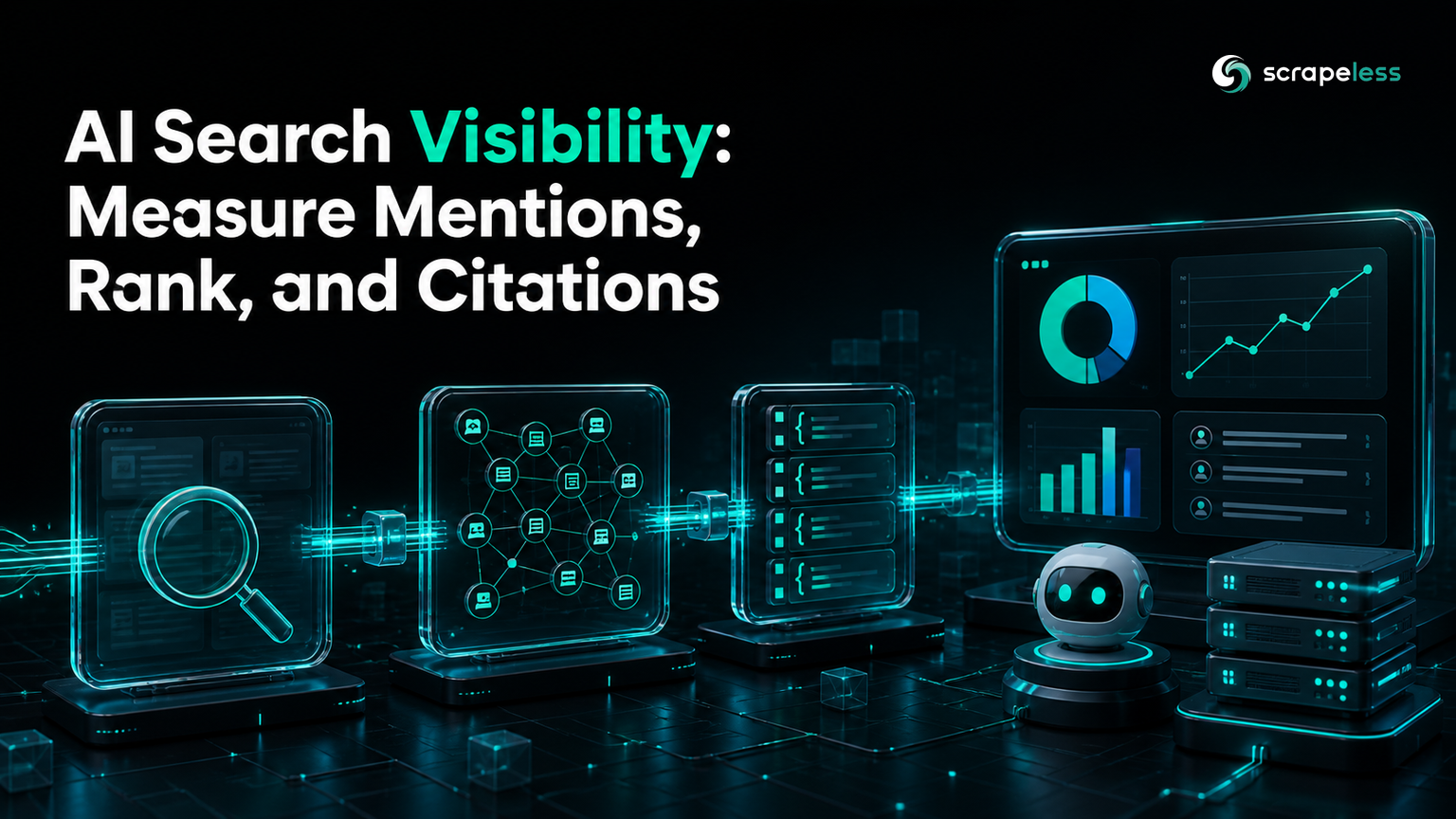
A Measurement Pipeline That Preserves Evidence
Use a simple sequence:
- Freeze the prompt, entity, market, and surface versions for the collection window.
- Collect answers under those declared contexts.
- Store raw text and citations before parsing.
- Normalize entity and domain matches with explicit rules.
- Calculate mention, order, citation, and diversity metrics separately.
- Review samples that changed state or failed parsing.
- Publish a dashboard linked back to the underlying evidence.
The pipeline should be append-only at the raw layer. Corrections belong in parsing rules and derived tables, which lets analysts recompute history without rewriting what the model returned.
Compare Markets Without Mixing Them
An English prompt from one market and a localized prompt from another do not form a clean ranking contest. Report visibility by market and language first. Add a global rollup only with a transparent weighting rule based on business importance.
The same separation applies to surfaces. ChatGPT, Gemini, and Perplexity have different interfaces, citation behaviors, and session controls. A cross-surface summary is useful, but the per-surface evidence must remain available.
Avoid False Precision
Generative visibility research is still developing. A critical survey of GEO identifies unresolved conceptual and evaluation issues. Operational dashboards should therefore show sample counts, collection context, and uncertainty rather than presenting one decimal as a universal truth.
Common sources of false precision include:
- Treating an unranked narrative as an ordered list.
- Counting a substring without entity disambiguation.
- Mixing prompt versions in one trend line.
- Comparing markets with different prompt inventories.
- Dropping answers that contain no mention from the denominator.
- Counting redirected or duplicated citation URLs as separate evidence.
Turn Measurements Into Content Decisions
Metrics are diagnostic signals, not publication instructions.
- Mention weak, citations strong: the sources are present, but the entity may not be clearly connected to the category.
- Mention strong, citations weak: the brand is known, but the answer lacks owned or attributable evidence.
- One market strong, another weak: inspect localized entities, sources, and topic coverage.
- One prompt family weak: improve the content that answers that decision stage rather than rewriting unrelated pages.
- Source diversity falling: investigate dependence on one citation domain and strengthen original evidence.
Google's guidance for AI features in Search reinforces a useful baseline: make content accessible, technically sound, and valuable to people. Monitoring cannot compensate for weak source material.
Collect LLM Answer Data With Scrapeless
Scrapeless Universal Scraping API includes LLM-oriented collection surfaces for gathering answer and citation evidence across supported platforms. Use a fixed request schema and retain raw output alongside normalized metrics.
The LLM scraper comparison guide explains collection choices, and the Scrapeless pricing page provides current usage terms.
Where This Leaves Us
AI search visibility is not one rank. It is a set of observations about mentions, order, citations, sources, prompts, markets, and time. Preserve those observations first, then build metrics that remain explainable when an answer changes.
Ready to Build an AI Visibility Dataset?
Join the Scrapeless community on Discord or Telegram. Open the Scrapeless Dashboard to start collecting structured answer evidence.
FAQ
Q: What is AI search visibility?
AI search visibility is the measured presence of an entity or its sources inside generated answers under a defined prompt, market, surface, and sampling context.
Q: Is a brand mention the same as a citation?
No. A mention names the entity in answer text. A citation links to a source. Either can occur without the other.
Q: How do you rank brands in ChatGPT, Gemini, or Perplexity?
Record first-mention order only when the answer presents comparable options. Keep unranked narrative answers as mention observations instead of inventing an order.
Q: Why should raw AI answers be stored?
Raw answers let analysts recheck entity matches, citation parsing, and context after measurement rules change.
Q: How should prompt changes be handled?
Version every prompt. Report a break or parallel sample when wording changes materially so the trend does not confuse a new instrument with a visibility change.
Q: Can AI visibility be summarized in one score?
A rollup can support reporting, but it should link to separate mention, order, citation, source, market, and sample metrics. The underlying evidence remains the authoritative record.
At Scrapeless, we only access publicly available data while strictly complying with applicable laws, regulations, and website privacy policies. The content in this blog is for demonstration purposes only and does not involve any illegal or infringing activities. We make no guarantees and disclaim all liability for the use of information from this blog or third-party links. Before engaging in any scraping activities, consult your legal advisor and review the target website's terms of service or obtain the necessary permissions.