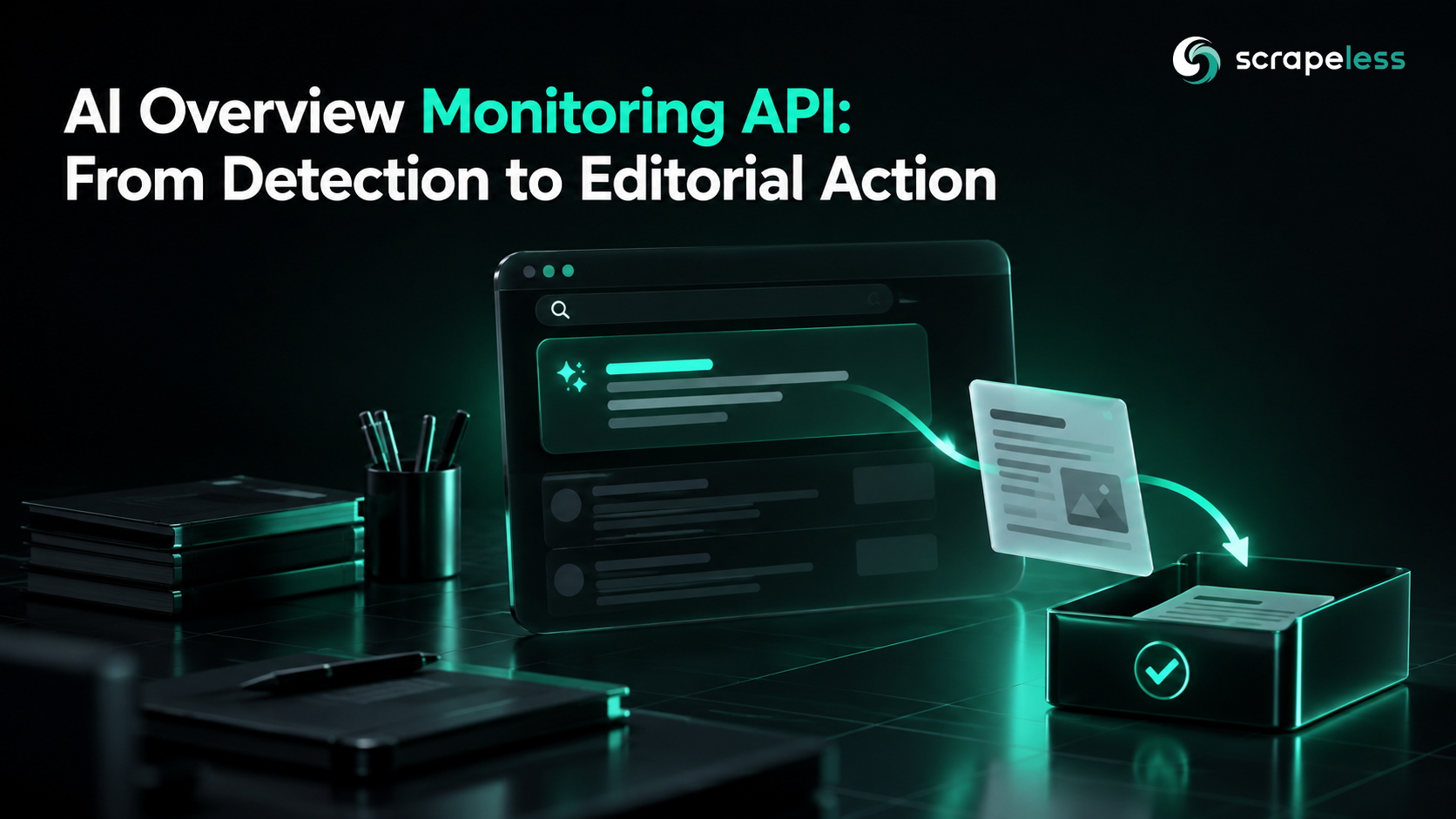
AI Overview Monitoring API: From Detection to Editorial Action

Senior Web Scraping Engineer
TL;DR:
- AI Overview monitoring needs an editorial destination. Assign each meaningful source change to a decision owner before increasing collection volume.
- Citation changes need preserved context. Keep the question, market, answer evidence, and source relationship together when creating a review item.
- Ordinary rankings provide a separate comparison. Use Google Search API context to investigate search presence without treating an organic result as an AI citation.
- A monitoring queue should distinguish investigation from publication. A detected change warrants review; it does not automatically justify rewriting a page.
Introduction: A Source Change Is an Editorial Question
An AI answer can cite a page that addresses a buyer's question more directly than a brand's own landing page. For a content team, the useful question is what that source contributes: a definition, a comparison criterion, a product detail, or an explanation that deserves closer inspection. A list of changed domains alone cannot answer that question.
An ai overview monitoring api belongs in a workflow that connects observation to editorial judgment. Collection should produce evidence that an editor can inspect, classify, and use to decide whether work is warranted. That workflow needs a destination even when the decision is to leave existing content unchanged.
The approach below is a planning framework, with hypothetical editorial cases rather than captured search results. It connects the Google Search API to a broader Google search intelligence program, while keeping the dedicated AI Overview surface distinct. The AI search and GEO scenario provides the relevant product starting point for answer and source collection.
Start With the Decision an Editor Can Make
An editorial monitoring program should start with a decision that its team has authority to carry out.
Consider a hypothetical procurement publisher covering inventory software. The publisher can improve an explanation of stock reconciliation, correct an outdated product capability, or commission a comparison of implementation requirements. It cannot control whether an answer engine selects that page as a source. Define success around better informed editorial choices before tracking downstream visibility.
Write the intended decision on each monitoring brief. A comparison query might support a review of missing evaluation criteria. A troubleshooting question might reveal that the existing page does not explain an important prerequisite. A definition query might point to unclear terminology. Those briefs require different reviewers and should not enter the same undifferentiated backlog.
Name the action that closes each item. Closure may mean a correction accepted, an outline commissioned, an unsupported claim rejected, or no change justified. Keeping the decision explicit prevents the dashboard from becoming a permanent collection of interesting observations that nobody has the time or authority to use.
Also specify the evidence that would change the editor's mind. A surprising source may be irrelevant after inspection. An unfamiliar domain may host an authoritative original document. The review brief should invite either conclusion and preserve the reasoning rather than reward the reviewer for finding a content gap every time.
Build a Collection Brief Around Content Responsibilities
A collection brief should describe the question family, the intended audience, and the content asset that could respond.
Organize questions by an actual editorial responsibility. Product education, category explanation, evaluation support, and customer troubleshooting are practical divisions. A broad topic label such as software creates too little accountability. A narrower responsibility such as explaining stock valuation gives the reviewer a meaningful reason to inspect a source change.
Preserve the wording approved for observation. If an editor wants a more specific question, create a documented revision instead of silently replacing the original. Keep a note explaining whether the new wording reflects a changed audience need or simply improves clarity. Otherwise, a later answer difference may be mistaken for a visibility change on a stable question.
Separate stable questions from event-driven investigations. A recurring education question can remain in a retained monitoring set. A temporary launch question may belong in a short review project with an end condition. Both can be useful, but their outputs should not be blended into a continuous trend without explaining their different purposes.
Assign ownership at the question-family level so related observations reach the same editorial context. Individual evidence items can still be redirected to a subject expert. The ownership map should survive staff changes, which means it needs a maintained team destination rather than a person's private notes or an unmonitored inbox.
Keep the AI Answer and Organic Context Distinct
AI Overview sources and ordinary organic results should enter the investigation as separate evidence streams.
Use the dedicated AI Overview product path for the generated answer and its associated sources. Use Google Search API for ordinary search context. Ask for confirmation of the specific collection surface during evaluation rather than assume that a product returning organic results also supplies every generated-answer feature.
The AI Overview collection architecture explains the dedicated surface. For an editorial handoff, the important distinction is the relationship between a cited source and the observed answer. An organic page on the same domain can help investigate the publisher's wider presence, but it does not establish that the page supported the generated answer.
Preserve the collection context independently for each stream. If ordinary results were observed during a different reporting window, make that relationship visible. Avoid presenting the two records as a single page capture merely because their question text matches. Editors should know what was observed together and what was assembled later for comparison.
Let the comparison guide questions rather than conclusions. Strong organic presence with limited answer citations might justify inspecting source suitability. Weak presence in both streams might justify a broader discoverability review. Neither pattern alone proves why an answer selected a source, and the workflow should leave that causal question open.
Give Every Review Item an Evidence Packet
A review item should include enough evidence for an editor to inspect the observation without reconstructing the collection process.
Keep the observed answer representation, associated source destinations, question context, observation time, and collection surface together. Add the previous comparable observation when the item is described as a change. An editor should be able to distinguish a new citation from a newly added question that has no comparison history.
Record the transformation that produced the review item. A domain grouping, alias match, or duplicate-source filter changes how raw observations become a human task. The W3C provenance framework describes how data can retain information about its origin and processing. Apply that principle by keeping the observation and the editorial interpretation separately identifiable.
An evidence packet also needs a short question for the reviewer. For example: does the cited destination explain implementation constraints missing from the existing page? That is more useful than an instruction to improve GEO. It focuses the review on a specific content responsibility and makes a no-change outcome defensible.
The W3C privacy principles provide a general foundation for limiting unnecessary personal data in shared evidence.
Keep sensitive or irrelevant material out of the packet. A search question supplied by a customer may contain details that the editorial team does not need. Use approved public or appropriately minimized question sets and limit evidence access to the people responsible for the decision.
Start Scraping with Scrapeless
Power up your web scraping and automation workflow with Scrapeless!
Sign up today and get $5 in free credit — no credit card required.Claim your free credit now in the Scrapeless Dashboard.
Route Source Changes by Their Editorial Meaning
Source changes should be routed according to the type of content judgment they require.
A factual discrepancy belongs with someone who can verify the underlying fact. A missing explanation belongs with an editor who can improve the page's educational structure. A product comparison belongs with a reviewer who understands the relevant selection criteria. Routing everything to the SEO owner creates a bottleneck and can encourage changes outside that person's expertise.
Use a hypothetical example to establish the distinction. Suppose a generated answer cites a technical manual while the brand page offers only a feature summary. The review question is whether readers need a clearer explanation of configuration requirements. That does not mean the brand should copy the manual or reproduce the answer's wording.
Another hypothetical case concerns an unrelated brand with a similar name. This belongs in identity resolution before any editorial work begins. A third case is a source link moving to another page within the same publisher. Investigate the destination and source relationship before announcing a competitive loss or commissioning replacement content.
Preserve the reason for the routing choice. Later reviewers may disagree, and a recorded rationale makes reassignment constructive. It also helps improve the rules when a queue repeatedly sends technical questions to general editors or business questions to implementation specialists.
A review label is also a quality annotation. The Data Quality Vocabulary offers a general way to describe such information without treating an annotation as the original observation.
Review Queue Health Before Increasing Coverage
A monitoring queue is useful only when the team can resolve the decisions it creates.
Track unresolved workload by editorial responsibility, not just total item count. A small queue of highly technical claims can require more effort than a larger queue of straightforward source classification tasks. Ask reviewers where evidence is missing, where ownership is unclear, and where a topic needs specialist support.
Create an explicit waiting state for items that cannot yet be decided. Missing source evidence, unavailable subject expertise, and an unresolved question definition are different conditions. Their labels should tell the program owner what would unblock the review. A generic pending status provides too little information to improve the process.
The W3C data publishing practices cover metadata and versioning. Carry that discipline into the question catalog and review rules so a team can identify which definition applied when a task was created. This is an operational recommendation rather than a claim that a standard prescribes a particular editorial workflow.
Expand the monitored portfolio when the existing queue produces useful decisions and the evidence burden is understood. If reviewers repeatedly close items as uninterpretable, improve the evidence packet first. More observations under the same weak review design will multiply the uncertainty instead of resolving it.
Turn Accepted Findings Into Scoped Content Work
An accepted finding should become a content task with a reader problem and an acceptance condition.
Write the task around the explanation that readers need. A brief might ask for a clearer account of inventory reconciliation prerequisites, with review by a product specialist and a check that the terminology matches current documentation. The task should not promise that publication will produce an AI citation.
Keep original source analysis separate from the new draft. Editors can study which questions a source answers without borrowing its phrasing or organization. Use primary product material and subject expertise to develop the final explanation. That produces useful work even if the observed answer changes before the content is published.
Define what the reviewer will accept before drafting begins. Accuracy, clear scope, current product details, and direct answers to the intended reader question are reasonable criteria. A visibility outcome remains an observation to evaluate later, rather than a condition a writer can guarantee during production.
After publication, preserve the content change record alongside the monitoring history. The PROV data model distinguishes entities and activities; the practical application here is keeping a page revision separate from the observation used to justify it. Temporal proximity alone does not establish that the revision caused a later citation.
Evaluate Scrapeless Against the Handoff You Need
A Scrapeless evaluation should assess whether the collected evidence supports your editorial handoff.
Bring a defined question family, an example review packet, and the required distinction between AI Overview and ordinary search. Ask which product surface supplies each element and what limitations the team should expect. Evaluate source association, context retention, and export suitability without assuming that every observation contains an answer or citation.
Review Scrapeless pricing against the collection scope and evidence retention your workflow requires. Collection charges are only part of the operating cost: reviewer time, question maintenance, source inspection, and correction handling also need an owner. A cheaper observation can still be expensive if nobody can interpret it.
Agree on a bounded evaluation outcome. The team should be able to take an observation through classification, subject review, and a documented decision. That provides a concrete basis for choosing Google Search API context and the dedicated AI surface together, without needing a fabricated benchmark or a promise of citation growth.
Conclusion: Close the Loop at the Editorial Decision
An ai overview monitoring api becomes valuable when its evidence reaches someone who can make a useful content decision. Start with the editorial responsibility, preserve answer and source context, and keep ordinary rankings as a separate comparison. Expand coverage after the team can explain which observations led to corrections, better explanations, or justified no-change decisions.
Ready to Build Your Search Evidence Program?
Join developers working on search data in Discord and Telegram.
Start your Scrapeless evaluation with a defined question portfolio and an accountable decision owner.
FAQ
Q: What should an AI Overview monitoring API workflow produce?
An AI Overview monitoring API workflow should produce inspectable answer evidence and a clearly owned review decision. A source-change alert is an intermediate artifact rather than the final business outcome.
Q: Can ordinary Google rankings prove an AI citation?
Ordinary Google rankings cannot prove an AI citation. Keep the dedicated answer's source relationship distinct from a page's appearance in organic results.
Q: Should every citation change trigger a page rewrite?
A citation change should trigger classification when it is relevant to the monitoring brief. Rewrite a page only when the review identifies a reader problem that the team can substantiate and improve.
Q: How should a team evaluate Scrapeless for this scenario?
Evaluate Scrapeless using a representative question family and a complete editorial handoff. Confirm the specific product surfaces, evidence requirements, commercial scope, and limitations before expanding the program.
At Scrapeless, we only access publicly available data while strictly complying with applicable laws, regulations, and website privacy policies. The content in this blog is for demonstration purposes only and does not involve any illegal or infringing activities. We make no guarantees and disclaim all liability for the use of information from this blog or third-party links. Before engaging in any scraping activities, consult your legal advisor and review the target website's terms of service or obtain the necessary permissions.