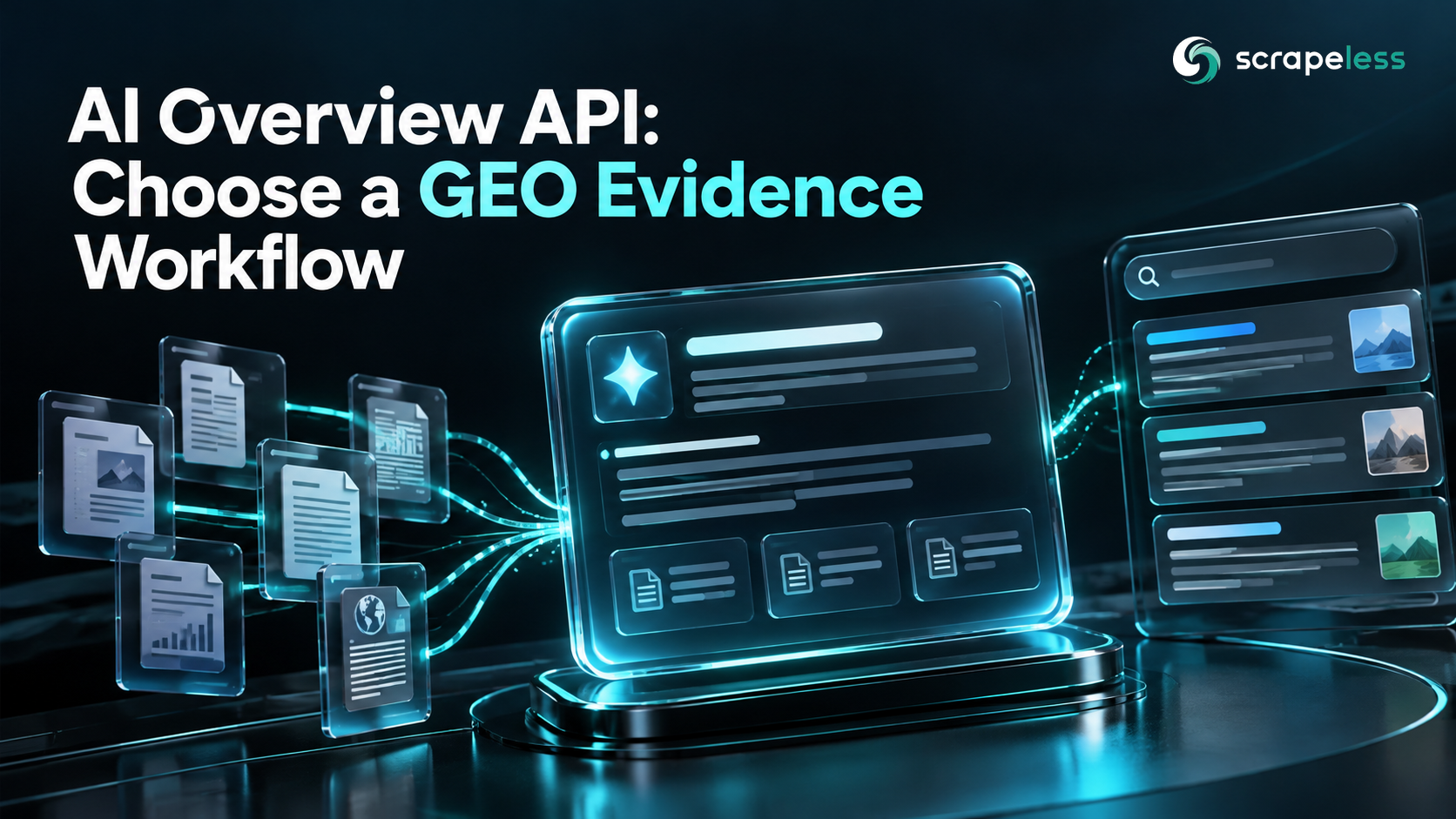
AI Overview API: Choose a Defensible GEO Evidence Workflow

Advanced Data Extraction Specialist
TL;DR:
- An AI Overview API should support a defined GEO decision. Choose whether the first workflow investigates answer wording, cited sources, or changes beside organic results.
- Answer collection and organic rank collection need distinct treatment. Scrapeless identifies a dedicated AI Overview actor alongside ordinary Google search collection.
- A source link and a brand mention provide different evidence. Preserve both concepts before deciding what your report should call visibility.
- A useful buyer brief includes uncertainty and review ownership. Unknown answer state and disputed source identity need explicit handling.
- Free to start. Bring a bounded query portfolio to a Scrapeless search evidence evaluation.
Introduction: An Answer Can Discuss a Category Without Citing Your Site
An AI answer can describe a product category, mention a brand, and link to a different publisher. Each observation has a different implication for a marketing team. A buyer who asks only whether an API captures AI Overviews can miss the more useful question: which evidence must the team inspect to make its next decision?
An AI Overview API buying process should begin with that question. Scrapeless Google Search API belongs in the evaluation because structured organic search context can sit alongside AI answer evidence. The AI Overview surface uses a dedicated collection path, so the brief must distinguish what each collection task is expected to provide.
The scenarios here are proposed editorial and product planning exercises. They contain no live response samples, measured citation gains, or claims of an executed integration. The purpose is to help GEO tool teams choose an evidence workflow that can support real customer decisions without overstating what a search observation proves.
Choose the First Decision Before Choosing Dashboard Features
The first GEO workflow should serve a named decision with a clear reviewer.
A content team may want to understand which kinds of explanations are cited for a category question. A brand team may need to review an inaccurate description. A product team may want to compare cited destinations with the organic results shown for related queries. These tasks share collection infrastructure but require different evidence and different follow-up work.
Consider a hypothetical software company researching a procurement question. If the concern is an inaccurate eligibility claim, the answer wording matters. If the concern is the absence of its documentation among sources, the citation set matters. If the concern is a changed landing page, organic destination context may matter more than either.
Use the AI search visibility and GEO solution to frame the business scenario, then narrow the first release to a task the customer can explain. A broad visibility dashboard can come later. Early qualification is more useful when the buyer can point to the evidence required for an actual review case.
Preserve the Boundary Between AI Overview and Organic Search
AI Overview evidence and ordinary Google search observations should retain separate collection identities.
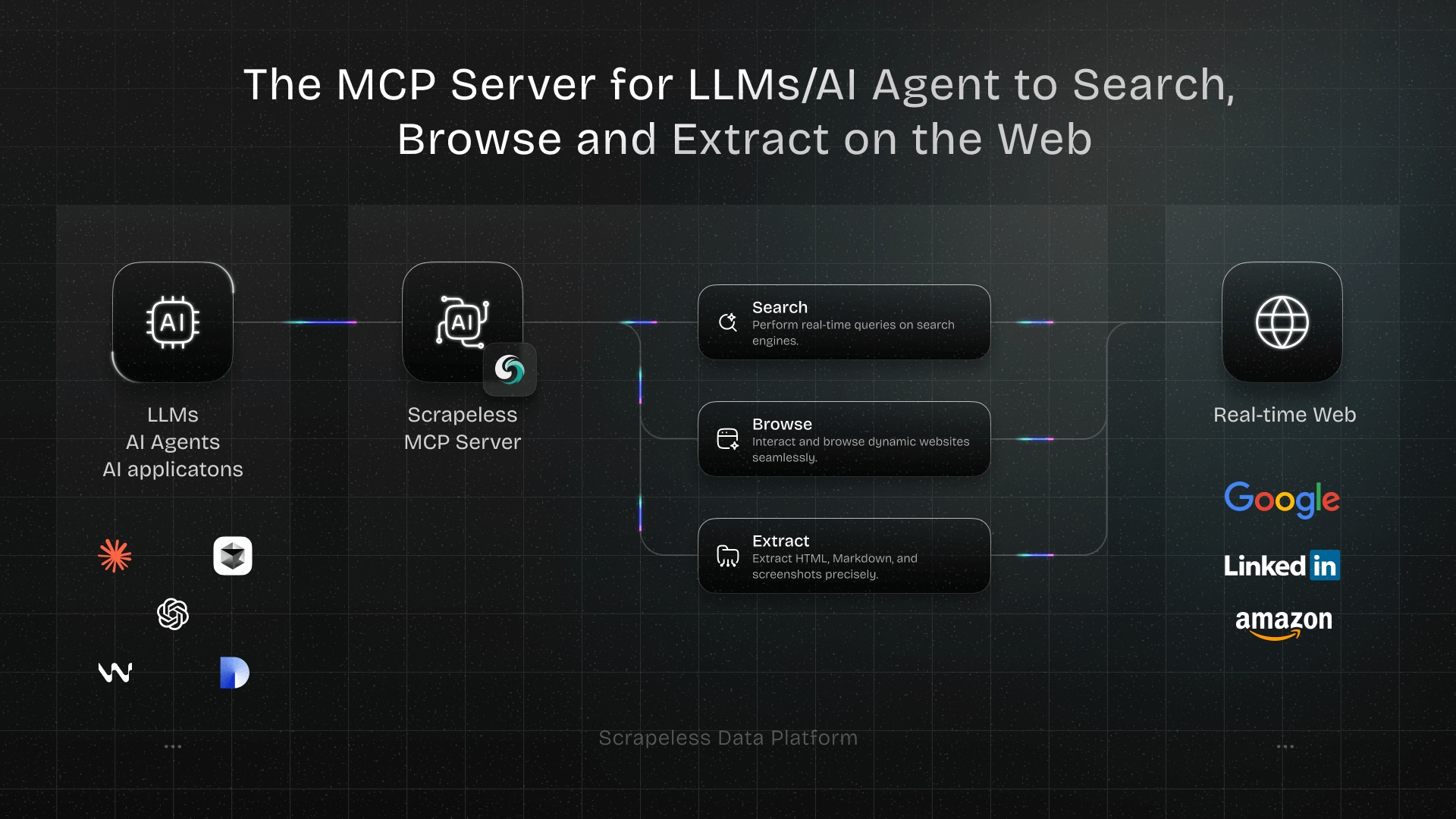
Scrapeless identifies scraper.overview for AI Overview collection and scraper.google.search for classic search results. The current AI Overview documentation describes the dedicated AI surface. Treat these identifiers as a routing distinction, not as permission to assume that every result field or parameter works identically across both tasks.
A buyer should ask which collection path supplies the answer, which supplies citations, and which supplies organic destinations. The JSON data interchange format defines a shared representation rather than a shared business meaning. Keep those responsibilities explicit even when a product experience presents them together. This prevents the implementation brief from promising answer evidence that has only been qualified for ordinary search collection.
When the product combines observations in a report, retain their individual context and collection times. A joint display can help a reader compare evidence, but it does not establish that the two observations are an identical search page or simultaneous view. Label the relationship according to what was actually collected.
Compare Collection Approaches by the Evidence They Preserve
The best collection approach is the one that preserves evidence needed for the approved task at an operating cost the team can maintain.
Manual review is useful when the portfolio is small or the team is still learning which questions matter. It becomes harder to manage when observations must be repeated consistently across contexts. A managed API can supply structured evidence for an application, while a complete reporting product can also supply interpretation and workflow conventions.
A team building its own GEO product may prefer the control of an API because its customer promise depends on custom source grouping or review logic. A marketing team without application ownership may need a reporting layer in addition to collection. The procurement discussion should name that extra responsibility rather than assuming normalized output is a finished business product.
| Approach | Best initial fit | Question the buyer still owns |
|---|---|---|
| Manual inspection | Discovering useful review tasks | How will context and decisions be retained? |
| Managed evidence API | Building a tailored GEO workflow | Who defines identity, metrics, and review? |
| Complete reporting application | Operating an established reporting process | Do its definitions match customer needs? |
This is a decision framework rather than a benchmark ranking. It does not claim that any approach guarantees source inclusion or commercial impact.
Keep Mentions, Citations, and Supporting Search Sources Separate
A brand mention describes answer text, while a citation identifies a linked source in the captured answer evidence.
A brand can be named without its site appearing among citations. A publisher can be cited without the answer mentioning the publisher's brand. Related search sources can also appear alongside an answer without carrying the same relationship as a citation used within it. The application's evidence model should preserve these distinctions.
A proposed review case might show a product described through a trade publication's comparison page. The content team may investigate what the answer says; the communications team may review the publisher relationship. Neither case automatically becomes a request to improve organic rank, and the citation alone does not prove that every claim came from that page.
The URI comparison framework helps define careful handling of source addresses. Retain the captured address and any application grouping separately. A domain summary is convenient, but the reader may need the exact page to understand the task the cited material serves.
Design a Query Portfolio That Represents Buyer Tasks
A GEO portfolio should describe the questions relevant to a decision rather than promise universal coverage of a category.
Separate navigational brand questions from category comparisons and problem-solving questions. A change in the mixture can change the report even if no individual query behaves differently. Keep the query's purpose and owner so the team can explain why it belongs in the portfolio.
Country and wording should remain visible. A team entering another market should have local review of the questions rather than assuming translated language expresses the same task. Context controls must be qualified against the selected collection path before they become a customer-facing promise.
Google's AI search feature guidance explains that AI Overviews do not appear for every query and that different AI search experiences can produce different responses and links. Preserve that variability in the product design. A non-triggering query should not automatically look like a brand exclusion, and AI Mode observations should not silently join an AI Overview measure.
Start Scraping with Scrapeless
Power up your web scraping and automation workflow with Scrapeless!
Sign up today and get $5 in free credit — no credit card required.Claim your free credit now in the Scrapeless Dashboard.
Make Uncertainty a Product Requirement
A GEO evidence workflow needs a state for observations that cannot support an interpretation.
Distinguish an answer observed without the target citation from an answer that was not present, and distinguish both from an unresolved collection state. The exact available evidence must be confirmed during qualification. A buyer should not require the parser to infer an absence state merely because an expected field is empty.
Show uncertainty where the user reaches a decision. A small note hidden behind a dashboard settings panel will not stop a reader from interpreting a zero as a loss. The report should say whether the observation was suitable for the intended measure and what remains unknown.
Define who can resolve uncertainty. An implementation owner can investigate a collection representation. An analyst can review a source mapping. A content editor can assess answer meaning. Routing the question to the right owner is part of the product requirement and should be included in the buying brief.
Require Evidence Lineage for Customer-Facing Conclusions
A customer-facing GEO conclusion should lead back to a preserved observation and an identified interpretation rule.
The W3C provenance model separates evidence entities from the activities and agents involved in producing derived data. A GEO workflow can use those concepts for the captured answer, the source-grouping activity, and the reviewer who approves an interpretation. The standard supports traceability without prescribing a visibility score.
Keep the original query context, captured answer representation, and source references with the report version. If the application later changes domain grouping or brand aliases, the team should be able to explain whether the historical view was recalculated. A current interpretation should not silently replace the evidence that supported an earlier customer conversation.
The citation program use cases explores how citation programs can support different business tasks. A procurement brief should select the tasks it intends to serve and state the evidence each requires. That produces a practical boundary between collection capabilities and the application logic the product team must build.
Plan the Editorial Response Before Activating Monitoring
A GEO workflow should specify what happens after a reviewer accepts the observation.
A disputed brand description may lead to an internal factual check and a content review. An unfamiliar cited publisher may lead to research about the source's relevance. A missing company page may prompt an examination of whether that page answers the task clearly. These are investigative paths, not guaranteed methods of changing future AI answers.
Give each case a closure condition. A content team can close a case after correcting an inaccurate explanation on its own site, while continuing to monitor whether future observations differ. The completion of that editorial work does not prove that any later citation change was caused by it.
Avoid designing a product that recommends the same action for every absence. A question outside the brand's legitimate expertise may not deserve new content. A useful GEO tool can help customers decline low-value work as well as identify relevant opportunities. That decision discipline makes the collected evidence commercially useful.
Evaluate Commercial Scope Across Both Collection Tasks
The commercial brief should separate AI answer evidence from the organic search context used alongside it.
Review Scrapeless pricing and confirm the actual units and options for the selected paths. Do not assume that a shared product experience implies identical charging rules. If a workflow requires both answer and organic observations, include both obligations in the planned scope and ask which conditions apply.
The W3C data publishing practices support making data quality and version information available to consumers. Include those obligations in the product plan.
Keep application costs visible. Source mapping, storage, customer permissions, analyst review, and report delivery can affect the operating decision even when collection is managed. An API buyer is choosing a component within that larger program, so the quote should be evaluated against a concrete evidence portfolio.
Begin with a constrained release whose required fields and uncertainty states have been confirmed. Hold specialized needs as open qualification items rather than presenting them as supported by inference. This keeps the evaluation useful without demanding a speculative design for every future customer feature.
Approve a Buyer Checklist With Acceptance Cases
An AI Overview API buyer checklist should contain reviewable cases rather than a feature wish list alone.
Include a case with an observed answer and target citation, a case with answer text but a different source, and a case whose answer state cannot be interpreted. These are proposed acceptance scenarios, not fabricated captures. The eventual evaluation should demonstrate how the available evidence supports each case.
Add a source identity dispute and a portfolio change. The team should explain how those events alter the report without confusing a mapping revision with a change in Google's answer. Ask the customer-facing owner to read the proposed result and describe the action it permits.
The broader Google Search solution offers context for combining search intelligence tasks over time. Choose the first GEO workflow around an accepted evidence contract, then expand to additional questions or markets when the team can preserve the same clarity. A useful procurement decision leaves the organization knowing what it is buying and what it still owns.
Conclusion: Choose an Evidence Workflow You Can Explain
An AI Overview API becomes valuable through the decisions its evidence supports. Keep the dedicated answer path distinct from organic search, separate mentions from citations, and give unknown states an honest representation. Evaluate Scrapeless around specific acceptance cases so the resulting GEO product can explain its conclusions to customers and route useful work to the right team.
Ready to Build Your Search Evidence Program?
Join developers working on search data in Discord and Telegram.
Choose the GEO review case and the evidence required to resolve it. Start your Scrapeless evaluation with the decision brief your team has approved.
FAQ
Q: Does an organic ranking result prove an AI Overview citation?
An organic ranking result does not establish citation in an AI Overview. Preserve the AI answer evidence and source relationship separately from classic search observations.
Q: Does every monitored query produce an AI Overview?
AI Overviews do not appear for every query. A monitoring product needs an explicit treatment for absent answers and for observations whose state cannot be established.
Q: Is a mention equivalent to a citation?
A mention is text in the answer, while a citation is a linked source relationship. Track them separately when the customer's decision depends on that distinction.
Q: Can citation monitoring prove content changes caused improvement?
Citation monitoring can describe observed changes under its sampling policy. Causal claims require a separate evaluation design that addresses other possible explanations.
At Scrapeless, we only access publicly available data while strictly complying with applicable laws, regulations, and website privacy policies. The content in this blog is for demonstration purposes only and does not involve any illegal or infringing activities. We make no guarantees and disclaim all liability for the use of information from this blog or third-party links. Before engaging in any scraping activities, consult your legal advisor and review the target website's terms of service or obtain the necessary permissions.