AI Browser Detection: What Changes for Web Automation?

Specialist in Anti-Bot Strategies
TL;DR:
- AI browser detection concerns the execution environment and its activity, not just the model choosing an action. An agent can use a real browser and still generate observable automation signals.
- Detection, authentication, and authorization are separate decisions. A page opening successfully does not establish permission to collect or reuse its content.
- Browser failures need classification before diagnosis. An empty result can come from rendering, session state, navigation, extraction, or an access challenge.
- Session continuity supports coherent automation. Preserve the session needed by a task, and treat recordings and cookies as sensitive operational data.
- A managed browser does not make every target accessible. Define expected content and stop conditions before judging whether a workflow succeeded.
AI Browsers Change the Controller, Not Every Observable Signal
An AI browser workflow places a model in the action-selection loop while a browser still executes navigation, scripts, and page interaction. The model may decide which link is relevant, but the target receives traffic from a concrete network connection and browser environment.
This distinction explains why replacing a fixed script with a model does not automatically change every signal visible to a website. The browser still has a runtime, a session, and a sequence of requests. The application can also produce a recognizable task pattern even when individual actions look ordinary.
For developers, the useful question is whether the workflow can complete its authorized task with enough evidence to diagnose failures. Claims that an AI browser is universally undetectable are not an engineering specification. A successful page visit demonstrates one outcome under one set of conditions; it does not establish the behavior of every page or future session.
What AI Browser Detection Can Observe
AI browser detection can combine network, browser, and behavioral observations, but a client generally cannot see how the target weights those observations. Keep the visible evidence separate from an assumed detection mechanism.
| Observation layer | Examples of signals available at that layer | What the signal cannot establish by itself |
|---|---|---|
| Network and request | Source network, protocol behavior, headers, request sequence | Whether the task is authorized or the content is useful |
| Browser environment | Exposed browser properties, script behavior, rendering state | Whether a model or a person selected an action |
| Session | Cookie continuity, authentication state, navigation context | Permission for every page or data use |
| Behavior | Action order, timing, repeated navigation patterns | Malicious intent without additional context |
| Application outcome | Challenge page, login wall, missing fields, explicit denial | Which detector or rule caused the result |
Multi-engine bot detection provides a concrete example of a system using heuristics, JavaScript checks, and machine learning. Its documented inputs include request features, session characteristics, and browser signals. Those mechanisms illustrate why changing one property does not establish a general outcome.
Avoid diagnosing a block as a particular fingerprint issue solely because it occurred in automation. Source policies, account permissions, geographic availability, and application state can affect the same visible page. The strongest diagnosis connects the observed failure to a controlled comparison or a target-side explanation.
A Real Browser Can Still Be an Automated Browser
Running a full browser improves compatibility with JavaScript and interaction, but browser compatibility and automation detection are different properties. A browser may render the expected interface while still exposing information associated with automated control.
The WebDriver automation interface formalizes remote control of browsers. The existence of standardized automation behavior is useful for testing; it also makes clear that a functioning browser is not necessarily indistinguishable from a manually controlled session.
Browser fingerprinting is broader than a single automation flag. The browser fingerprinting guidance describes how exposed characteristics can contribute to identifying a browser or device. Do not infer that one characteristic uniquely identifies a user, an agent, or a particular tool in every setting.
A model's reasoning quality is another separate variable. A capable model can choose an incorrect link. A correctly chosen link can open the wrong regional page. A correct page can yield a malformed extraction. Measure these failures independently so that a browser change is not used to compensate for a planning or validation defect.
Detection Does Not Decide Authorization
Detection classifies or scores observable traffic, while authorization determines whether an action is permitted. Authentication identifies an account or credential context. These concepts can interact, but none is a substitute for the others.
A logged-in page may expose information that the research task should not collect. A public page may impose conditions on automated access or reuse. An access challenge is not an invitation to continue through a different identity. Design the task around appropriate sources and supported access paths.
The Robots Exclusion Protocol communicates crawler preferences and explicitly distinguishes those rules from access authorization. Treat it as one input to source policy rather than a complete legal decision.
For an AI browser application, this separation belongs in the action gate. The application should decide whether a proposed destination and operation are allowed before the model reaches the page. Page content can inform the answer; it cannot expand the user's task or grant access to unrelated resources.
Start Scraping with Scrapeless
Power up your web scraping and automation workflow with Scrapeless!
Sign up today and get $5 in free credit — no credit card required.Claim your free credit now in the Scrapeless Dashboard.
Preserve the Session That the Task Depends On
Session continuity lets a workflow maintain the state required for a coherent sequence of page actions. That state can include navigation history, cookies, selected locale, or application state; which elements matter depends on the target.
With Scrapeless Agent Browser, the browser session configuration includes a session lifetime and optional session recording. Configure those features for the task rather than assuming a long-lived browser is always preferable. Close the session when the work ends.
If a task unexpectedly returns to a login page or loses a selected region, inspect the session lifecycle before changing extraction logic. A new session can produce different application state even when the requested URL is unchanged. Preserve the actual session identifier in operational records so that related actions can be reconstructed.
Recordings can help explain whether the browser reached the intended page. They can also contain personal or account information. Limit access and retention according to the task; do not put session cookies, credential-bearing URLs, or unrestricted recordings into the model's general research output.
Session continuity is not a guarantee against detection. Its immediate engineering value is making the sequence consistent and inspectable. That is enough to justify careful session management without promising an outcome that depends on the target.
Classify the Failure Before Changing the Browser
A useful incident record starts with what the application observed, then narrows the possible cause. Avoid assigning every missing result to bot detection.
| Observed result | First distinction to make | Evidence to retain |
|---|---|---|
| Navigation fails before useful content appears | Connection or navigation failure versus an application response | Destination, elapsed time, sanitized error category |
| Page asks for authentication | Expected public page versus account-gated content | Final URL and visible login state |
| A challenge or denial page appears | Access response versus target content | Visible page classification and relevant status |
| Page is present but a field is missing | Absent source data versus extraction defect | Source excerpt or DOM region and selected locator |
| Page content belongs to another locale | Session or regional context mismatch | Observed region, page title, relevant session settings |
| Source text is correct but the answer is wrong | Model interpretation versus acquisition failure | Source excerpt, proposed claim, acceptance decision |
Expected content should be specific to the task. A product workflow might require a product identifier and an explicit availability field. A research workflow might require a heading and a supporting passage. The presence of a page title or a successful status alone is too weak to accept either result.
When browser state changes, re-observe the page before interacting with it. A locator based on an earlier snapshot can point at a different element after navigation or a layout update. Treat an interaction as successful only after its intended effect is visible in the resulting state.
Evaluate Automation with a Controlled Task Set
A useful evaluation holds the research task and acceptance rules steady while changing one relevant condition. Compare successful data outcomes, not just whether a browser window opened.
Start with a small set of authorized pages whose expected content can be checked. Record navigation completion, content validity, field completeness, session consistency, and time to an accepted result. Include ordinary negative cases such as an absent optional field or a page that requires authentication. The system should label those outcomes accurately instead of inventing data.
Separate browser execution from model decisions in the record. If a model chose the wrong destination, that is not evidence that the browser failed. If the page never exposed the required data, a polished summary cannot repair the acquisition gap.
Use Scrapeless pricing to identify the relevant browser usage unit, then compare it with actual task usage. Avoid universal cost or success-rate claims drawn from unrelated page sets. The pages, environment, accepted output, and observation period define what a measurement means.
Where Scrapeless Fits in the Workflow
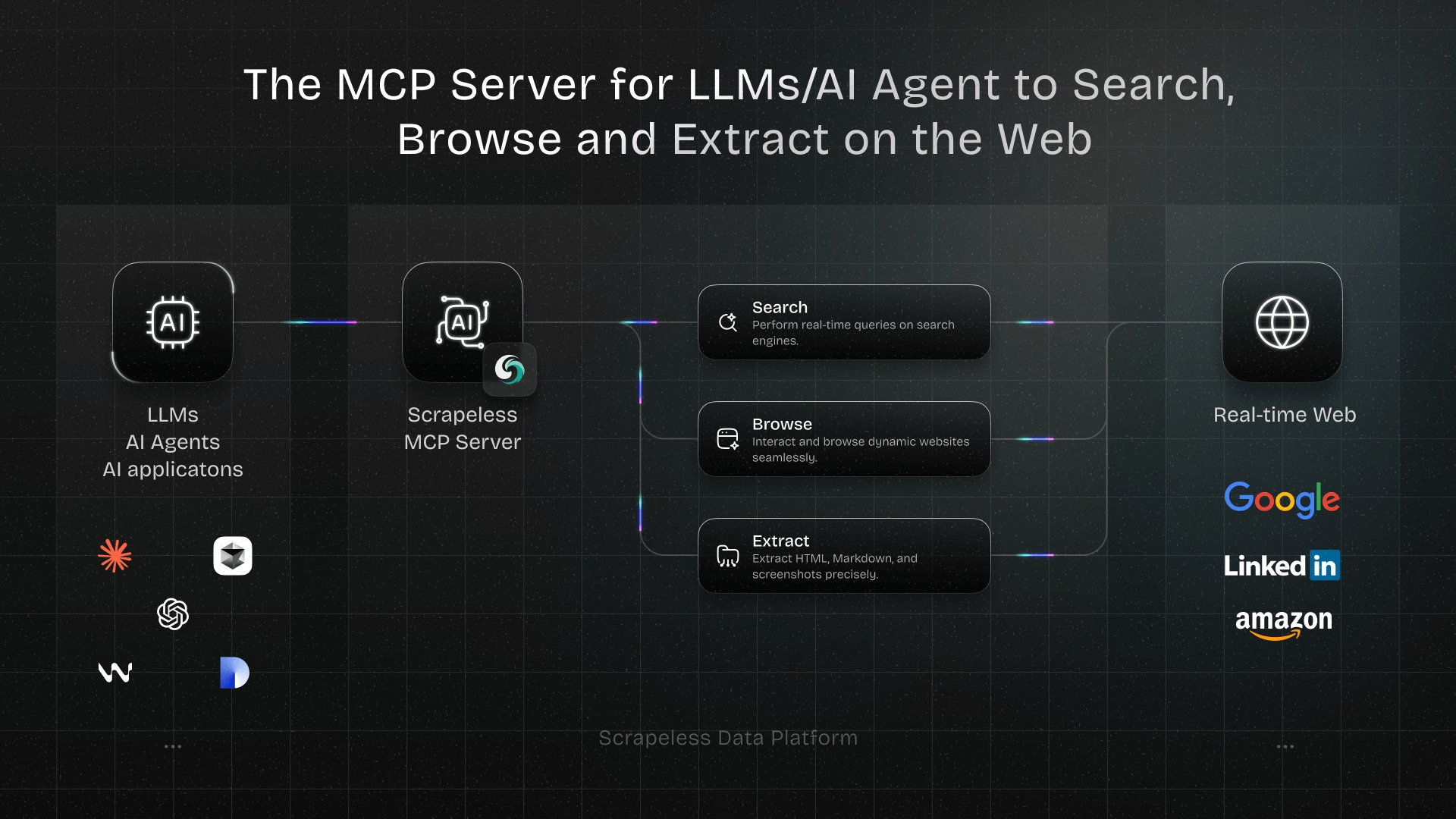
Scrapeless Agent Browser supplies a managed browser execution layer for web automation. The surrounding application still supplies the research scope, model decisions, data validation, and completion criteria.
This division is useful when a team wants to focus on the task while using a managed environment for page execution. It does not remove source restrictions or make every site behave consistently. Choose the browser configuration supported by the current product and evaluate the actual task before increasing its scope.
The agent-to-browser integration pattern illustrates how a controller and a browser can remain separate components. Regardless of the controller, preserve the same boundary: the model proposes an action, the application checks it, and the browser observation supplies evidence about what happened.
Conclusion
AI browser detection makes observability more valuable than an unqualified promise of invisibility. Track the execution environment, session state, and accepted content independently. A workflow that can explain a failed page and stop at an access boundary is easier to operate than one that reports success whenever it receives text.
Ready to Build Your Web Data Workflow?
Join our community to connect with developers building web data workflows: Discord · Telegram.
Create an account at app.scrapeless.com and start with a small, clearly scoped task.
FAQ
Q: Can websites detect an AI-controlled browser?
Websites can observe signals associated with the browser, network, session, and behavior of an AI-controlled workflow. Whether those signals cause a challenge or block depends on the target's implementation and policies.
Q: Does using a real browser make an agent undetectable?
Using a real browser does not guarantee that an agent is undetectable. It supports browser execution and interaction, while detection can consider additional environment and activity signals.
Q: Is every empty page a bot detection failure?
An empty page is not sufficient evidence of bot detection. Rendering, navigation, authentication, source availability, and extraction errors can produce similar outcomes; classify the observed state before assigning a cause.
Q: Does a successful session mean the data is authorized for collection?
A successful session does not establish authorization to collect or reuse its data. Source access conditions, the user's task, and applicable rules still govern the operation.
Q: What should be measured when evaluating an AI browser workflow?
Measure whether the workflow reaches the intended page and produces complete, supported data within its permitted scope. Track browser execution, model decisions, session behavior, and usage separately so that failures can be diagnosed.
At Scrapeless, we only access publicly available data while strictly complying with applicable laws, regulations, and website privacy policies. The content in this blog is for demonstration purposes only and does not involve any illegal or infringing activities. We make no guarantees and disclaim all liability for the use of information from this blog or third-party links. Before engaging in any scraping activities, consult your legal advisor and review the target website's terms of service or obtain the necessary permissions.