15 AI Automation Workflows Powered by Live Web Data

Scraping and Proxy Management Expert
TL;DR:
- Useful AI automation starts with a stable trigger and a reviewable output. A model should make a bounded decision inside a workflow, not replace the workflow itself.
- Live web data turns a static agent into an observer. Search, rendered pages, and structured extraction let the automation respond to current public evidence.
- The same four-part contract fits all 15 examples. Define the Trigger, Live Web Data, Decision, and Output before choosing tools or models.
- Human approval belongs before consequential action. Publishing, outreach, purchasing, account changes, and high-impact decisions should never be hidden inside an autonomous step.
- Scrapeless AI Agent supplies the live-web layer while your system owns schedules, policy, and destinations. That division keeps evidence collection separate from business authority.
- Free to start. New Scrapeless accounts include free AI Agent runtime — sign up at app.scrapeless.com.
Introduction: An Automation Is a Contract, Not a Prompt
Business automation fails when a vague prompt is expected to discover data, interpret it, decide what matters, and take action without a visible boundary.
A durable workflow separates those responsibilities. A scheduler or event creates the trigger. A web tool collects current public evidence. A model classifies, summarizes, or maps that evidence into a fixed schema. A deterministic system writes the output, and an authorized person approves any consequential action.
The 15 AI automation examples below all use that shape. They span marketing, sales, research, reporting, intelligence, and operations, but they compose from the same small set of primitives.
What Makes an AI Automation Useful?
An AI automation is useful when its trigger, evidence, decision, and output can each be inspected independently.
| Component | Question to answer | Example |
|---|---|---|
| Trigger | What starts the workflow? | A scheduled check or approved source update |
| Live Web Data | What current public evidence is collected? | A rendered product page or official release note |
| Decision | What bounded judgment does the model make? | Classify a change as material or cosmetic |
| Output | What durable artifact is produced? | A review card with fields, URL, and evidence text |
The NIST AI Risk Management Framework treats governance, mapping, measurement, and management as connected functions. That is a practical automation design: establish policy first, map the use case, measure behavior, then operate it under controls.
The Live-Web Workflow Pattern
Live-web AI workflows should collect evidence before they ask a model to interpret it.
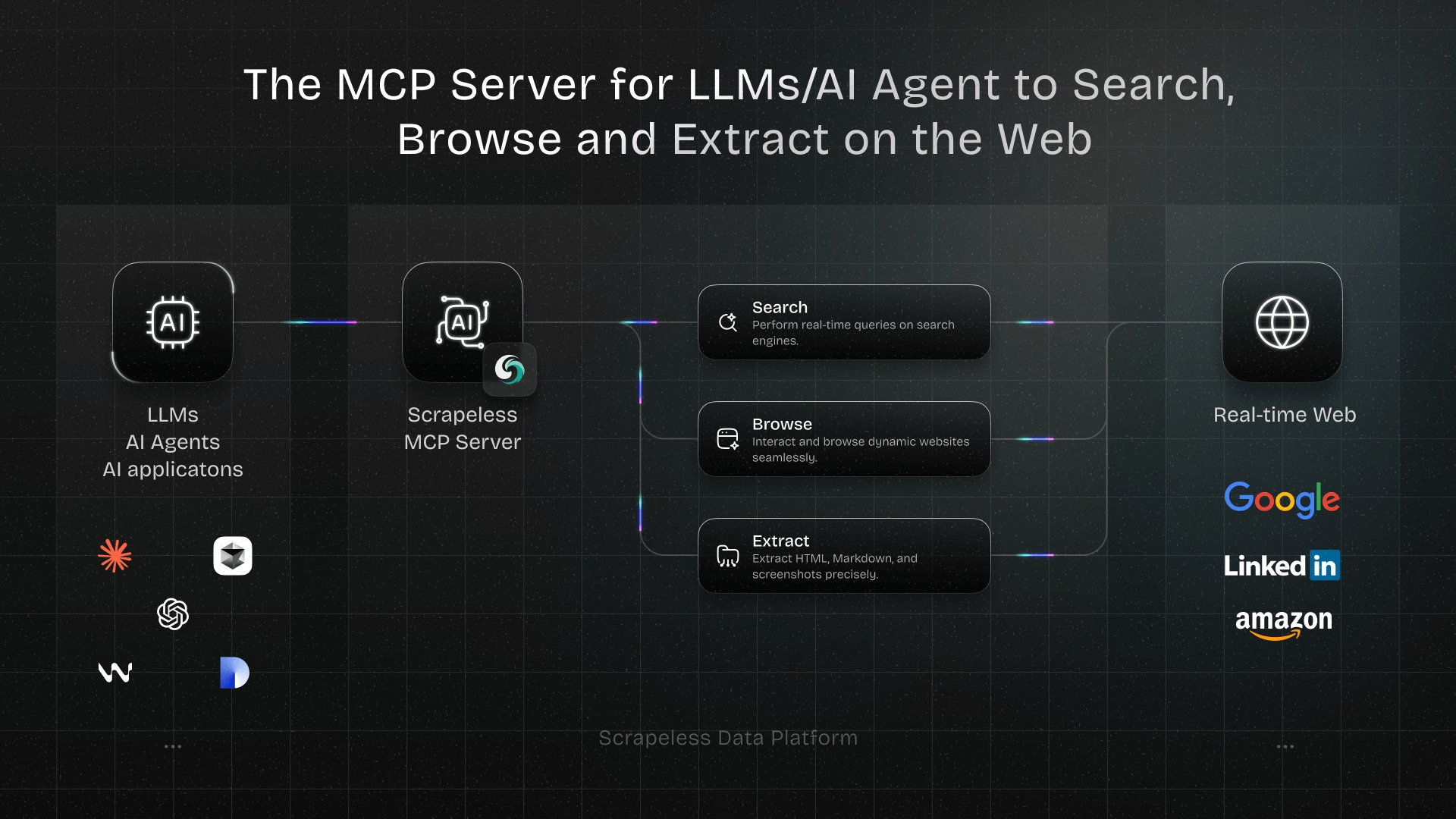
Scrapeless AI Agent can search, render JavaScript pages, and extract fields from current public sources. Your application should still provide the source registry, schedule, schema, significance rules, approval state, and destination.
A shared evidence envelope keeps every workflow traceable:
| Field | Purpose |
|---|---|
source_url |
Canonical page that produced the observation |
observed_at |
Time the system read the page |
content_fingerprint |
Stable digest for change detection |
evidence_text |
Minimal page fragment supporting the decision |
extracted_fields |
Normalized values for downstream logic |
decision |
Model classification with allowed labels |
approval_state |
Pending, approved, or rejected |
The workflow prototypes used public pages and this same envelope for page-to-brief extraction, fingerprint-based change monitoring, and evidence-linked research summaries. No account-restricted data was required.
1–4. Marketing Workflows
1. SEO Brief From Current Search and Source Pages
Trigger: A content owner approves a target query.
Live Web Data: Current search results and primary pages relevant to the query.
Decision: Group the observed questions, concepts, and content formats into a brief without copying source prose.
Output: A reviewable outline with target intent, required sections, evidence URLs, and unanswered questions.
The automation should treat search results as discovery, not a factual source. Claims still come from primary pages.
2. Public Brand-Mention Triage
Trigger: A scheduled public-web search finds a new mention.
Live Web Data: The mention page, publication context, date, and canonical URL.
Decision: Classify the mention by topic, sentiment signal, urgency, and team ownership.
Output: A queue item with the evidence excerpt and a suggested owner.
The model should not send a response. It organizes evidence for a communications reviewer.
3. Campaign Landing-Page Quality Check
Trigger: A release pipeline submits an approved landing-page URL.
Live Web Data: Rendered heading structure, links, forms, visible copy, and mobile viewport evidence.
Decision: Compare observed elements with a release checklist.
Output: A pass/fail report with screenshots and element-level findings.
Accessibility checks should align with WCAG 2.2 requirements rather than a model's preference.
4. Content Refresh Candidate Finder
Trigger: A content inventory reaches its scheduled review date.
Live Web Data: The current article, linked product pages, and relevant primary updates.
Decision: Identify claims, screenshots, steps, or links that may be stale.
Output: A refresh ticket with exact sections and current source URLs.
This workflow proposes edits; it does not silently rewrite and publish the page.
5–8. Sales and Research Workflows
5. Account Research Brief
Trigger: A representative requests research for an approved organization.
Live Web Data: The organization's public website, newsroom, product pages, and public filings where applicable.
Decision: Map visible initiatives to the team's documented qualification criteria.
Output: A sourced brief with confirmed facts, open questions, and no inferred personal data.
6. Public Product-Change Monitor
Trigger: A scheduled check reads a registered product or changelog page.
Live Web Data: Current visible features, packaging, documentation, and release notes.
Decision: Separate material changes from layout or wording changes.
Output: A change card containing the old value, new value, evidence, and reviewer route.
The competitive intelligence pipeline expands this pattern into snapshots, diffs, and evidence routing.
7. Public Partner-Directory Research
Trigger: A business-development team defines an approved market and partner profile.
Live Web Data: Public directories and organization pages.
Decision: Match observed offerings and regions to explicit eligibility rules.
Output: A deduplicated organization list with source URLs and a manual review state.
The workflow should collect organization-level facts only. Contact discovery and outreach require separate policy and approval.
8. Research Question Evidence Pack
Trigger: An analyst submits a narrow research question.
Live Web Data: Primary documentation, public datasets, standards, and official statements.
Decision: Classify each source by authority and map evidence to the requested claims.
Output: A claim-evidence table that distinguishes observation, inference, and uncertainty.
The agent should return “not confirmed” when the source set does not support a conclusion.
Start Scraping with Scrapeless
Power up your web scraping and automation workflow with Scrapeless!
Sign up today and get $5 in free credit — no credit card required.Claim your free credit now in the Scrapeless Dashboard.
9–11. Reporting and Intelligence Workflows
9. Executive Web-Signal Digest
Trigger: A weekly reporting window closes.
Live Web Data: Approved public sources covering customers, markets, policy, and product categories.
Decision: Rank observations by the organization's documented materiality rules.
Output: A short digest where every item carries an evidence URL and owner.
The model compresses evidence; it does not invent a causal explanation for a signal.
10. Policy and Standards Watch
Trigger: A registered authority publishes or updates a page.
Live Web Data: The authority's current notice, standard, consultation, or guidance page.
Decision: Map changed text to internal control owners and affected processes.
Output: A review ticket with the changed section, effective-language evidence, and legal-owner route.
The automation should never provide legal advice. It identifies source changes for qualified review.
11. Review-Theme Monitor
Trigger: An approved public review source receives new content.
Live Web Data: Public review text, rating where visible, date, product, and source URL.
Decision: Assign a controlled theme label and flag possible safety or service issues.
Output: An aggregated theme report with representative evidence and minimum-volume privacy rules.
Avoid profiling individuals. The unit of analysis should be a product, location, or service theme, not a person.
12–15. Operations Workflows
12. Supplier Notice Monitor
Trigger: A supplier registry reaches its scheduled check.
Live Web Data: Public status pages, documentation, notices, and support announcements.
Decision: Classify changes by affected component and operational impact.
Output: A service-owner ticket with evidence and a proposed validation checklist.
13. Documentation Drift Detector
Trigger: A dependency or API reference changes.
Live Web Data: Current official documentation and the last approved snapshot.
Decision: Identify changed parameters, examples, defaults, or deprecations.
Output: A code-owner notification with a side-by-side field diff.
The automation should verify the documentation page itself rather than relying on a search snippet.
14. Public Incident Context Collector
Trigger: An internal incident owner approves external context collection.
Live Web Data: Public status pages, vendor notices, and standards references.
Decision: Order observations by time and distinguish confirmed events from speculation.
Output: A source-linked timeline for the incident lead.
The incident team remains responsible for diagnosis and response.
15. Catalog Consistency Auditor
Trigger: A catalog release or scheduled quality window begins.
Live Web Data: Public product pages across approved regional or channel URLs.
Decision: Compare required fields, visible availability, naming, and policy text against the canonical catalog.
Output: An exception table with URL, field, observed value, expected value, and owner.
This workflow is deterministic until a model maps varied page language into the approved schema.
How the 15 Workflows Compose
The 15 workflows reduce to reusable services rather than 15 separate agent stacks.
- Source registry: Approved public URLs, ownership, cadence, region, and data policy.
- Collection layer: Search, direct extraction, or a rendered cloud browser.
- Normalization layer: Stable fields, content fingerprints, evidence fragments, and nullable values.
- Decision layer: Controlled labels, thresholds, and confidence rules.
- Approval layer: A human boundary for publishing, outreach, purchasing, account changes, and high-impact decisions.
- Destination layer: Tickets, dashboards, databases, or reports with idempotent record keys.
The MCP tools specification provides a typed way for agents to discover and call the collection layer. The business contract still belongs in your application.
The Scrapeless AI Agent gives the agent current web capabilities, and Scrapeless pricing provides the account options for the expected collection mix.
Human Approval, Security, and Data Minimization
AI automation should collect only the data required for the declared business purpose and should expose its evidence to a reviewer.
The OWASP agentic-application risks cover threats such as tool misuse, identity and privilege abuse, and unsafe autonomous behavior. Apply those concerns directly:
- Give the collection tool read-only access unless the use case genuinely requires more.
- Keep model credentials, web-tool credentials, and destination credentials separate.
- Allowlist source classes and destination actions.
- Store the minimum evidence needed to audit the decision.
- Remove secrets and personal data from model prompts and logs.
- Require a person to approve consequential external actions.
Public availability is not the same as unrestricted reuse. Review terms, robots directives, licensing, privacy obligations, and regional law for each source and purpose.
Where to Start
Start with one workflow whose output is advisory, whose sources are clearly public, and whose success can be measured without granting write authority.
A documentation drift detector, source-linked research pack, or catalog consistency audit is usually easier to govern than autonomous outreach. Define the schema first, run the collection and normalization path, compare the output with a human baseline, and only then add model judgment.
The OECD AI Principles emphasize human-centered values, transparency, robustness, and accountability. Those ideas become concrete when every workflow has a source URL, bounded decision, approval state, and named owner.
Conclusion: Build From Shared Primitives
AI automation becomes maintainable when the model is one bounded step inside an observable system. The Trigger → Live Web Data → Decision → Output contract exposes what started the work, what the agent saw, what it decided, and what happened next.
Choose one public-data workflow, keep its first output review-only, and reuse the resulting source registry, evidence envelope, and approval layer across the next use case.
Ready to Build a Live-Web Automation Program?
Join our community to compare evidence-first workflow patterns with other teams: Discord · Telegram.
Sign up at app.scrapeless.com and begin with one review-only workflow backed by approved public sources.
FAQ
Q: What is an AI automation workflow?
An AI automation workflow is a bounded process where a model classifies, extracts, or summarizes evidence between a defined trigger and a controlled output.
Q: Why does live web data matter?
Live web data lets the workflow observe current public pages instead of relying only on model training data or an old internal snapshot.
Q: Which AI automation should a team build first?
Start with a read-only workflow such as documentation drift detection or an evidence-linked research brief because the output can be reviewed before it affects an external system.
Q: Should an AI agent publish or contact people automatically?
No. Publishing, outreach, purchasing, account changes, and other consequential actions should require an explicit approval boundary.
Q: How should workflows handle personal data?
Collect only what the declared purpose requires, prefer organization-level public facts, apply retention limits, and obtain legal review where privacy or outreach law applies.
Q: Can these workflows run without an AI agent?
The collection, fingerprinting, and rule-based comparison steps can run without a model. Add an agent only where bounded interpretation materially improves the result.
At Scrapeless, we only access publicly available data while strictly complying with applicable laws, regulations, and website privacy policies. The content in this blog is for demonstration purposes only and does not involve any illegal or infringing activities. We make no guarantees and disclaim all liability for the use of information from this blog or third-party links. Before engaging in any scraping activities, consult your legal advisor and review the target website's terms of service or obtain the necessary permissions.