AI Agent Case Study: Production in 18 Days at 58% Lower Cost

Web Data Collection Specialist
TL;DR:
- A top-tier AI support agent provider turned knowledge onboarding into a six-day product capability. The composite client had needed a median of 21 days to ingest each enterprise customer’s public help content; after the Scrapeless rollout, the median fell to 6 days.
- The new pipeline reduced cost per 1,000 valid pages by 58%. The modeled unit cost moved from $9.80 to $4.12 because the team paid for a higher share of usable output and removed most source-specific access work.
- Valid-page success rose from 72.4% to 96.4%. A page counted only when it returned usable content and passed language, duplication, and schema checks—not when it merely returned an HTTP success status.
- The joint implementation reached production in 18 days. A four-stage rollout defined the data contract, routed sources by behavior, compared shadow traffic, and moved new customer domains to full production.
- Free to start. New Scrapeless accounts include free trial credits—sign up in the Scrapeless Dashboard.
Editorial note: This is a composite case study. The company profile, chronology, quotations, workload, and performance figures are fictionalized to illustrate a representative enterprise deployment. The story is not a named customer testimonial or a guarantee of future results.
The Launch Review That Stopped at Slide Seven
The enterprise launch review stopped when the implementation lead put one number on screen: 21 days.
That was the median time required to turn a new customer’s public help center, product documentation, release notes, and status content into a searchable knowledge corpus. The AI support agent could answer complex questions once the data was ready. The problem was getting the data ready before the customer’s launch window closed.
The client in this composite story is a top-10 provider in the AI customer-support agent category. Its product sits inside enterprise help desks, reads a customer’s approved knowledge sources, and generates grounded answers for support teams and end users. The reasoning layer was fast. The ingestion layer was not.
One enterprise buyer had scheduled a six-week pilot across three product lines and seven languages. By the end of week two, only the English corpus had passed quality review. Two JavaScript-heavy documentation sites were returning navigation chrome without article bodies. Locale routes collapsed into duplicate English pages. Release notes arrived without reliable timestamps. The customer success team began discussing a narrower pilot.
The head of platform summarized the risk in a single sentence: the company was selling an agent that learned a customer’s business in days, while its onboarding process still worked in weeks.
The goal was no longer “improve scraping.” The goal was to make public-web knowledge ingestion predictable enough to support enterprise launch dates.
Case Study at a Glance
This AI agent case study follows an 18-day implementation and the first 30 days after full production cutover.
| Dimension | Composite Client Detail |
|---|---|
| Company profile | Top-10 AI customer-support agent provider |
| Business model | Enterprise SaaS with usage-based agent seats |
| Ingestion job | Public help centers, product docs, release notes, status pages, and public community answers |
| Primary Scrapeless product | Universal Scraping API |
| Cost per 1,000 valid pages | $9.80 → $4.12, down 58% |
| Valid-page success | 72.4% → 96.4% |
| Technical rollout | 18 calendar days from approved design to production |
| Median customer onboarding | 21 days → 6 days |
| Median knowledge freshness lag | 46 hours → 4.8 hours |
The KPI windows were deliberately narrow. The baseline covered the 30 days before the pilot. The comparison window covered days 31–60 after cutover, once the initial backlog had cleared. Embedding and model-inference costs were excluded because the project changed web access and ingestion, not the agent’s reasoning stack.
The Company Had a Sales Problem Disguised as a Data Problem
Knowledge onboarding had become a constraint on enterprise growth.
Every signed customer arrived with a different web estate. One had a static help center and clean sitemaps. Another rendered article bodies in the browser. A third split documentation across regional subdomains, each with its own navigation and locale rules. Public status pages and release notes used different templates again.
The original ingestion service treated every URL the same way. It fetched the page, extracted the largest text block, and sent the result into a normalization queue. That worked well enough for simple documentation sites. It broke down when content appeared after client-side rendering, when navigation outweighed the article body, or when several URLs represented the same localized page.
The team measured transport success, so many bad pages looked healthy. A conventional HTTP response can say the request succeeded while the returned representation is still useless to a knowledge system; HTTP Semantics defines the protocol outcome, not whether a page contains the business content an agent needs.
That measurement gap spread into the operating model:
- Customer solutions engineers wrote source-specific rules during onboarding.
- Platform engineers maintained separate browser and request paths.
- Quality analysts discovered empty or duplicated articles after indexing.
- Customer success teams could not give buyers a dependable go-live date.
The company did not lose every deal because of onboarding. It lost momentum inside deals. Security reviews finished before the knowledge base was ready. Pilot users opened the agent and found gaps. Expansion conversations waited for an implementation checklist to clear.
By the quarter-end planning meeting, the backlog contained 43 customer-specific ingestion tasks. The company’s largest growth constraint was no longer model quality or demand. It was the time between signature and first trustworthy answer.
The Pilot Replaced “Page Loaded” With “Knowledge Ready”
The pilot succeeded because both teams agreed on the outcome before choosing the routing logic.
Scrapeless and the client defined a valid page as a public page that met four conditions:
- The main article content was present after any required rendering.
- The normalized record carried a canonical URL and detected language.
- Boilerplate removal left a usable body rather than navigation or an access page.
- The record passed duplicate and schema checks before entering the index.
This definition moved the project away from request counts. A cheap page that produced unusable content was not cheap. A nominally successful response that created an empty chunk was not successful.
The team selected 120 public sources from recent enterprise onboardings. The set included static documentation, JavaScript-rendered help centers, localized release notes, public status pages, and support communities. No private portals or authenticated customer content were included.
During the evaluation, the Scrapeless Universal Scraping API handled the access and rendering layer. The client kept ownership of discovery, normalization, quality rules, and indexing. That boundary mattered: Scrapeless did not replace the company’s knowledge pipeline. It made the web input to that pipeline consistent enough to operate as a product.
The pilot ended with a decision matrix, not a demo:
| Decision Area | Client Ownership | Scrapeless Role |
|---|---|---|
| Source discovery | Sitemaps, approved URL lists, and customer configuration | Fetch the requested public pages |
| Page access | Routing policy and source classification | JavaScript rendering, session mode, and request execution |
| Content quality | Main-content extraction, language checks, and duplicate detection | Return complete page content and response metadata |
| Knowledge indexing | Chunking, embeddings, versioning, and deletion policy | No access to the downstream knowledge store |
| Operations | Customer-level SLA and freshness targets | Enterprise support for the ingestion surface |
The separation gave the client a clean answer to a common build-versus-buy concern. Its competitive logic remained in the knowledge layer. The undifferentiated access layer moved to a managed API.
The 18-Day Rollout Followed Four Controlled Stages
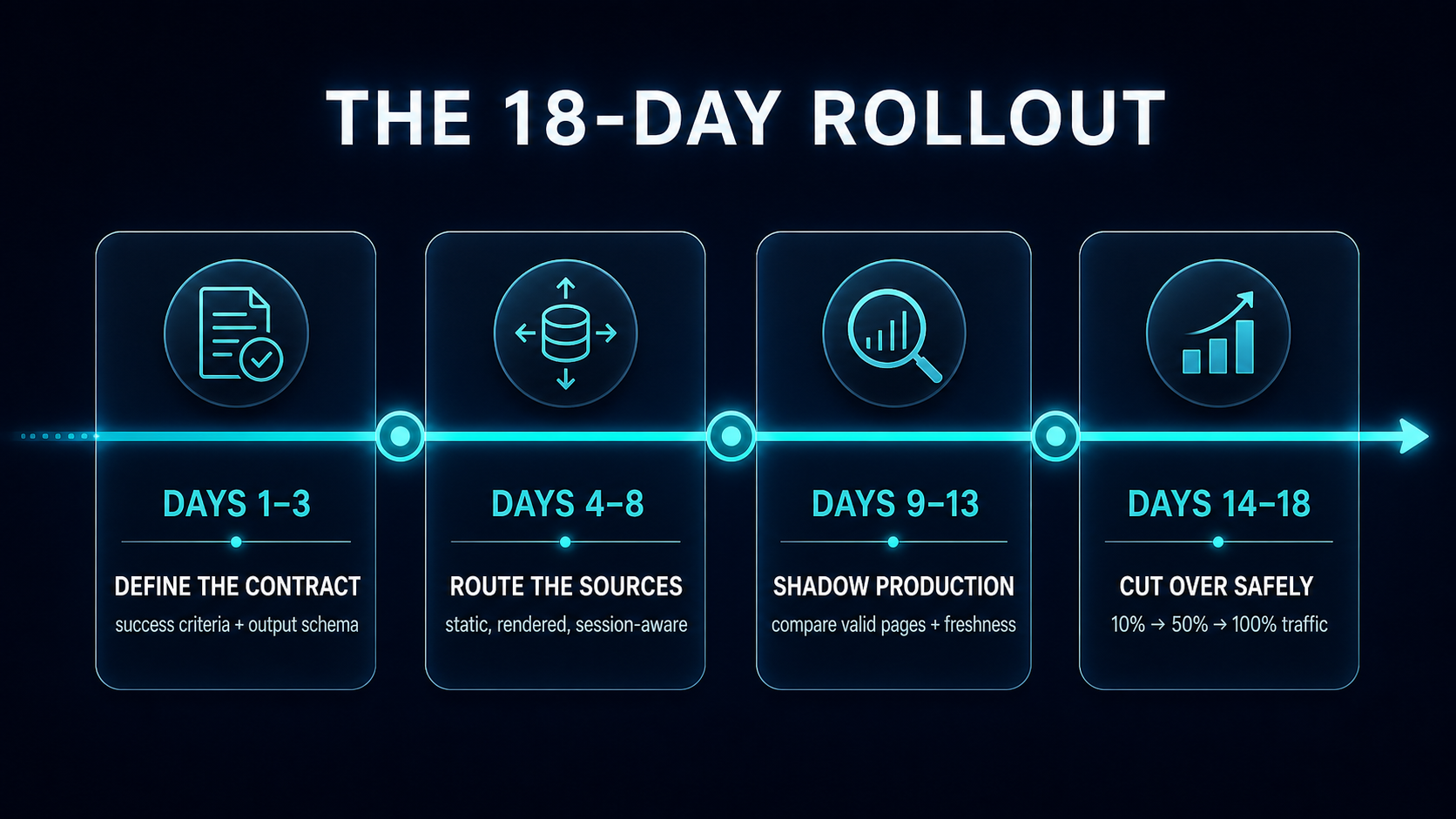
The joint team reached production in 18 calendar days by narrowing each stage to one decision.
Days 1–3: Define the Contract
The first deliverable was a versioned output contract. Each record required the requested URL, final URL, canonical URL, language, title, body, content hash, capture time, and any published or updated time exposed by the source. URL normalization followed the URI syntax standard, while language values used the tags defined by the language-tag standard.
The team also fixed the validity rule. Transport status remained observable, but it no longer determined the business KPI. A record entered the knowledge index only after content and duplication checks passed.
Days 4–8: Route the Sources
The source catalog was grouped by behavior rather than by customer.
Static pages used the standard path. JavaScript-dependent sources enabled rendering. Sources that depended on navigation context used session mode. This produced reusable routing rules for classes of sites instead of one-off scripts for every new customer domain.
Days 9–13: Shadow Production
Both pipelines processed the same approved public sources. The comparison dashboard tracked valid-page success, content completeness, duplicate rate, freshness lag, and cost per valid page.
The client also sampled agent answers whose citations depended on newly ingested pages. This followed the measurement discipline in the NIST AI RMF Playbook: define the outcome, observe it in operation, and keep the measurement tied to the system’s actual use.
Days 14–18: Cut Over Safely
Traffic moved in three steps: 10%, 50%, then 100% of new customer domains. Existing indexed content stayed untouched, so a routing decision could not erase a working customer corpus.
Day 18 ended when all new public-domain ingestion jobs used the Scrapeless path and the shadow dashboard showed the agreed quality threshold. The original plan had reserved 10 weeks for a larger rebuild. The controlled routing design made that rebuild unnecessary.
Start Scraping with Scrapeless
Power up your web scraping and automation workflow with Scrapeless!
Sign up today and get $5 in free credit — no credit card required.Claim your free credit now in the Scrapeless Dashboard.
The 30-Day Scorecard Changed the Expansion Conversation
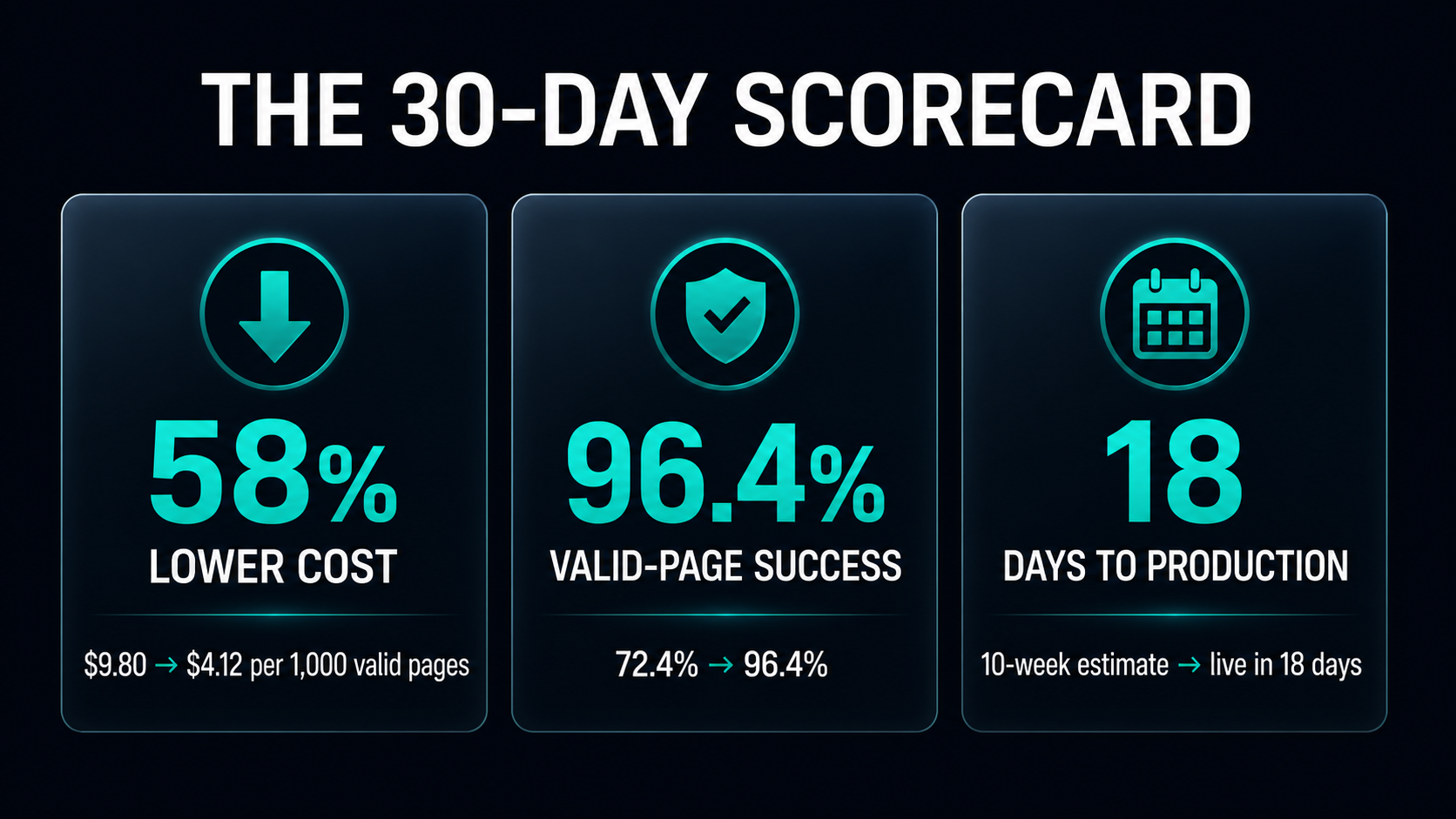
The production scorecard showed 58% lower unit cost, 96.4% valid-page success, and an 18-day rollout.
Cost per Valid Page Fell 58%
The client’s modeled cost fell from $9.80 to $4.12 per 1,000 valid pages.
| Cost Component | Before | After |
|---|---|---|
| Web-access infrastructure and vendor usage | $6.10 | $3.46 |
| Allocated platform maintenance | $2.75 | $0.44 |
| Quality recovery work | $0.95 | $0.22 |
| Total per 1,000 valid pages | $9.80 | $4.12 |
The largest saving did not come from a lower price per request. It came from producing more valid pages from the same workload. Maintenance allocation also fell because platform engineers stopped writing access logic for individual customer domains.
The article does not present $4.12 as a Scrapeless rate. It is a composite customer unit cost that includes internal allocations. Teams evaluating their own economics should compare against current Scrapeless pricing and use their own traffic mix, quality gate, and labor model.
Valid-Page Success Reached 96.4%
Valid-page success rose by 24 percentage points, from 72.4% to 96.4%.
The result was strongest on JavaScript-rendered help centers and localized documentation. Static pages already performed reasonably well; the new path made the difficult classes less exceptional. Duplicate-language routes also improved because final and canonical URLs arrived in the record used by the client’s normalization stage.
The remaining 3.6% was not hidden. Most of it came from removed pages, malformed source URLs, and content that had moved behind authentication. Those pages stayed outside the index and appeared in the customer onboarding report with a clear reason.
Production Launch Took 18 Days
The rollout reached production 18 days after the technical design was approved.
This metric did not start at the first sales call. It started when both teams had approved scope, security requirements, and the success definition. It ended when 100% of new customer domains used the new route.
That boundary keeps the launch number useful. Sales cycles, procurement, and legal review vary too widely to mix into a technical implementation KPI.
Customer Knowledge Onboarding Fell From 21 Days to 6
The median time from workspace creation to the first complete indexed corpus fell by 15 days.
This was the result the revenue team cared about. Six-day onboarding fit inside a typical enterprise pilot without asking the buyer to narrow scope. Customer solutions engineers spent their time reviewing knowledge coverage and answer quality, rather than waiting for source-specific extraction work.
Knowledge freshness improved as well. The median lag between a public page change and an indexed update moved from 46 hours to 4.8 hours. Release-note answers no longer depended on a weekly recovery queue.
What Changed in the Operating Model
The new ingestion path changed who could make commitments to customers.
Before the rollout, sales avoided promising a knowledge-ready date until engineering reviewed every source. After the rollout, solutions teams could classify the source mix during discovery and give the buyer a standard onboarding window.
Platform engineers also gained a firmer product boundary. Their team owned the quality contract, source catalog, and downstream index. Scrapeless owned public-page access and rendering. When a new help-center pattern appeared, the first question became “which routing class fits?” rather than “who can build a connector?”
The customer’s security review became simpler because the new design did not expand the data scope. The pipeline processed approved, publicly accessible sources and excluded authenticated portals. The operating policy also incorporated each site’s terms and the Robots Exclusion Protocol into source approval. Data minimization was enforced before indexing: navigation, account prompts, and unrelated page furniture were discarded.
Most important, the AI agent’s quality discussion moved closer to the buyer’s question. Instead of reporting fetched URLs, the team reported knowledge coverage, freshness, and grounded-answer readiness.
Three Decisions Made the Partnership Work
The implementation worked because the commercial goal and technical boundary were explicit.
1. Price the Outcome, Not the Request Counter
Cost per request can improve while total cost rises if the output needs heavy recovery work. Cost per 1,000 valid pages tied infrastructure spend to the unit the knowledge product could use.
2. Keep Differentiated Logic With the Agent Company
The client did not outsource its chunking strategy, knowledge graph, retrieval policy, or answer evaluation. Those capabilities shaped its product. The partnership focused on access and rendering, where source variability created work without creating customer value.
3. Make the Pilot Resemble Production
The source set included multiple page behaviors, locales, and content types. The shadow stage processed the same inputs through both paths. That made the launch decision a comparison of operating systems, not a polished demonstration against three convenient URLs.
For AI agent companies with a browser-infrastructure problem rather than a knowledge-onboarding problem, the previous AI agent case study covers a different migration pattern. The distinction is useful: one story consolidates a browser stack; this story standardizes the path from approved public pages to knowledge-ready records.
Conclusion: Make Time-to-Knowledge a Product Metric
This composite AI agent case study shows how a web-data partnership can affect revenue operations without changing the model layer.
The client defined “valid” in business terms, kept its differentiated knowledge logic, and used Scrapeless for consistent public-page access. The modeled result was 58% lower cost per valid page, 96.4% valid-page success, production in 18 days, and customer knowledge onboarding reduced from 21 days to 6.
The durable lesson is the metric choice. AI agent teams should measure the time and cost required to produce trustworthy knowledge, not the number of URLs a crawler touched. Once the ingestion layer reports the same unit the product sells, technical and commercial teams can make the same launch decision.
Ready to Shorten Your AI Agent’s Time-to-Knowledge?
Join the Scrapeless community to connect with developers building AI agent data pipelines: Discord · Telegram.
Sign up at app.scrapeless.com for free trial credits, or use the AI Agent solution page to map Scrapeless to the public-web inputs your product needs.
FAQ
Q: Is the company in this AI agent case study real?
No. This is a composite case study with fictionalized company details, chronology, workload, quotations, and performance figures. It illustrates a plausible enterprise deployment but is not a named customer testimonial or an audited Scrapeless benchmark.
Q: What does the 96.4% success rate measure?
The 96.4% figure measures valid pages, not HTTP responses. A page counted only when it contained usable main content and passed the composite client’s language, duplication, and schema checks.
Q: Does Scrapeless replace an AI agent company’s entire knowledge pipeline?
No. Scrapeless can handle the public-page access and rendering layer, while the agent company retains source governance, normalization, chunking, indexing, retrieval, and answer evaluation. The exact boundary should follow the company’s architecture and compliance requirements.
Q: Can an enterprise rollout always reach production in 18 days?
No. The 18-day figure belongs to the fictional scenario and is not a delivery guarantee. Actual timing depends on scope, procurement, security review, source behavior, integration depth, and the customer’s acceptance process.
Q: How should an AI agent team evaluate the business case?
An AI agent team should compare cost per valid output, valid-page success, knowledge freshness, and customer onboarding time across a representative source set. The evaluation should use the team’s own traffic, labor allocation, content-quality rules, and enterprise approval process.
Q: What data should a customer-support agent ingest?
A customer-support agent should ingest only approved sources needed for the use case, such as public help articles, product documentation, release notes, and status content. Teams should respect applicable law, site terms, source policies, and privacy requirements, and exclude private or restricted content unless they have explicit authorization.
At Scrapeless, we only access publicly available data while strictly complying with applicable laws, regulations, and website privacy policies. The content in this blog is for demonstration purposes only and does not involve any illegal or infringing activities. We make no guarantees and disclaim all liability for the use of information from this blog or third-party links. Before engaging in any scraping activities, consult your legal advisor and review the target website's terms of service or obtain the necessary permissions.