Beyond Vibe Coding: The Web Data Infrastructure AI Agents Need

Lead Scraping Automation Engineer
TL;DR:
- AI agents fail when tool data is unstable, not only when model reasoning is weak. Production systems need a web data layer with explicit contracts for acquisition, identity, validation, and provenance.
- Separate the model control loop from the data plane. The agent should choose a bounded capability; infrastructure should handle source policy, browser execution, structured output, caching, and telemetry.
- Every tool result needs an acceptance contract. Validate source, schema, freshness, permissions, and expected content before the result enters agent context.
- Failure states must be visible and typed. Empty pages, access challenges, stale records, schema violations, and exhausted budgets should become distinct outcomes rather than ambiguous text.
- Cost control begins before the model call. Route each source to the least expensive acquisition path that can satisfy the contract, then return only the evidence the task needs.
An AI agent can plan a useful task and still fail at the first webpage. The page may render client-side, vary by region, return a consent shell, require a session, or expose a layout that changed after the prompt was written.
Those are data-plane failures. A stronger model does not repair an empty document, an unverified source, or a tool response with no stable schema.
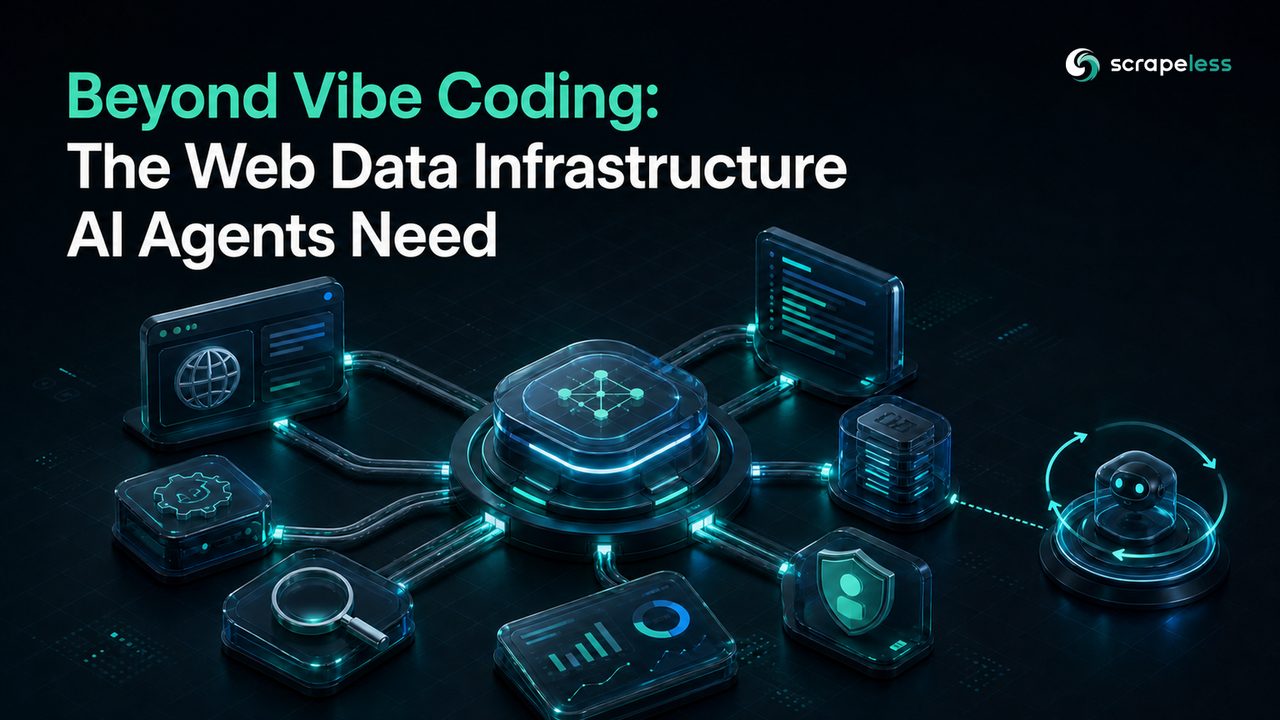
Production agents therefore need a web data infrastructure layer between reasoning and the open web. That layer turns an intent such as “compare the current public prices for these products” into bounded acquisition, validated records, observable tool calls, and an evidence bundle the model can use.
Why Agent Demos Break in Production
A demo usually optimizes for the happy path: one prompt, one page, one result. Production introduces variation across users, sources, time, and policy.
The breakpoints are predictable:
- Unknown source state: the URL redirects, changes layout, or returns a non-content shell.
- Rendering mismatch: the initial response does not contain the fields the agent expects.
- Identity drift: several URLs represent one document, or one URL changes meaning by locale or session.
- Unbounded context: the tool returns an entire page when the task needs one table.
- Weak provenance: the answer cannot show which source, version, or collection event supported it.
- Permission ambiguity: the agent can reach a resource that the user or tenant is not allowed to use.
- Silent failure: a malformed response looks like ordinary prose and reaches the model.
Prompt changes can hide these problems during a demonstration. They do not create an operating contract.
The Model Layer and Data Plane Have Different Jobs
The model layer interprets the goal, selects a capability, and decides how to use accepted evidence. The data plane controls how external information is acquired and admitted.
| Concern | Model control loop | Web data plane |
|---|---|---|
| Goal | Interpret user intent | Enforce approved source policy |
| Tool choice | Select a named capability | Route to fetch, browser, search, or stored record |
| Input | Produce bounded arguments | Validate URL, scope, locale, and budget |
| Execution | Wait for a typed outcome | Acquire, render, parse, and validate |
| Evidence | Reason over accepted fields | Attach source, collection context, and freshness |
| Failure | Choose another approved path or stop | Return a specific machine-readable state |
| Output | Compose the user response | Preserve the evidence used by the model |
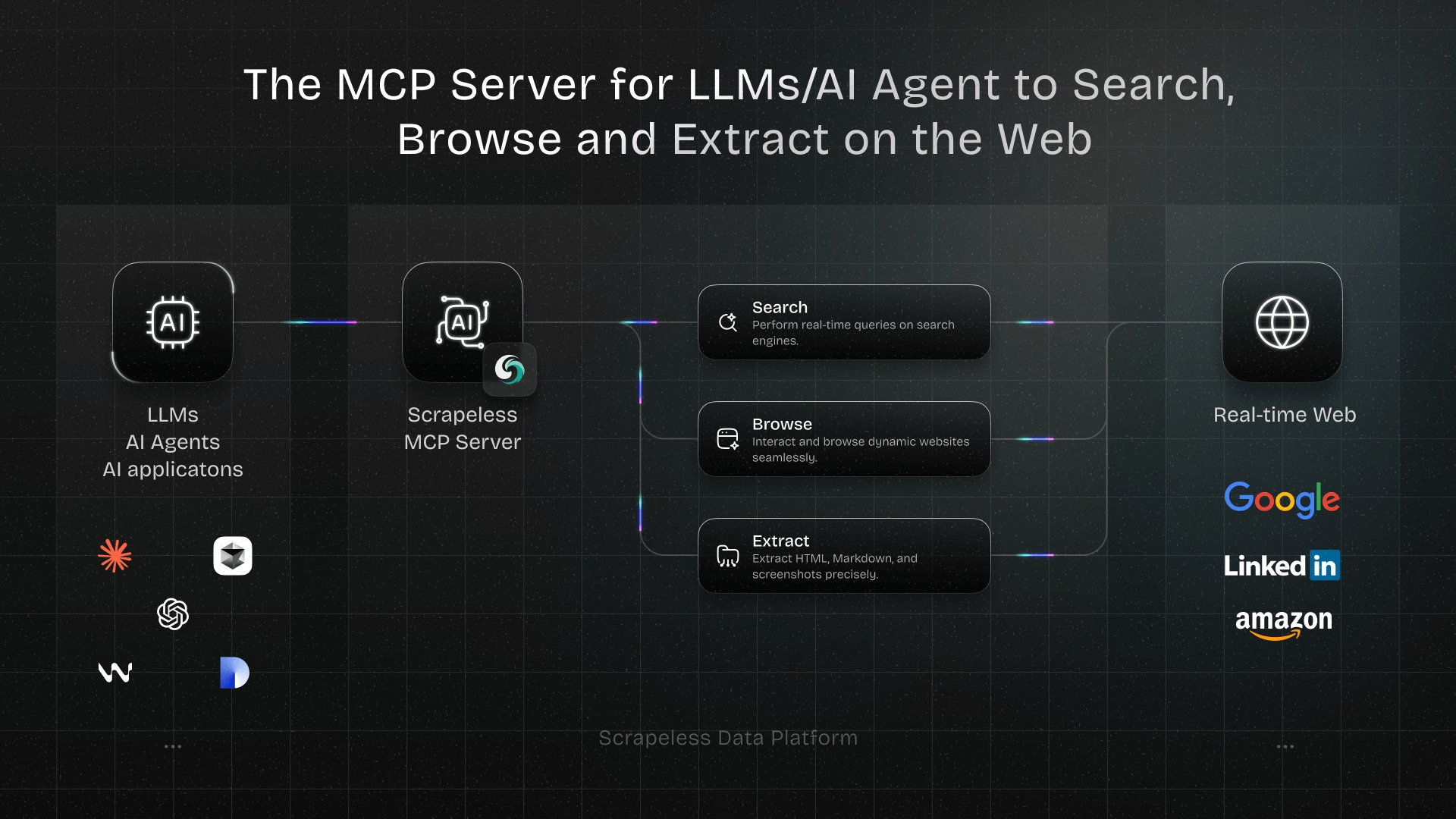
The Model Context Protocol specification defines a client-server interface for exposing tools and other context to model applications. A protocol makes capability discovery and invocation consistent. Production reliability still depends on the contracts behind each capability.
Reference Architecture for Agent Web Data
A practical architecture separates nine responsibilities:
User request → policy gateway → tool router → acquisition layer → content validation → normalization → evidence store → agent context → response audit
Policy gateway
The policy gateway resolves user, tenant, source, purpose, geography, and data-class rules before any external call. It rejects private or restricted destinations that are outside the approved program.
Tool router
The router selects the least complex route that can satisfy the task. A stable public HTML page may need a direct fetch. A client-rendered page may need a browser. A common question may already have a fresh accepted record.
Acquisition layer
The acquisition layer owns network routing, browser execution, session state, and source-specific limits. The agent receives a named capability rather than credentials or low-level infrastructure controls.
Content validation
Validation decides whether the result is the expected public content. Status alone is insufficient. The validator checks required fields, page identity, language, content type, and known error or challenge states.
Normalization
Normalization assigns canonical source identity, removes boilerplate, extracts structured fields, and attaches collection context. The output uses one versioned schema regardless of whether acquisition used a browser or direct request.
Evidence store
The evidence store keeps accepted records, source URLs, content hashes, policy class, and freshness state. It can serve repeated questions without reacquiring unchanged content.
Agent context builder
The context builder selects only the passages or fields needed for the current decision. It does not dump every accepted document into the prompt.
Response audit
The audit layer records which tool result supported the answer, which fields reached the model, and whether the user approved any consequential action.
Define a Source Registry Before Building Tools
A source registry turns “the web” into a controlled inventory. Each entry should define:
- source owner and business purpose;
- allowed hosts and path scope;
- public or authorized access class;
- locale and geography requirements;
- expected document types and content markers;
- acquisition route;
- freshness objective;
- retention and deletion policy;
- escalation owner.
The registry prevents a natural-language prompt from silently expanding the program's scope. If the agent discovers a useful but unregistered host, it can surface the candidate without collecting it.
Make Every Tool a Data Contract
A tool description tells the model when to call a capability. A data contract tells the system what an acceptable result looks like.
Each web-data tool should specify:
| Contract element | Example decision |
|---|---|
| Input scope | Public HTTPS URL on an approved host |
| Required arguments | URL, locale, requested fields |
| Output schema | Source, fields, collection context, status |
| Required fields | Canonical source and at least one accepted data field |
| Nullable fields | Missing price or author is explicit, not omitted silently |
| Freshness rule | Stored record is acceptable until the source objective expires |
| Permission class | Public-authorized or owned source |
| Failure states | Scope denied, content absent, schema invalid, budget exhausted |
The JSON Schema object guidance explains how properties, required fields, and type constraints define valid objects. The useful design move is not adding a schema file after development. It is deciding which fields the agent may rely on before the tool exists.
Do not turn every field into required data. A public listing may legitimately omit a discount or review count. Mark those fields nullable while keeping source identity and validation status mandatory.
Route Sources by Behavior
One acquisition method is rarely correct for every source.
| Source behavior | Preferred starting route | Validation signal |
|---|---|---|
| Stable public HTML | Direct acquisition | Expected field in response |
| JavaScript-rendered page | Cloud browser | Expected field in rendered document |
| Public search result | Search-specific tool | Query, locale, and result structure |
| Interactive lookup | Stateful browser session | Final state and extracted fields |
| Frequently requested stable page | Accepted cache | Source freshness remains within policy |
| Unknown or restricted destination | No acquisition | Policy decision required |
This routing keeps a browser available for pages that need it without paying browser cost for every document. It also gives the validator a page-specific acceptance signal.
Scrapeless AI Agent provides an agent-facing route to live web capabilities. Scrapeless Universal Scraping API supports authorized public-page acquisition when the application needs a managed HTTP workflow. The router should expose only the capability appropriate to the source and task.
Get your API key on the free plan: app.scrapeless.com
Return Evidence Bundles, Not Page Dumps
An agent rarely needs every navigation label, footer, recommendation widget, and repeated product card on a page. Returning that material consumes context and makes the relevant evidence harder to identify.
An evidence bundle can contain:
- canonical source URL;
- collection context and freshness state;
- requested structured fields;
- selected supporting passages;
- schema version;
- permission class;
- validation status;
- content hash or record version.
The bundle is both smaller and more auditable than a complete page. The model can cite the source and distinguish current evidence from an older stored record.
For multi-source research, assemble several bounded bundles and keep their provenance separate. Do not merge the text first and try to reconstruct attribution afterward.
Design Typed Failure States
“No result” is not one failure. The agent needs to know whether the source was outside policy, the page lacked expected content, the stored record was too old, or the output violated its schema.
Useful states include:
scope_denied: the source is not approved;content_absent: the expected public field was not present;unexpected_page: the response was a consent, challenge, error, or unrelated page;schema_invalid: the extracted object does not satisfy the contract;stale_record: the stored evidence exceeds the source objective;budget_exhausted: the task reached its acquisition or context limit;human_review_required: the next step carries legal, privacy, or business risk.
Each state should define the permitted next action. Some states allow a different approved acquisition path. Others require the agent to stop and explain what is missing. None should be converted into invented data.
Keep Identity and Sessions Out of the Prompt
Credentials, cookies, proxy configuration, and browser-session identifiers belong to infrastructure. The model should request a capability under the current user and tenant context, not receive reusable secrets.
Use short-lived server-side session handles, allowlisted destinations, scoped credentials, and role checks. Separate read-only research tools from tools that can submit forms, change records, or trigger external actions.
This least-privilege design also limits what an agent can do when a tool call is mistaken or manipulated. OWASP guidance on excessive agency highlights the risk created by giving systems more functionality, permissions, or autonomy than a task requires.
NIST frames AI risk management as work across governance, mapping, measurement, and management. The NIST AI Risk Management Framework applies those practices across the AI lifecycle. For agent systems, the tool layer and its data permissions belong inside that lifecycle, not outside it.
Make the Data Plane Observable
Agent observability needs more than model input and output. A request can fail before the model sees evidence, during tool selection, inside browser execution, at schema validation, or when the context builder drops a required field.
The OpenTelemetry signal model distinguishes traces, metrics, logs, and baggage. Apply that model across the tool path with one correlation identifier.
Record these events:
- policy decision and source-registry match;
- selected acquisition route;
- tool input shape with secrets removed;
- acquisition duration and final page identity;
- validation status and rejection reason;
- normalized schema version;
- evidence fields admitted to context;
- model decision and user-visible citations;
- human approval for consequential actions.
Useful operating measures include accepted-document cost, acquisition duration, stale-record share, schema rejection share, unexpected-page share, context size, evidence coverage, and human-review frequency.
The point is diagnosis. If a research answer lacks a current price, the trace should show whether the source was denied, the field was absent, the page was unexpected, or the context builder excluded it.
Control Cost at Every Boundary
Model tokens are only one cost center. Browser runtime, search calls, network transfer, extraction, storage, embeddings, and repeated acquisition can dominate a long task.
Use four controls:
Route to the least complex valid path
Direct acquisition is enough for stable server-rendered content. Use a browser when JavaScript or interaction is required. Serve an accepted stored record when it remains fresh for the task.
Ask for fields, not pages
The tool input should name the fields or question. The output should return accepted evidence for that request rather than the complete document.
Deduplicate by source and content
Canonical URLs prevent repeated work across aliases. Content hashes show whether a stable URL has changed. Cache decisions should preserve source policy and freshness.
Set budgets before execution
Give each task limits for sources, browser duration, acquired bytes, stored documents, and context size. When a limit is reached, return a typed state and let the user narrow the request.
Production Readiness Checklist
An agent web-data layer is ready for a controlled launch when the team can answer these questions:
Source and policy
- Are every host, path, purpose, and permission class registered?
- Can the system reject unknown or private destinations before acquisition?
- Are personal and sensitive data excluded or separately governed?
Tool contracts
- Does each tool have bounded inputs and a versioned output schema?
- Are required and nullable fields explicit?
- Does each failure state have a permitted next action?
Evidence
- Does every accepted record keep its source and collection context?
- Can an answer show which evidence supported it?
- Can one source or record version be removed cleanly?
Operations
- Can traces connect policy, acquisition, validation, context, and response?
- Are cost and freshness measured per source and route?
- Are high-impact actions separated behind user confirmation?
The live web data guide for AI agents covers acquisition use cases and evaluation criteria. The Scrapeless documentation provides the implementation reference, while the Scrapeless MCP Server overview explains how agent applications reach Scrapeless web tools through a standard interface. Review Scrapeless pricing against measured accepted-result volume rather than raw call count alone.
Conclusion: Build the Data Plane Before Scaling the Agent
An agent does not need unrestricted web access. It needs a small set of permitted capabilities backed by stable data contracts.
Separate reasoning from acquisition. Validate every result before context. Preserve identity and provenance. Emit typed failures. Trace the full tool path. Those controls make model behavior easier to evaluate because the evidence boundary is no longer hidden inside a prompt.
Ready to Give Your Agent a Controlled Web Data Layer?
Join developers building agent tools and public-web data pipelines: Discord · Telegram.
Sign up at app.scrapeless.com and start with one approved source, one typed contract, and one observable agent task.
FAQ
Q: What is AI agent data infrastructure?
AI agent data infrastructure is the policy, acquisition, validation, normalization, storage, and observability layer that supplies an agent with permitted, structured, and traceable evidence.
Q: Why should the web data layer be separate from the model?
The separation keeps source policy, credentials, browser execution, schemas, and telemetry deterministic while the model focuses on selecting capabilities and reasoning over accepted evidence.
Q: Does MCP solve every production reliability problem?
No. MCP standardizes how a model application discovers and invokes capabilities. Each tool still needs authorization, bounded inputs, validation, typed outcomes, telemetry, and cost controls.
Q: When does an AI agent need a cloud browser?
An agent needs a cloud browser when the required public content appears only after JavaScript rendering or browser interaction. Stable server-rendered pages should use a simpler approved acquisition route.
Q: How should an agent handle an invalid tool result?
The system should reject the result before it reaches model context and return a typed failure state that identifies whether the problem was policy, page identity, content, freshness, schema, or budget.
Q: How can teams reduce web-research cost for agents?
Route each source to the least complex valid acquisition path, reuse fresh accepted records, request only the needed fields, deduplicate canonical content, and cap acquisition and context budgets before execution.
At Scrapeless, we only access publicly available data while strictly complying with applicable laws, regulations, and website privacy policies. The content in this blog is for demonstration purposes only and does not involve any illegal or infringing activities. We make no guarantees and disclaim all liability for the use of information from this blog or third-party links. Before engaging in any scraping activities, consult your legal advisor and review the target website's terms of service or obtain the necessary permissions.