AI Agent Builders Compared: What Web Data Workflows Actually Need

Lead Scraping Automation Engineer
TL;DR:
- An AI agent builder is an orchestration environment, not the data itself. The builder plans, calls tools, maintains state, and presents results.
- No-code, low-code, and code-first builders trade speed for control. The right choice depends on workflow risk, team skills, and how much behavior must be inspected.
- Web data needs its own evaluation criteria. Search freshness, rendered-page access, structured output, provenance, and change detection matter more than a long connector list.
- Tool permissions need hard boundaries. Read-only research should not inherit write or delete capabilities.
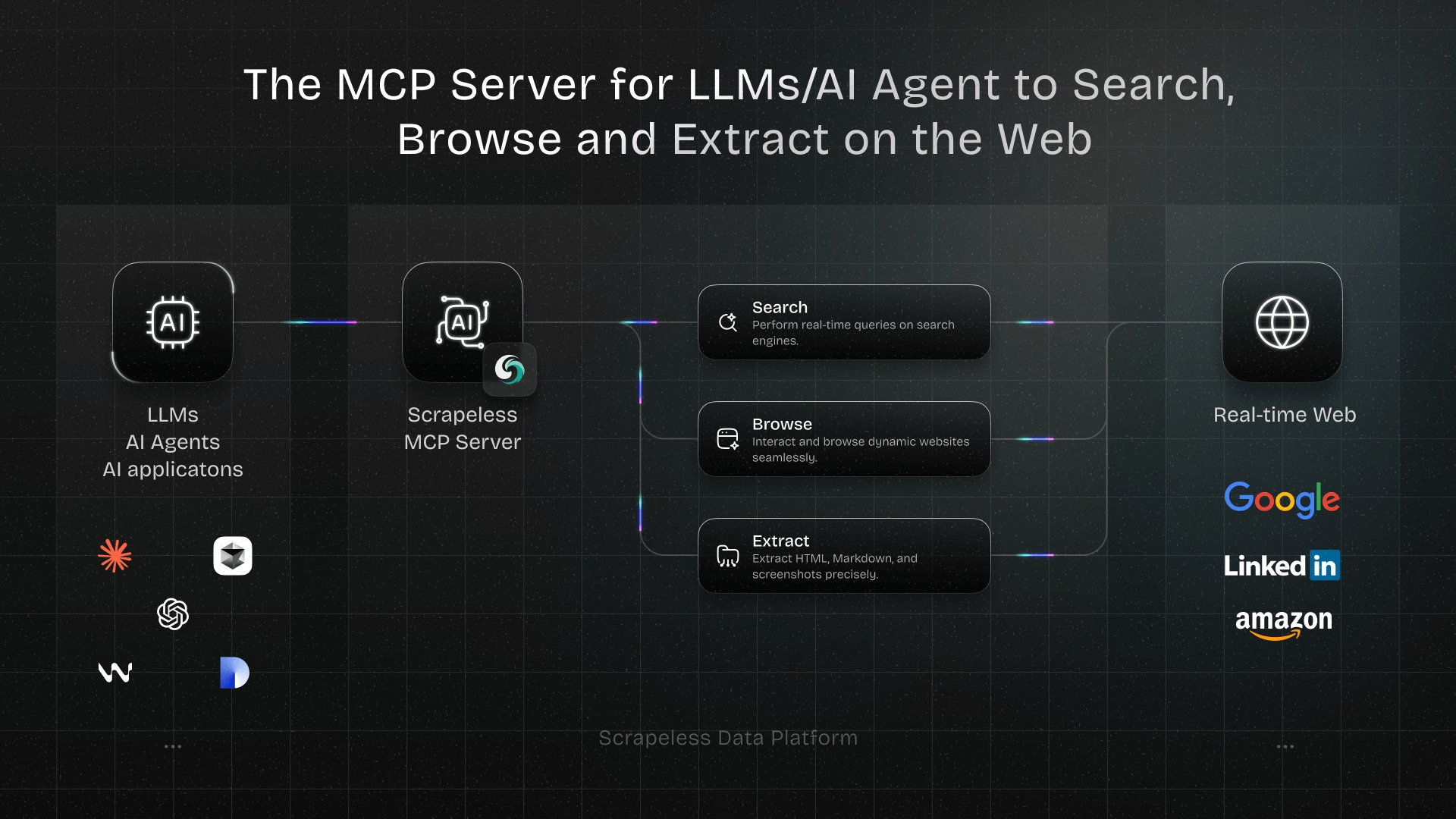
- MCP can make the data layer portable. A compatible builder can discover a consistent tool surface without embedding every provider directly.
AI agent builders make orchestration easier, but a visual canvas does not make web data current, complete, or safe to act on. A builder can have polished memory and deployment controls while still handing the model stale search snippets or unverified page text.
The useful comparison is therefore not “Which builder has the most features?” It is “Which builder gives this team enough control over tools, state, evidence, and approval for this workflow?”
What Is an AI Agent Builder?
An AI agent builder is software for assembling an agent's model, instructions, tools, state, triggers, and deployment behavior. Some builders use a visual graph, some mix forms with code steps, and others expose a programming framework.
An agent builder should be separated from three adjacent categories:
- a chatbot answers inside a conversation but may not own a multi-step task;
- a fixed automation follows predetermined branches without deciding which tool to use;
- a data service supplies search, page, or application data but does not orchestrate the whole agent.
The boundary matters because teams often blame the model or builder for missing evidence that the data layer never supplied.
No-Code vs Low-Code vs Code-First Builders
The three builder categories solve different operating problems.
| Dimension | No-code | Low-code | Code-first |
|---|---|---|---|
| Initial build speed | Fastest for supported patterns | Fast for mixed visual and scripted flows | Slower setup |
| Custom logic | Limited to provided blocks | Custom steps around a visual graph | Full application control |
| Debugging | Builder logs and node output | Node output plus custom instrumentation | Application-level traces and tests |
| Deployment | Managed by the platform | Managed or self-hosted options vary | Team owns runtime and release process |
| Governance | Policy features depend on the platform | Platform controls plus custom gates | Policies must be designed and maintained |
| Best fit | Stable departmental workflows | Cross-system workflows with custom transforms | High-risk or product-critical agents |
No-code is a strong fit when the workflow uses supported connectors, clear inputs, and reversible actions. Low-code fits teams that want a visual operating view but need custom validation or transformations. Code-first fits a product team that must test every tool contract, version behavior, and deployment change.
The Evaluation Matrix That Actually Matters
An AI agent builder should be evaluated across seven dimensions.
Tool contracts
The builder must expose tool names, descriptions, input schemas, and outputs clearly enough to test them. The MCP architecture separates hosts, clients, and servers and defines tools as executable functions exposed through a discoverable protocol surface.
Ask whether tools can be listed before a run, whether schemas are validated, and whether a tool result carries structured data rather than only prose.
Memory and state
Memory should have a defined scope. Conversation history, task state, user preferences, and durable business records are different data classes. A builder that stores all four in one opaque memory object makes retention and debugging difficult.
Check who can read or modify state, how long it persists, and whether a task can resume without repeating completed actions.
Observability
An agent run needs a trace from goal to tool call to accepted result. Logs should show tool arguments with sensitive values redacted, result status, validation decisions, model output, and human approvals.
The OpenTelemetry framework defines traces, metrics, and logs as complementary telemetry. A builder does not need to use one specific stack, but it should provide equivalent evidence for production diagnosis.
Deployment and change control
Prompts, models, tools, and schemas all change behavior. A production builder should version those inputs, separate development from production, and make rollbacks or staged releases possible.
The important question is not whether deployment takes one click. It is whether a reviewer can identify exactly what changed between two runs.
Governance and permissions
Tool access should follow least privilege. A research agent that needs to read public pages should not inherit the ability to publish content or delete records.
The OWASP guidance on excessive agency ties risk to excessive functionality, permissions, and autonomy. Evaluate permission scope and approval boundaries before evaluating how autonomous the demo appears.
Evaluation and acceptance checks
The builder should support assertions after a tool call. A search result set can require a query and locale; a page record can require a final URL, title, and collection time; an action can require explicit confirmation.
Without acceptance checks, a completed node only proves that the workflow moved forward.
Cost controls
Agent cost comes from more than model tokens. Search calls, page rendering, browser time, third-party APIs, storage, and repeated evaluation all contribute. A useful builder exposes per-run usage and lets teams cap expensive branches.
Web Data Is a Separate Layer
Web data workflows need search, acquisition, extraction, and verification. Treating those jobs as one generic “browse” tool hides important choices.
| Web-data job | Required output | Acceptance check |
|---|---|---|
| Search | Ranked result records | Query, locale, result type, URL |
| Direct fetch | Response representation | Status, final URL, content type |
| Browser interaction | Rendered state or action result | Required element and resulting page state |
| Extraction | Structured business fields | Schema, nullable fields, provenance |
| Verification | Decision evidence | Cross-source agreement or explicit uncertainty |
Scrapeless MCP Server can expose Scrapeless web-data capabilities to compatible MCP clients. The Scrapeless documentation is the current reference surface for configuring the underlying data products. The builder still owns planning, memory, approval, and presentation; the MCP server supplies a consistent tool boundary.
Start Scraping with Scrapeless
Power up your web scraping and automation workflow with Scrapeless!
Sign up today and get $5 in free credit — no credit card required.Claim your free credit now in the Scrapeless Dashboard.

How to Test a Builder Before Committing
Run one representative workflow through the full operating path.
- Define a narrow public-web task and expected output schema.
- Connect the data tool with the smallest required permissions.
- Confirm the builder can discover the exact tool names and schemas.
- Execute a search and one page acquisition.
- Reject a result that lacks provenance or required fields.
- Pause before any external write or irreversible action.
- Inspect the trace, usage, and version record after the run.
This test reveals more than a feature checklist. It shows whether the builder can preserve evidence across tool calls and whether an operator can explain the final answer.
The NIST AI Risk Management Framework organizes risk work around governance, mapping, measurement, and management. Those functions translate directly into builder questions: who owns the workflow, what can it affect, how is behavior measured, and what happens when the evidence is insufficient?
Choose by Team and Workflow
Choose a no-code builder for a bounded internal workflow with standard connectors, human review, and reversible outcomes. Favor low-code when custom validation, structured transforms, or mixed business systems are central. Choose code-first when agent behavior is part of a customer-facing product, handles sensitive operations, or needs repeatable tests in the software delivery pipeline.
The builder category is only half the decision. A strong web workflow also needs:
- current search data rather than a static knowledge snapshot;
- a browser path for JavaScript-dependent public pages;
- structured extraction with explicit nullable fields;
- provenance attached to every accepted record;
- permission and approval boundaries before action.
Scrapeless AI Agent provides the web-data side of that architecture. It does not remove the need to evaluate the builder's memory, governance, and deployment model.
Common Selection Mistakes
The first mistake is choosing from a connector count. A connector can expose one narrow action or a complete data contract; the number alone says nothing about reliability.
The second is evaluating only the happy path. Test a missing field, a wrong final URL, an ambiguous result, and a blocked action. The builder should stop or route to review without inventing completion.
The third is granting broad permissions during prototyping and carrying them into production. Prototype convenience is not a production access policy.
The fourth is mixing orchestration state with source evidence. Keep raw tool results and normalized records available so a later model answer can be audited.
Conclusion
AI agent builders should be compared on control, not spectacle. No-code, low-code, and code-first systems each fit different teams, but all production workflows need explicit tool contracts, scoped state, observability, deployment control, governance, and acceptance checks.
For web-data agents, evaluate the search and acquisition layer separately. A portable MCP boundary can let the team change builders without redesigning every web-data integration.
Give Your Agent a Verifiable Web Data Layer
Review Scrapeless pricing, create a Scrapeless account, and connect with builders working on agent tooling through Discord or Telegram.
FAQ
Q: What is an AI agent builder?
An AI agent builder is an environment for configuring a model, instructions, tools, state, triggers, and deployment behavior around multi-step tasks.
Q: Is a no-code builder enough for production agents?
A no-code builder can support production when the workflow is bounded, permissions are narrow, outputs are validated, and operators can inspect every important step.
Q: What is the difference between low-code and code-first agents?
Low-code builders keep a visual workflow while allowing custom logic; code-first frameworks give the engineering team direct control over orchestration, testing, and deployment.
Q: Why does an agent builder need live web data?
An agent needs live web data when the task depends on current search results, prices, availability, pages, or events that are not safely represented in model memory.
Q: Does MCP replace an AI agent builder?
No. MCP standardizes how compatible applications discover and call external tools; the builder still manages the agent loop, state, approvals, and user experience.
Q: How should teams evaluate agent-builder security?
Test least-privilege tool access, secret handling, human approval, output validation, logging, data retention, and the ability to disable a workflow quickly.
At Scrapeless, we only access publicly available data while strictly complying with applicable laws, regulations, and website privacy policies. The content in this blog is for demonstration purposes only and does not involve any illegal or infringing activities. We make no guarantees and disclaim all liability for the use of information from this blog or third-party links. Before engaging in any scraping activities, consult your legal advisor and review the target website's terms of service or obtain the necessary permissions.