Agentic Web Scraping Workflows: A Practical Architecture

Lead Scraping Automation Engineer
TL;DR:
- An agentic web scraping workflow lets a model choose the next bounded action from observed page state. It is useful when the route cannot be enumerated reliably in advance.
- Most extraction should remain deterministic. Fixed-source jobs with stable pagination, schemas, and stop conditions are easier to test as conventional pipelines.
- A production agent needs six explicit components: a task contract, permitted tools, state, an evaluator, policy limits, and an evidence trail.
- Keep data acceptance outside the agent. A model may navigate and propose records, but deterministic validators should enforce hosts, schemas, counts, provenance, and restricted-data rules.
- Scrapeless AI Agent, Agent Browser, and MCP cover different layers. Use AI Agent for outcome-driven tasks, Agent Browser for managed page execution, and MCP to expose bounded tools to compatible agent clients.
What Is an Agentic Web Scraping Workflow?
An agentic web scraping workflow is a controlled loop in which a model observes web state, selects an allowed action, evaluates the result, and continues until it meets a stated goal or stop rule. The model can choose among tools, but it does not receive unlimited authority.
The useful distinction is decision ownership:
| Workflow type | Who chooses the next step? | Best fit | Main risk |
|---|---|---|---|
| Deterministic pipeline | Application code | Stable routes, pagination, and schemas | Brittle logic when page paths vary |
| AI-assisted step | Application code calls a model at a fixed point | Classification, field mapping, or normalization | Unvalidated model output |
| Agentic workflow | Model chooses among bounded tools | Ambiguous navigation or research tasks | Scope drift and weak stopping rules |
An LLM inside a pipeline does not make the whole system agentic. The system becomes agentic when model decisions determine the next action or route.
When Should You Use an Agent Instead of a Pipeline?
Use a deterministic pipeline when the job can be expressed as a stable graph: fetch a list, follow pagination, open detail pages, extract known fields, and store records. Every branch can be tested, and failure states are easy to classify.
Consider an agent when the route varies by page state or the task is outcome-based. Examples include locating a specific policy across several documentation sections, comparing products whose attribute labels differ, or navigating a public site where the relevant result may require search, filtering, and follow-up inspection.
Do not use an agent to hide an undefined requirement. If the team cannot state which sources are allowed, what the output looks like, or when the task should stop, agent reasoning will magnify the ambiguity.
The Agent Control Loop
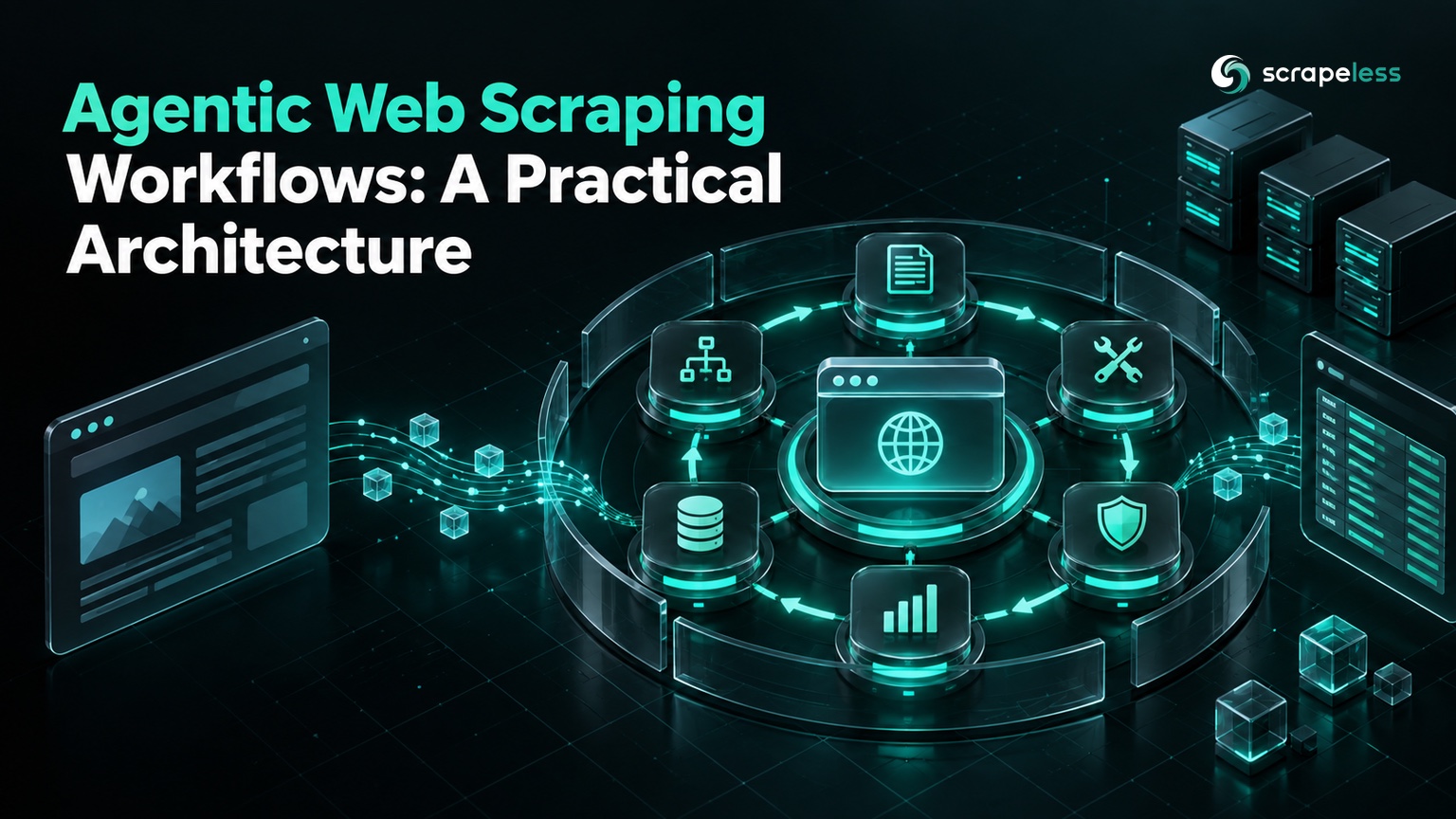
A practical loop has five phases:
- Observe: capture the current URL, visible structure, tool result, and task state.
- Decide: choose one permitted next action or finish.
- Act: call a browser, search, extraction, or storage tool with bounded arguments.
- Evaluate: compare the new state with the task contract and acceptance rules.
- Record: append evidence, update progress, and enforce budget or stop conditions.
The model should see enough state to decide but not an unbounded transcript. Summarize completed work, retain canonical source URLs, and store structured observations separately from conversational reasoning.
Six Components Every Production Agent Needs
1. A Task Contract
The task contract states the goal, allowed sources, required fields, missing-value behavior, maximum scope, and completion rule. Replace “research competitors” with a contract such as: collect the public pricing-plan names and billing units from five approved vendor pages, attach a source URL to each row, and flag fields that are not displayed.
2. Bounded Tools
Tools should expose the smallest useful action. open_approved_url, extract_schema, and save_candidate_record are safer than a general function that can navigate anywhere and write arbitrary data. Validate tool arguments outside the model.
The Model Context Protocol specification defines a client-server protocol for exposing tools and contextual resources. MCP can standardize the connection, but the server and host application still own authorization, validation, and logging.
3. Explicit State
State should distinguish task facts from temporary observations. Store approved source lists, visited URLs, extracted candidates, validation results, remaining budget, and completion status as structured fields. Do not rely on the model to reconstruct them from prose.
4. An Evaluator
The evaluator checks whether the latest action advanced the task. It can combine deterministic rules and a narrowly scoped model judgment. Deterministic checks should cover URL scope, schema shape, duplicate records, required provenance, and stop conditions.
5. Policy and Budget Limits
Enforce host allowlists, denied paths, permitted interactions, page limits, time limits, and data restrictions in code around the agent. The model may decide which allowed page to open, but it must not grant itself new scope.
6. An Evidence Trail
Each accepted field should point to a source URL and capture. Store tool inputs, final URLs, extracted evidence, validator outcomes, and the final dataset version. This makes human review possible and prevents a polished summary from hiding weak source coverage.
How Scrapeless Fits an Agentic Architecture
Scrapeless AI Agent provides an outcome-oriented entry point for web tasks. Agent Browser supplies managed browser execution when the workflow needs JavaScript, page interaction, or persistent browser state.
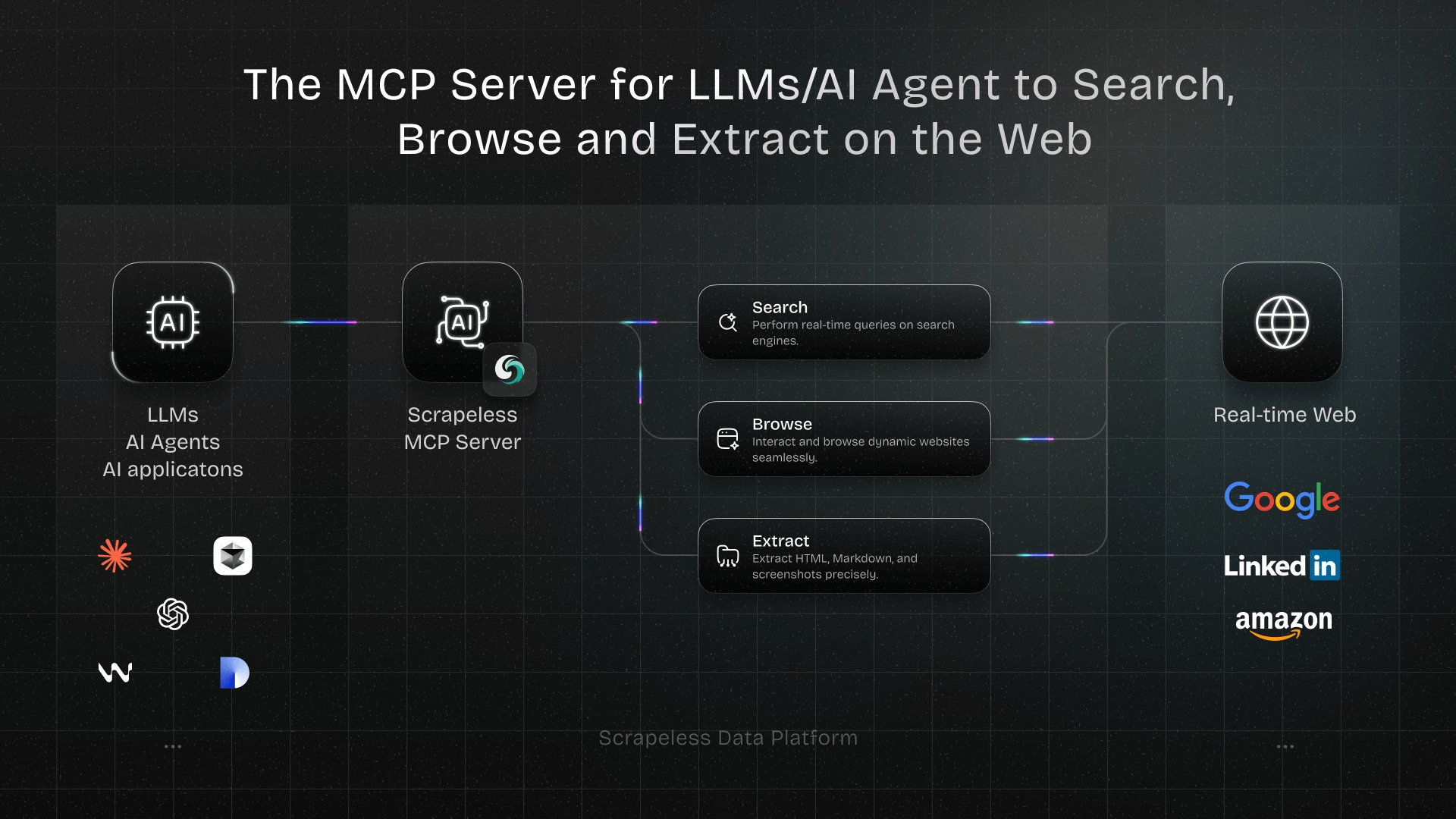
MCP is the connection layer when an external agent client needs bounded Scrapeless tools. The Scrapeless MCP guide explains that interface, while the Agent Browser documentation covers managed browser connection details. These layers can be used independently: a deterministic application can call Agent Browser, and an agent can call request-based tools without opening a browser for every page.
Start Scraping with Scrapeless
Power up your web scraping and automation workflow with Scrapeless!
Sign up today and get $5 in free credit — no credit card required.Claim your free credit now in the Scrapeless Dashboard.
Separate Navigation From Data Acceptance
An agent can decide how to reach a page, but it should not be the only judge of whether extracted data is valid. Put an acceptance boundary after the agent:
- the source URL must be approved;
- the final URL must remain in scope;
- required fields must conform to a schema;
- values must carry source evidence;
- duplicates must resolve to a stable record key;
- sensitive or restricted content must be rejected or reviewed;
- completion must satisfy a deterministic count or coverage rule where possible.
This design lets the agent handle route variation while conventional software protects the dataset. It also makes model or prompt changes easier to compare because the output gates stay fixed.
Single-Agent vs Multi-Agent Workflows
A single agent is the default. It keeps one task state, one evidence trail, and one budget. Split the workflow only when roles have distinct inputs, tools, and acceptance rules.
A defensible multi-agent design might separate discovery from verification:
- The discovery agent finds candidate pages inside an approved host list.
- The extraction agent maps page evidence into a fixed schema.
- The verification agent checks source coverage and flags conflicts without changing the original evidence.
The orchestrator owns the shared task contract and prevents agents from expanding each other's authority. Multiple agents do not guarantee independent judgment if they receive the same weak source or prompt. Use deterministic checks for claims that can be verified directly.
Observability for Agentic Scraping
Traditional crawl metrics remain useful, but agent decisions add new failure modes. Track:
- approved and rejected navigation attempts;
- tool calls by type and target host;
- unique source pages contributing accepted fields;
- candidate records rejected by schema validation;
- repeated actions that do not change state;
- tasks stopped by page, time, or action budget;
- records sent to human review;
- final answers without sufficient source evidence.
Capture browser diagnostics when interaction fails, but avoid storing secrets or unnecessary personal data. Redact credentials and sensitive fields before logs enter model context or long-term storage.
Guardrails for Web Agents
Guardrails should be enforced outside the model prompt. Prompts are useful instructions, but they are not a security boundary.
Use layered controls:
- Allow only required tools.
- Validate every URL against scheme, host, and path policy.
- Restrict browser downloads and form submissions unless the task explicitly needs them.
- Keep credentials in a secret manager and inject them only into approved tool calls.
- Require confirmation for actions with external side effects.
- Apply deterministic output validation before storage or downstream execution.
- Keep a human review path for ambiguous, sensitive, or high-impact results.
The NIST AI Risk Management Framework is a useful governance reference for mapping and managing AI risk. The Robots Exclusion Protocol covers crawler directives, while site terms, privacy obligations, and access controls remain separate requirements. Browser-control implementations can also use the W3C WebDriver specification as a reference for remote automation semantics.
A Reference Architecture
| Layer | Responsibility | Deterministic control |
|---|---|---|
| Request intake | Convert a user goal into a task contract | Schema, source allowlist, action budget |
| Planner | Select the next useful step | Only allowed tool names and argument shapes |
| Acquisition | Fetch or render approved public pages | URL and media-type validation |
| State store | Track sources, candidates, and progress | Stable IDs, dedupe keys, budget counters |
| Extractor | Map evidence to candidate fields | Required source pointer on each record |
| Evaluator | Decide whether to continue or finish | Coverage and stop rules |
| Review queue | Resolve ambiguous or sensitive items | Role-based human approval |
| Output store | Publish the accepted dataset | Version, provenance, and audit record |
The model belongs in the planner and, where useful, the extractor or evaluator. It should not be the only control at every layer.
When Agentic Scraping Is the Wrong Choice
Stay with a deterministic pipeline when:
- URLs and pagination are stable;
- the schema is fixed and selectors are reliable;
- the task runs frequently at high volume;
- every step must be reproduced exactly;
- the target provides a documented API or export;
- the workflow has no meaningful decision branches.
An AI-assisted extraction step may still help with varied labels or classification. Keep that model call inside a fixed workflow and validate its output.
Conclusion: Put Agency Where Uncertainty Lives
Agentic scraping is useful when the next route depends on page state or research judgment. It is unnecessary when the path and schema are already known. The strongest architecture keeps the agent's choices narrow and surrounds them with deterministic scope, validation, evidence, and stop rules.
Begin with one outcome-driven task that a fixed crawler cannot express cleanly. Define its contract, give it a small tool set, record every source, and compare its accepted outputs with a deterministic baseline. Expand agency only where that test shows a real benefit.
Build a Bounded Web Agent
Compare Scrapeless pricing, explore Scrapeless AI Agent, or join the Scrapeless Discord community and Telegram community.
FAQ
Q: What makes a web scraping workflow agentic?
The model chooses the next action from observed state within a bounded tool set. A fixed pipeline that calls an LLM for one extraction step is AI-assisted, not fully agentic.
Q: Are agentic workflows better than linear pipelines?
They are better for some variable routes and outcome-driven tasks. Linear pipelines remain easier to test, reproduce, and operate when sources and steps are stable.
Q: What is the most important guardrail for a web agent?
Enforce source and action boundaries outside the prompt. URL allowlists, tool schemas, budgets, data rules, and side-effect approvals should be application controls.
Q: Does MCP make an agent safe?
No. MCP standardizes how clients and servers exchange tools and context. Safety still depends on tool design, authorization, validation, host policy, logging, and user approval.
Q: When should a workflow use multiple agents?
Use multiple agents when roles have distinct tools and acceptance rules, such as discovery and independent verification. Keep a single orchestrator and shared task contract.
Q: How should an agentic scraping result be audited?
Store the task contract, tool calls, final URLs, source evidence, validator results, and dataset version. Review accepted records against their sources rather than only reading the final summary.
At Scrapeless, we only access publicly available data while strictly complying with applicable laws, regulations, and website privacy policies. The content in this blog is for demonstration purposes only and does not involve any illegal or infringing activities. We make no guarantees and disclaim all liability for the use of information from this blog or third-party links. Before engaging in any scraping activities, consult your legal advisor and review the target website's terms of service or obtain the necessary permissions.