How to Build an Agentic RAG Pipeline With Live Web Data

Lead Scraping Automation Engineer
TL;DR:
- Agentic RAG lets an agent decide when and how to retrieve evidence. The retrieval loop can reformulate a query, inspect another source, grade evidence, and stop under explicit limits.
- Live web data needs a separate acquisition layer. Search finds candidate sources, browser rendering exposes client-side pages, and normalization turns page content into traceable documents.
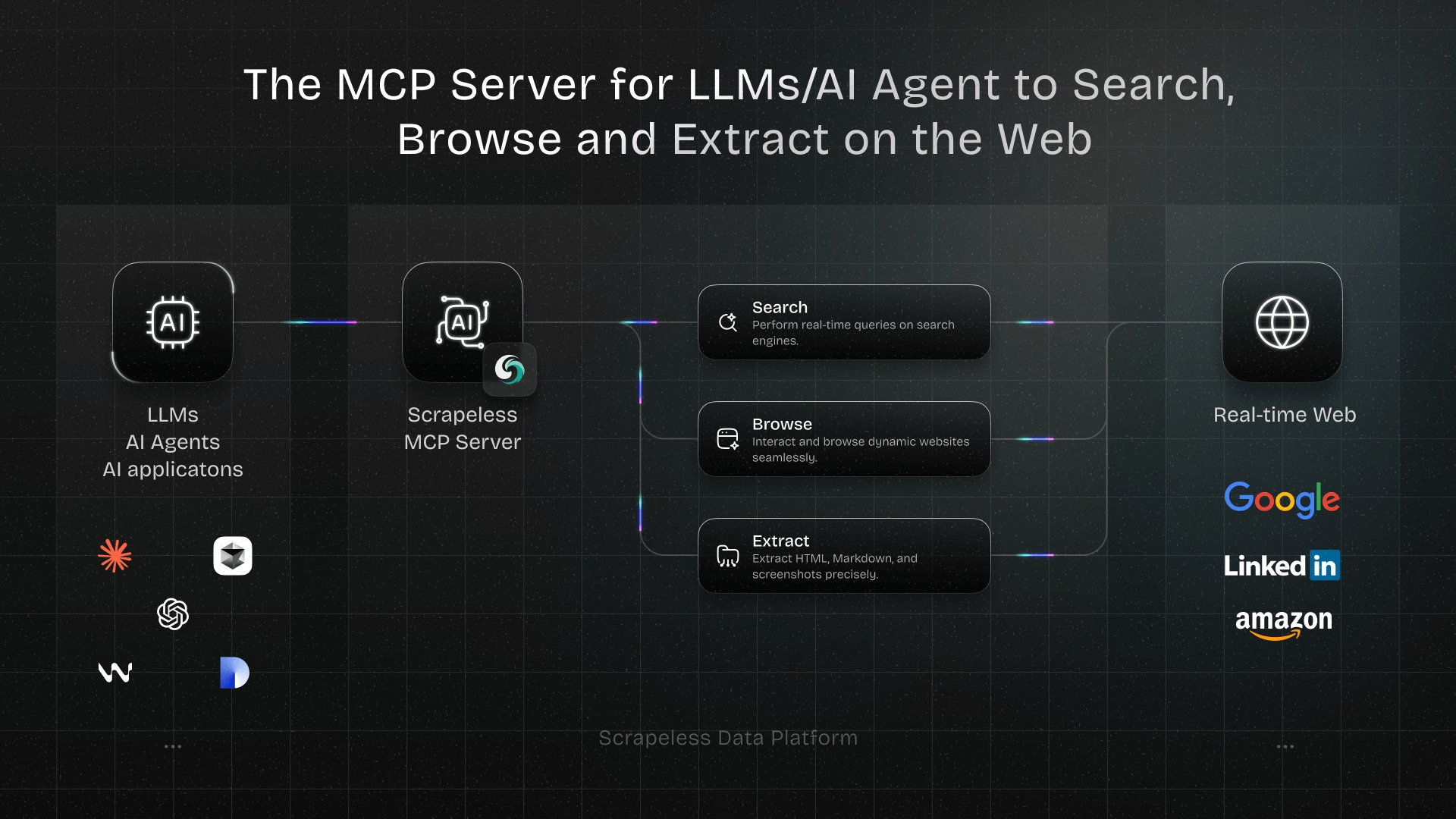
- Scrapeless MCP Server gives an MCP client one tool surface for search, page extraction, and cloud-browser actions. The agent can select those tools from the task instead of hard-coding one retrieval path.
- Evaluation belongs at every boundary. Measure source relevance, extraction completeness, citation support, answer quality, latency, and cost independently.
Agentic RAG Architecture at a Glance
An agentic RAG pipeline places retrieval decisions inside an agent loop instead of running one fixed retrieve-then-generate sequence.
The original retrieval-augmented generation architecture combines a generator with retrieved external memory. Agentic RAG adds planning and tool use around that foundation:
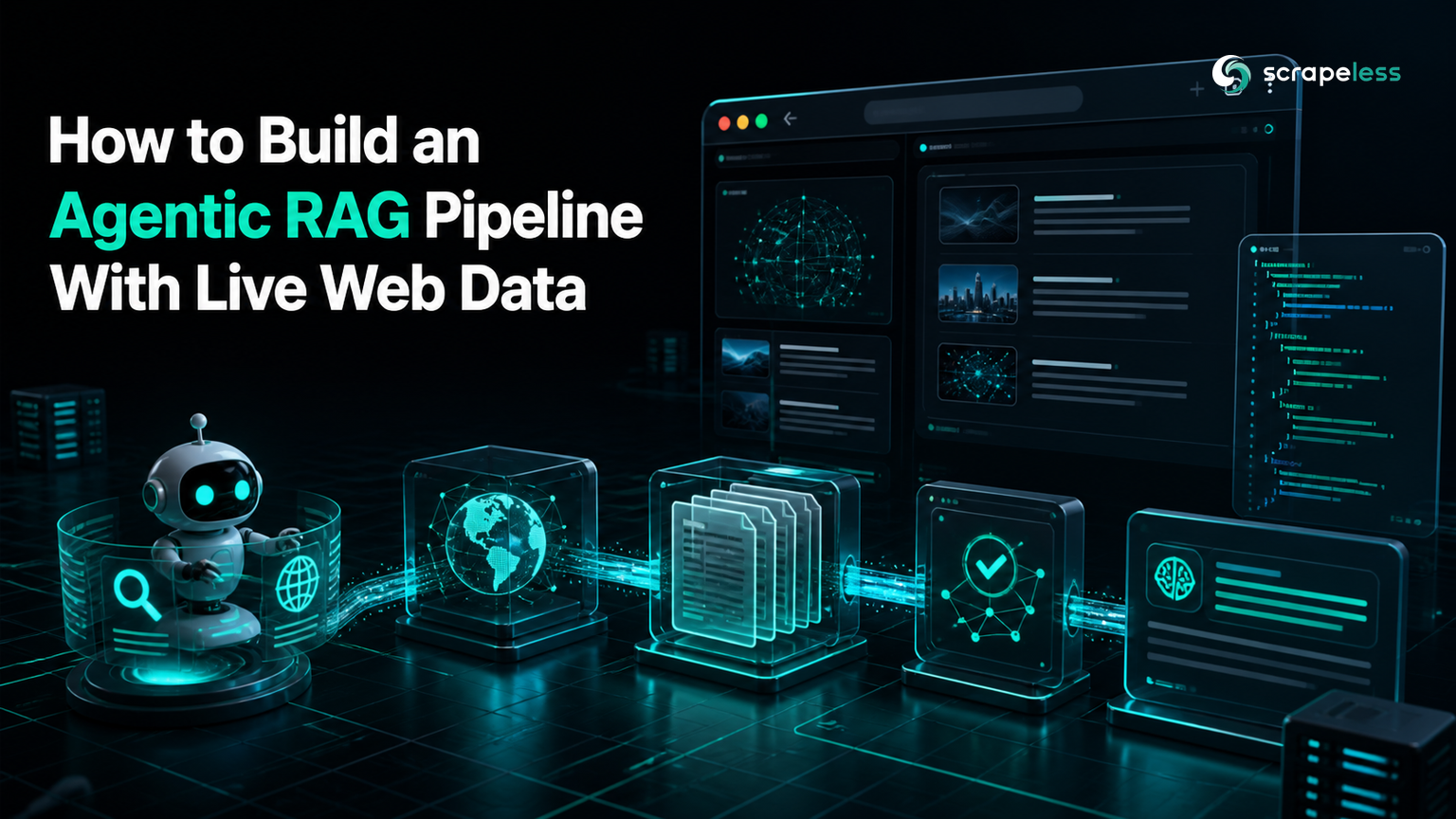
Question → Plan → Search → Render or fetch → Normalize → Grade → Store or answer → Cite
Each arrow is a contract. Search returns candidates, not truth. Rendering returns page state, not a clean record. A vector store returns similar chunks, not necessarily sufficient evidence. The agent should move forward only when the current artifact passes the next stage's checks.
When Agentic RAG Beats a Fixed Pipeline
Agentic RAG is useful when retrieval needs differ from question to question.
A fixed pipeline is usually simpler for a known corpus with stable chunking and one retrieval strategy. Agentic control earns its cost when a question may require several searches, source comparison, a JavaScript-rendered page, a freshness check, or a second pass after weak evidence.
The ReAct research pattern interleaves reasoning traces with actions and observations. In a retrieval system, that pattern becomes a bounded loop: decide on a tool, inspect its output, update the evidence state, and either continue or stop.
Do not add an agent merely to rename a deterministic sequence. If every request uses the same query, retriever, chunk count, and answer prompt, an ordinary RAG pipeline is easier to test and operate.
Prerequisites
An agentic RAG build needs a working retrieval tool layer before it needs a model loop.
- Node.js and a project that can run ECMAScript modules.
@modelcontextprotocol/sdkandscrapeless-mcp-serverinstalled in the project.- A Scrapeless account and
SCRAPELESS_KEYenvironment variable. - A model provider key for the final planning and answer-generation loop.
- A document store that preserves canonical URL, title, retrieval time, content hash, and chunk offsets.
Note: The MCP client handshake below requires
SCRAPELESS_KEY. The package installation was run, while the authenticated handshake and live tool call remain a prerequisite when that product key is not present in the runtime.
Connect the Scrapeless MCP Server
Scrapeless MCP Server connects to any standards-compliant MCP client over a local stdio process or the hosted streamable HTTP endpoint.
Install the exact client SDK and server package:
bash
pnpm add @modelcontextprotocol/sdk scrapeless-mcp-serverCreate a client, connect over stdio, inspect the tool surface, and close the transport cleanly:
javascript
import { Client } from "@modelcontextprotocol/sdk/client/index.js";
import { StdioClientTransport } from "@modelcontextprotocol/sdk/client/stdio.js";

const transport = new StdioClientTransport({
  command: "pnpm",
  args: ["exec", "scrapeless-mcp-server"],
  env: {
    ...process.env,
    SCRAPELESS_KEY: process.env.SCRAPELESS_KEY,
  },
});

const client = new Client(
  { name: "agentic-rag-client", version: "1.0.0" },
  { capabilities: {} },
);

await client.connect(transport);
const { tools } = await client.listTools();
console.log(tools.map((tool) => tool.name));

// Attach `tools` to the tool adapter used by your agent framework.

await client.close();
The MCP lifecycle specification defines initialization and capability negotiation before normal operations. Listing tools is therefore the right smoke test: it proves the client and server completed the protocol handshake before an agent depends on them.
The Scrapeless MCP launch article covers the server's role, while the Mastra integration shows the same tool surface attached to a specific agent framework.
How You Actually Use This: Prompt the Retrieval Agent
The agent should receive a goal, an evidence contract, and a stopping rule.
A useful prompt is concrete:
Find current primary sources that answer the question. Search first, render a page only when the required content is absent from the fetched response, keep the canonical URL for every claim, reject sources that do not directly support the answer, and stop after the evidence is sufficient or the retrieval budget is exhausted.
The instruction separates source discovery from evidence acceptance. It also prevents an open-ended browsing loop.
Prompts you can adapt
| Retrieval task | Prompt constraint |
|---|---|
| Product change tracking | Require the vendor's own release note and its publication date |
| Standards research | Prefer the standards body and keep the section URL |
| Market comparison | Require equivalent fields and record missing values explicitly |
| Technical troubleshooting | Prefer official documentation and a reproducible configuration |
Start Scraping with Scrapeless
Power up your web scraping and automation workflow with Scrapeless!
Sign up today and get $5 in free credit — no credit card required.Claim your free credit now in the Scrapeless Dashboard.
Search and Render Fresh Sources
Live web retrieval should escalate from the least expensive trustworthy source to the richer one.
Start with search to collect candidate URLs and snippets. Fetch clean page content when response HTML contains the answer. Use browser rendering only when client-side execution controls the relevant page state. This keeps the acquisition layer fast without pretending every page is static.
Record a retrieval envelope for every accepted document:
json
{
  "canonicalUrl": "https://example.com/primary-source",
  "title": "Primary source title",
  "retrievedAt": "illustrative timestamp",
  "contentHash": "illustrative hash",
  "retrievalMethod": "search_then_render",
  "text": "Illustrative normalized page text"
}
The values above are an illustrative sample; the fields are the contract. Preserve the original URL even when the normalized text moves into another store.
Normalize, Chunk, and Store
Normalization converts page content into stable documents without erasing provenance.
Remove navigation duplication, invisible UI chrome, and unrelated boilerplate. Keep headings, lists, tables, and code boundaries because they carry meaning. Deduplicate by canonical URL and content hash before chunking.
Chunk on document structure first, then enforce the model's context constraints. Every chunk should retain the document identifier, canonical URL, heading path, character offsets, and retrieval time. The Self-RAG research demonstrates why retrieval and critique signals belong in the generation process rather than being treated as an invisible preprocessing step.
Store raw normalized documents separately from embeddings. That separation lets the team change the embedding model or chunk policy without fetching every source again.
Retrieve, Grade, and Answer
The grading step decides whether retrieved evidence can support the requested answer.
Score each candidate on directness, source authority, freshness, agreement with other evidence, and extraction completeness. A high vector-similarity score does not prove that the text answers the question.
The answer node should receive only accepted evidence, with source identifiers attached to each passage. If the evidence is insufficient, the agent reformulates the query or selects another acquisition tool. If the retrieval budget is exhausted, it returns a bounded “insufficient evidence” result instead of filling the gap from unsupported model memory.
Single-Agent vs Multi-Agent Design
A single retrieval agent is the default because one state machine is easier to trace.
Split the workflow only when roles have genuinely different tools, policies, or evaluation criteria. One agent may own source acquisition, another evidence grading, and a final agent answer synthesis. A multi-agent design adds coordination state, duplicated context, and more failure boundaries, so each handoff needs an explicit schema.
Use Scrapeless AI Agent as the product surface when the workflow needs an agent that can operate web tools. Use the hosted MCP endpoint when an existing agent framework already owns planning and only needs live web capabilities.
Evaluation and Observability
Agentic RAG evaluation should isolate acquisition, retrieval, and answer quality.
Track whether search found the expected primary source, whether rendering exposed the needed content, whether normalization preserved the supporting passage, whether grading accepted the right evidence, and whether the final claim is supported by that evidence.
Also record tool choice, query reformulations, source URLs, document hashes, chunk identifiers, stop reason, elapsed time, and cost. This trace makes a weak answer diagnosable. Without it, every problem looks like a model problem.
Review Scrapeless pricing against the expected search, fetch, and render mix, and keep the MCP client setup aligned with the current Scrapeless documentation.
Conclusion: Make Evidence a First-Class Artifact
An agentic RAG pipeline is useful when retrieval must adapt, but the agent loop does not remove the need for contracts.
Search, rendering, normalization, grading, and generation should each produce inspectable artifacts. Connect the MCP tool layer first, verify the handshake, then add the model loop with a retrieval budget and evidence-based stopping rule.
Ready to Build an Agentic RAG Pipeline?
Join our community to claim a free plan and connect with developers building live-web retrieval systems: Discord · Telegram.
Sign up at app.scrapeless.com and connect the Scrapeless MCP tool layer before adding the model-driven planning loop.
FAQ
Q: What is agentic RAG?
Agentic RAG is a retrieval-augmented generation design in which an agent chooses retrieval actions, evaluates evidence, and decides whether to continue or answer. The loop operates under explicit tool, time, and cost limits.
Q: How is agentic RAG different from standard RAG?
Standard RAG usually runs a fixed retrieval step before generation, while agentic RAG can reformulate queries, select different tools, grade results, and perform another bounded retrieval step.
Q: Does agentic RAG require a vector database?
Agentic RAG does not require a vector database. The agent can use keyword search, structured databases, live web tools, or a hybrid retriever as long as the evidence contract is explicit.
Q: Why use live web data in a RAG pipeline?
Live web data is useful when the answer depends on information that changes after the model's training cutoff or outside a static internal corpus. The pipeline must preserve source URLs and retrieval metadata so freshness is auditable.
Q: What does MCP add to an agentic RAG system?
MCP gives the client a standard lifecycle for discovering and calling server tools. Scrapeless MCP Server exposes search, page extraction, and browser actions through that tool boundary.
Q: Should an agent render every source in a browser?
No. The agent should render a source only when response content does not expose the required information or an interaction is necessary. HTTP-first retrieval keeps the pipeline faster and easier to operate.
Q: How do you prevent endless retrieval loops?
Set limits on tool calls, elapsed time, accepted sources, query reformulations, and total cost. The stop policy should allow an “insufficient evidence” outcome.
Q: Is a multi-agent design better for agentic RAG?
A multi-agent design is better only when separate roles need distinct tools, policies, or evaluation criteria. Start with one agent and split roles after traces show a clear boundary.
At Scrapeless, we only access publicly available data while strictly complying with applicable laws, regulations, and website privacy policies. The content in this blog is for demonstration purposes only and does not involve any illegal or infringing activities. We make no guarantees and disclaim all liability for the use of information from this blog or third-party links. Before engaging in any scraping activities, consult your legal advisor and review the target website's terms of service or obtain the necessary permissions.